Endangered
Brycon devillei
Brycon devillei
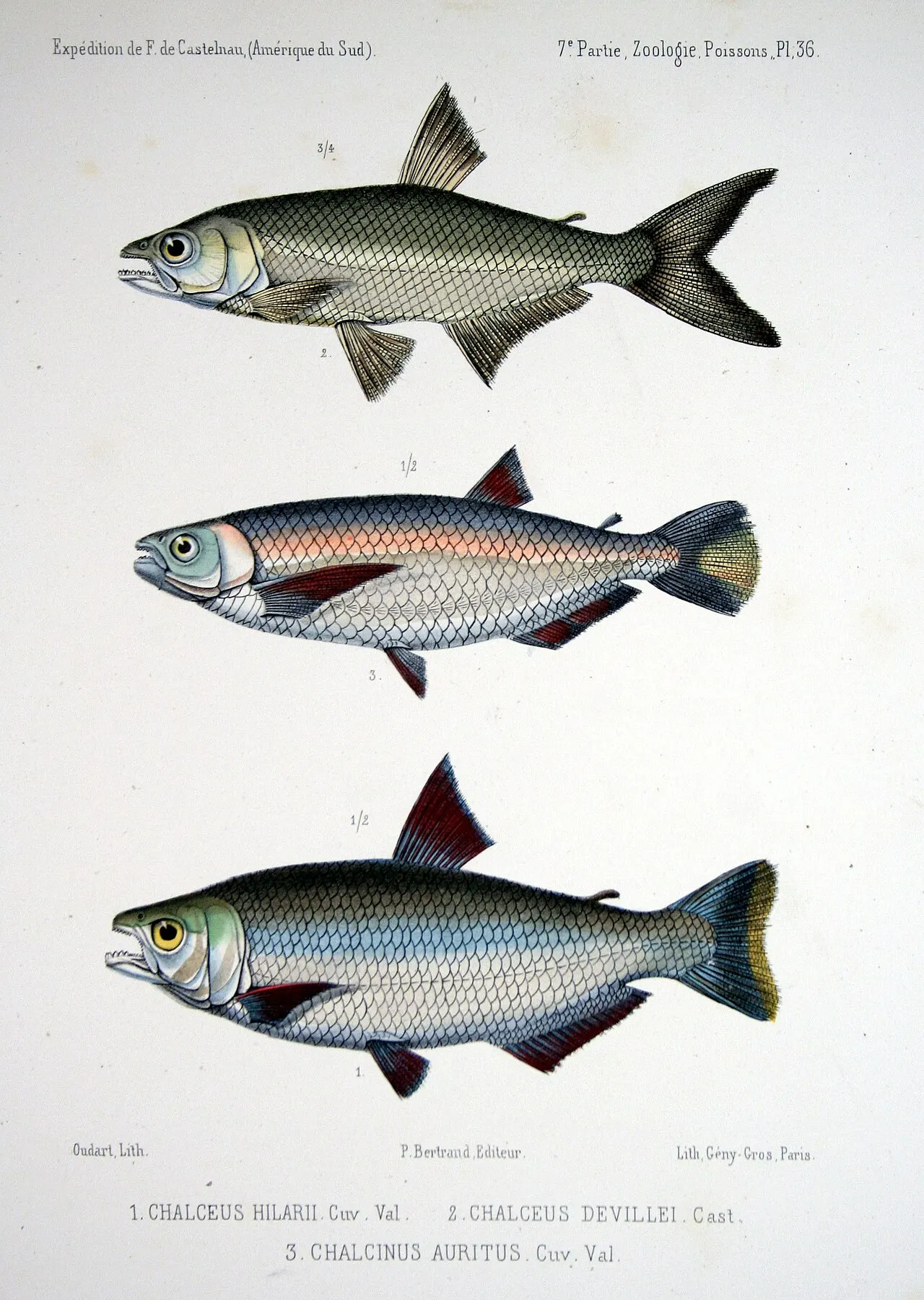
Brycon devillei, called piabanha in Brazil, is a river fish that the IUCN Red List rated Endangered in 2021, based on records from Minas Gerais state. Its identity is unsettled: the name was given in 1855 to a single museum specimen labelled Bahia, and a 2017 taxonomic account treats that name as of uncertain identity.
A name with an uncertain identity
Brycon is a genus of characin fishes in the family Bryconidae. François de Castelnau described this species in 1855 as Chalceus devillei and gave its locality as "Bahia". The only specimen tied to the name is the holotype, catalogued as MNHN 4517 in Paris. It measures 145.5 mm in standard length, has 53 scales along the lateral line and a noticeably pointed head.
In a 2017 account of the genus, Flávio Lima found that the name is known only from that one animal, and that it is nearly indistinguishable from Brycon insignis, a fish of rivers around Rio de Janeiro. Nineteenth-century writers often used "Bahia" for Salvador and the country around it, but Castelnau had also been in Rio de Janeiro, so Lima suggested the specimen might have come from there. If so, devillei would be the older name for B. insignis. Little is known about Brycon in the coastal rivers north of the Rio Pardo, so Lima advised waiting for more data and treated the name as a species inquirenda, meaning its validity and identity remain uncertain.
What the IUCN records
The IUCN assessment was completed in 2018 by Brazil's biodiversity agency ICMBio and published in 2021. It treats Brycon devillei as a living fish of permanent rivers and streams in Minas Gerais, gives the Portuguese names piabanha and piabanha-do-doce, and estimates the area it occupies at only 40 square kilometres. It does not address the 2017 doubt about the name.
GBIF holds 19 records under the name. Fifteen are human observations logged by ICMBio in Minas Gerais between 2012 and 2015, mostly at Grão Mogol, with ten fish counted at Cristália in 2015. A few of these are tagged to the Rio Doce. The other four are museum records: the Paris holotype and specimens from the Rio Doce in Espírito Santo held by the California Academy of Sciences, one dated 1906. Whether the living fish seen in Minas Gerais are the same species as the 1855 holotype is not settled by these records.
Pins are Wikidata “endemic to” fields. Orange dots, when present, are GBIF occurrence tiles — survey bias included.
Why it is in trouble
The IUCN rated the fish Endangered under criterion B2ab(iii,iv): a small occupied area, severely fragmented populations, and continuing decline in habitat quality and in subpopulations. Dams of unknown size, herbicides and pesticides, soil erosion and sedimentation, and unspecified other species were all listed as ongoing threats. The last two are each said to affect most of the habitat. The recorded stresses are ecosystem degradation and species mortality.
The population trend is unknown, and there is no published population estimate.
What is being done
The assessment records that the fish occurs in at least one protected area. It lists no species-specific action, such as a recovery plan or captive programme. Because the name's identity is itself unsettled, work on which river populations it covers could change how the species is assessed in future.
Sources
Written for this catalog in our own words from the sources below, checked against them on 12 November 2026. Population figures are estimates and carry the year they were made. Status and assessment year: IUCN. 2026. The IUCN Red List of Threatened Species. Version 2026-1. iucnredlist.org.




