Endangered
Southern maned sloth
Bradypus crinitus
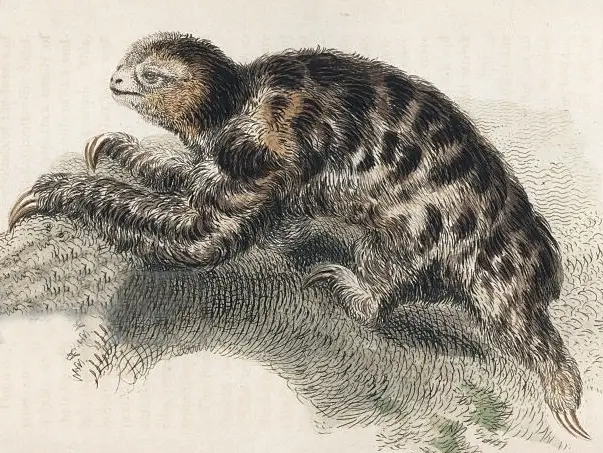
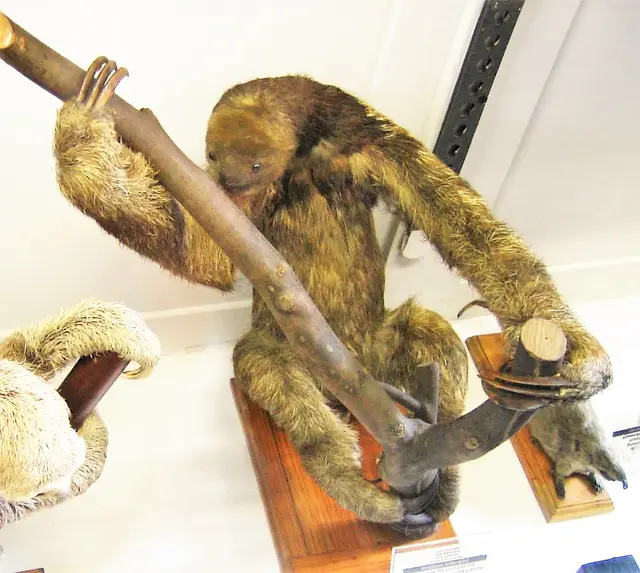
The southern maned sloth (Bradypus crinitus) is a three-toed sloth that lives only in the Atlantic Forest of eastern Brazil, in Espírito Santo and Rio de Janeiro. The IUCN Red List rated it Endangered in 2025, with a decreasing population. It was recognised as a species in its own right only in 2022.
How to recognise it
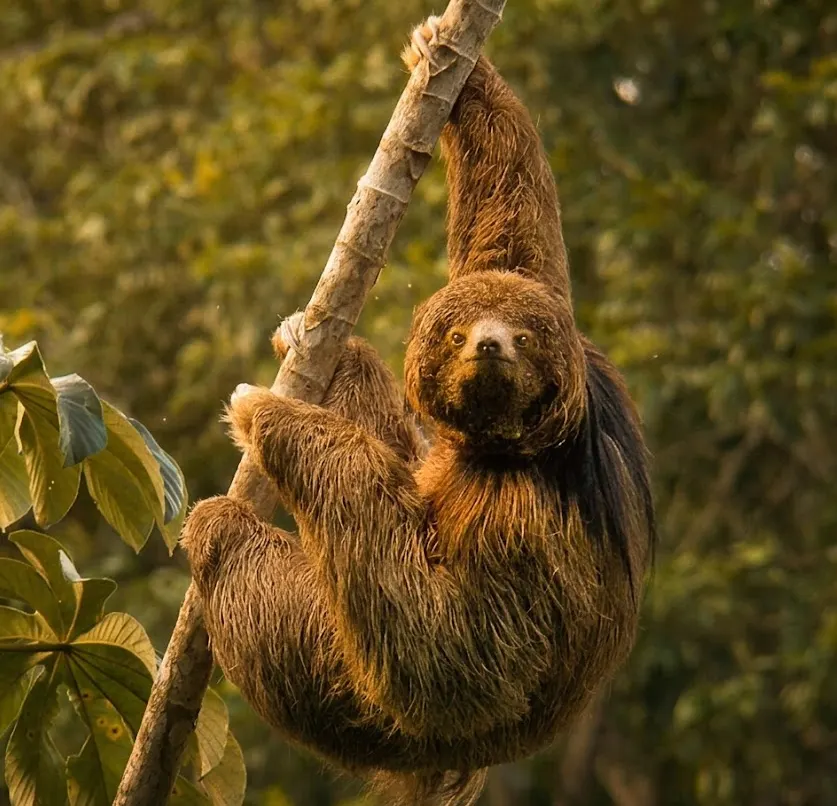
Adults measure roughly 59 to 75 cm from head to rump, with a stub of a tail only 4 to 5 cm long, and weigh about 4.5 to 10.1 kg. Males are the smaller sex. The coarse brown fur is often tinted by algae, and both sexes carry a dark mane on the neck, longer and darker in males.
The head is often compared to a coconut. Compared with the northern maned sloth, its skull is flatter, with rounder jaws and wider cheekbones.
A species split in two
Gray described this animal in 1850, but later taxonomists folded it into the maned sloth, Bradypus torquatus. A study by Miranda and colleagues in the Journal of Mammalogy, published online in 2022, revisited the question. It compared skulls from 24 sloths and mitochondrial DNA from 55, and concluded there are two species. The northern one (B. torquatus) lives in Bahia and Sergipe. The southern one took back Gray's name, and the two lineages are estimated to have separated about 4.24 million years ago.
The Rio Doce marks the northern edge of the southern species' range. Whether the river itself is the barrier, or climate and geography on either side explain the split, is not yet clear.
Where it lives
Its range is patchy, in discontinuous patches of Atlantic coastal forest. The mountainous part of Espírito Santo is the main stronghold, and the range reaches to north-central Rio de Janeiro. The IUCN lists dry and moist lowland forest as habitat, from sea level up to about 1,400 m.
Pins are Wikidata “endemic to” fields. Orange dots, when present, are GBIF occurrence tiles — survey bias included.
How it lives
It is a strict leaf-eater that feeds on a fairly small set of plant species. In one study, leaves from 21 species made up 99% of the diet, though that rested on only three animals. It averages about 17 m of travel by day and 5 m by night. Activity is spread over day and night, though sloths in Poço das Antas Biological Reserve were mainly nocturnal.
Home ranges are small, 0.8 to 10.8 ha. Females have one young a year, mostly between February and April, at the end of the wet season. Wild animals are known to live at least 12 years, and the IUCN gives a generation length of 11 years.
Why it is in trouble and what is being done
The main problem is forest loss and fragmentation. Pasture, wood and pulp plantations, farming and urban growth are the main pressures, and the IUCN also lists roads, utility lines and droughts. Deforestation has slowed but has partly rebounded in recent years. Road deaths, dog attacks and electrocution add pressure, and they weigh more in small fragments where few sloths remain.
The IUCN records a recovery plan and a monitoring scheme in place, conservation sites identified across the whole range, and presence in at least one protected area. Site and area management is the action listed as needed.
Sources
Written for this catalog in our own words from the sources below, checked against them on 12 November 2026. Population figures are estimates and carry the year they were made. Status and assessment year: IUCN. 2026. The IUCN Red List of Threatened Species. Version 2026-1. iucnredlist.org.