Endangered
Bornean Crestless Fireback
Lophura pyronota
The Bornean crestless fireback (Lophura pyronota) is a dark, shy pheasant of the lowland forests of Borneo. The IUCN Red List rated it Endangered in 2022, when it was uplisted, and records a declining population driven by forest loss and hunting.
How to recognise it
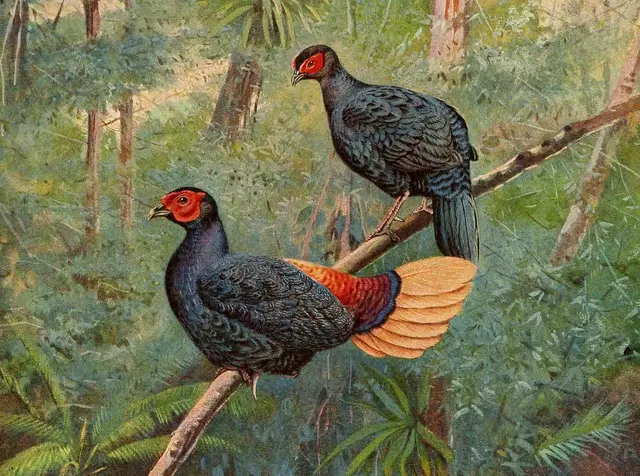
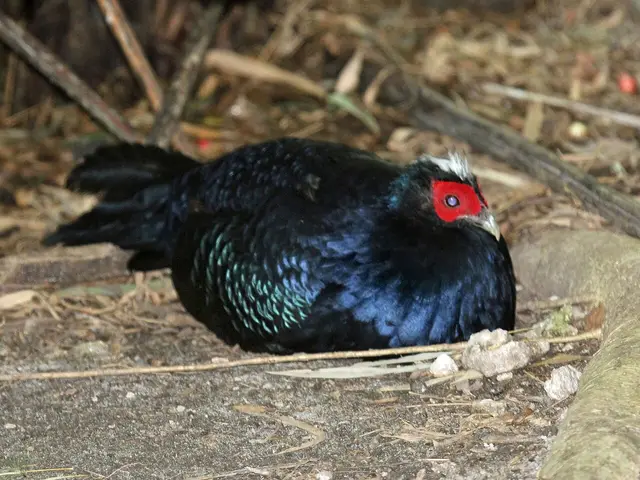
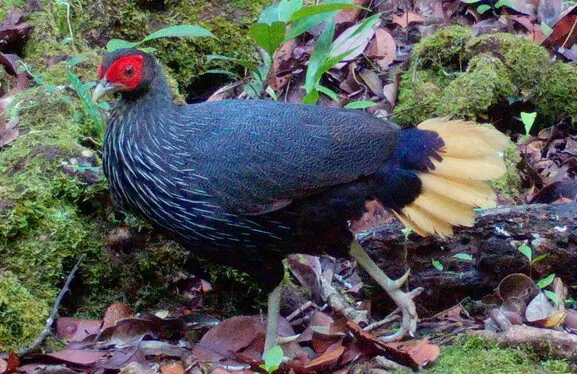
It's a stocky, dark pheasant with a short tail and no crest. Males are 47 to 51 cm long and females 42 to 44 cm, according to the Red List. The male is blackish with a purplish-blue gloss, a pale grey neck, and bold, narrow white streaks running from the neck down to the mid-belly and across the hindneck and mantle. The tail is short and caramel-coloured with black bases.
Females are blackish all over with a browner head, a paler throat and a dull, glossless tail. Juveniles look like females but have rusty tips on the body feathers. It was once treated as the same species as the Malayan crestless fireback (Lophura erythrophthalma) of the Malay Peninsula and Sumatra, and was split mainly because males look so different. The Bornean male is greyer and carries white streaking that the Malayan male lacks.
Where it lives
The species is found only on Borneo. The Red List lists it as present in Brunei and the Indonesian part of the island, and as possibly extinct in the Malaysian states of Sabah and Sarawak. It lives in level, low-lying moist forest from sea level to about 300 m, and this extreme lowland forest is described as the most threatened habitat in the Sundaic region. The wider crestless fireback group occupies lowland evergreen, peat swamp and karst forest.
Pins are Wikidata “endemic to” fields. Orange dots, when present, are GBIF occurrence tiles — survey bias included.
How it lives
Little has been studied. Crestless firebacks in general are shy, are rarely seen, and usually occur in pairs or small groups. They forage on the ground by day, scratching through leaf litter for small animals and eating plant matter and fallen fruit. A wild nest of the group was found between the buttress roots of a large tree, with four or five eggs, but that record is not specific to this species.
Why it is in trouble
The 2022 assessment lists three ongoing threats. Hunting aimed at the birds and large-scale accidental killing from harvesting affect most of the population, and the second is described as causing rapid declines. Clearing of forest for industrial agriculture is the third and also affects most of the population, with rapid declines. The assessment records a continuing decline in both numbers and habitat area. It uses criterion A2cd+3cd+4cd, which rests on population reduction over three generations (about 7 years each), estimated at 50 to 70 percent for the past, the present and the future.
No population estimate is given for this species. An older figure of 10,000 to 20,000 mature birds was given for the crestless fireback group as a whole, before the split into two species was widely applied.
What is being done
A recovery plan exists, and conservation sites have been identified across the whole range, with the bird occurring in at least one protected area. The assessment lists national-level action and site management as needed. There is no systematic monitoring scheme, no captive population and no control of invasive species.
Sources
Written for this catalog in our own words from the sources below, checked against them on 12 November 2026. Population figures are estimates and carry the year they were made. Status and assessment year: IUCN. 2026. The IUCN Red List of Threatened Species. Version 2026-1. iucnredlist.org.