Critically Endangered
Boninthemis
Boninthemis insularis
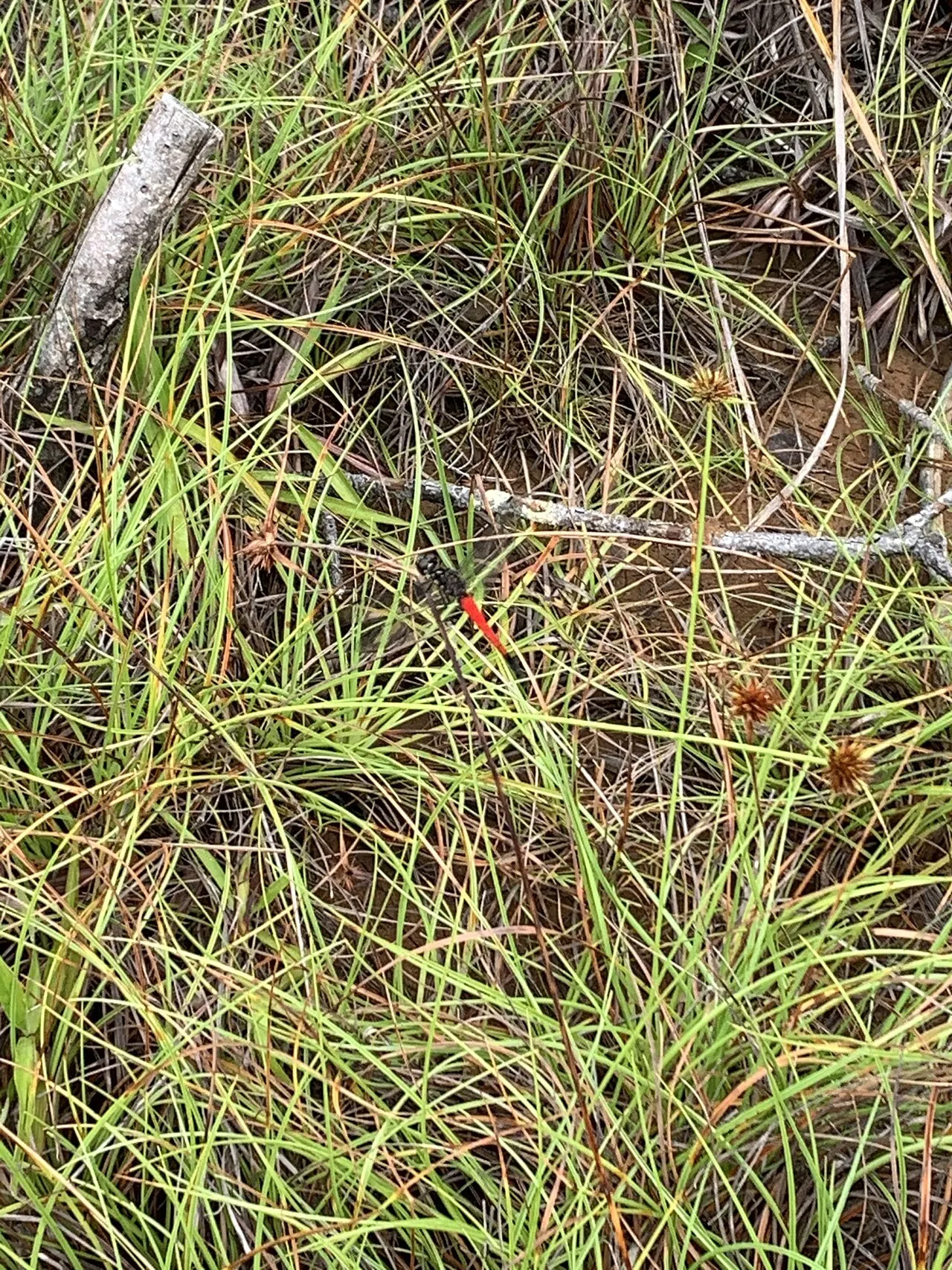
Shima-akane (Boninthemis insularis) is a slender dragonfly found nowhere but the Ogasawara, or Bonin, Islands, a remote Pacific chain belonging to Japan. It is the only member of its genus. The IUCN Red List has it as Critically Endangered, in an assessment dating from 1996, and Japan has protected it as a natural monument since 1969.
How to recognise it
It's a slender member of the skimmer family (Libellulidae), with a body about 40 mm long and hind wings of about 30 mm. The face is yellow in front with a shiny, indigo upper forehead. The chest is black with irregular yellow dots, and the narrow abdomen is dark red or orange and black. The wing edges carry blackish-brown patterns.
The species was described in 1913 and later placed in a genus of its own, Boninthemis. The Japanese name is Shima-akane.
Where it lives
The species is endemic to the Ogasawara Islands, about 1,000 km south of Tokyo. It breeds on Chichijima, Hahajima and Mukaijima, with adults on the wing from May to August.
Museum specimens show how widely it was once found. Dragonflies were collected at Komagari and Tokoyonotaki on Chichijima in 1983 and 1984, at Hahajima in 1984, and on Ototo-jima in 1933. Samples taken on Ototo-jima and Ani-jima in 2002 show it was still present on those smaller islands, and GBIF holds a human observation of the species from 2022.
Pins are Wikidata “endemic to” fields. Orange dots, when present, are GBIF occurrence tiles — survey bias included.
Why it is in trouble
Development was the first concern. The 1969 designation as a natural monument was made because island development threatened its survival.
A newer pressure is the green anole (Anolis carolinensis), an American lizard introduced to the islands that eats native insects. A 2009 study by Haruki Karube found that the five endemic dragonflies and damselflies of Ogasawara have declined rapidly since the mid-1980s, probably because the anole preys on them. Almost all had disappeared from Chichijima and Hahajima, surviving on a few satellite islands in small ponds that can dry out in a severe drought. The study covers the group as a whole rather than this species alone.
The 1996 Red List entry is old and gives no population figure, so the current number of adults is unknown.
What is being done
Beyond the monument status, the main effort is aimed at the anole. A control project running since 2006 traps lizards at the Chichijima harbour to stop them spreading to other islands by ship, and it maintains a barrier-fenced exclusion zone on Hahajima. Intensive capture there cut anole density to 10 to 20 percent, and insect abundance and variety rose.
Karube reported that artificial conservation ponds on the satellite islands have worked, with three endemic species now breeding in them, and he called for more permanent ponds and areas protected from anole predation.
Sources
Written for this catalog in our own words from the sources below, checked against them on 12 November 2026. Population figures are estimates and carry the year they were made. Status and assessment year: IUCN. 2026. The IUCN Red List of Threatened Species. Version 2026-1. iucnredlist.org.
- IUCN Red List assessment, Boninthemis insularis (1996)
- Boninthemis (Wikipedia)
- Shimaakane, Japan Nature Conservation Series XVII (stamp gallery)
- Karube 2009, Japanese Journal of Limnology 70(3) (abstract)
- Anole control in Ogasawara (EAFES symposium abstract)
- GBIF occurrence records for Boninthemis insularis




