Critically Endangered
Bojer's skink
Gongylomorphus bojerii
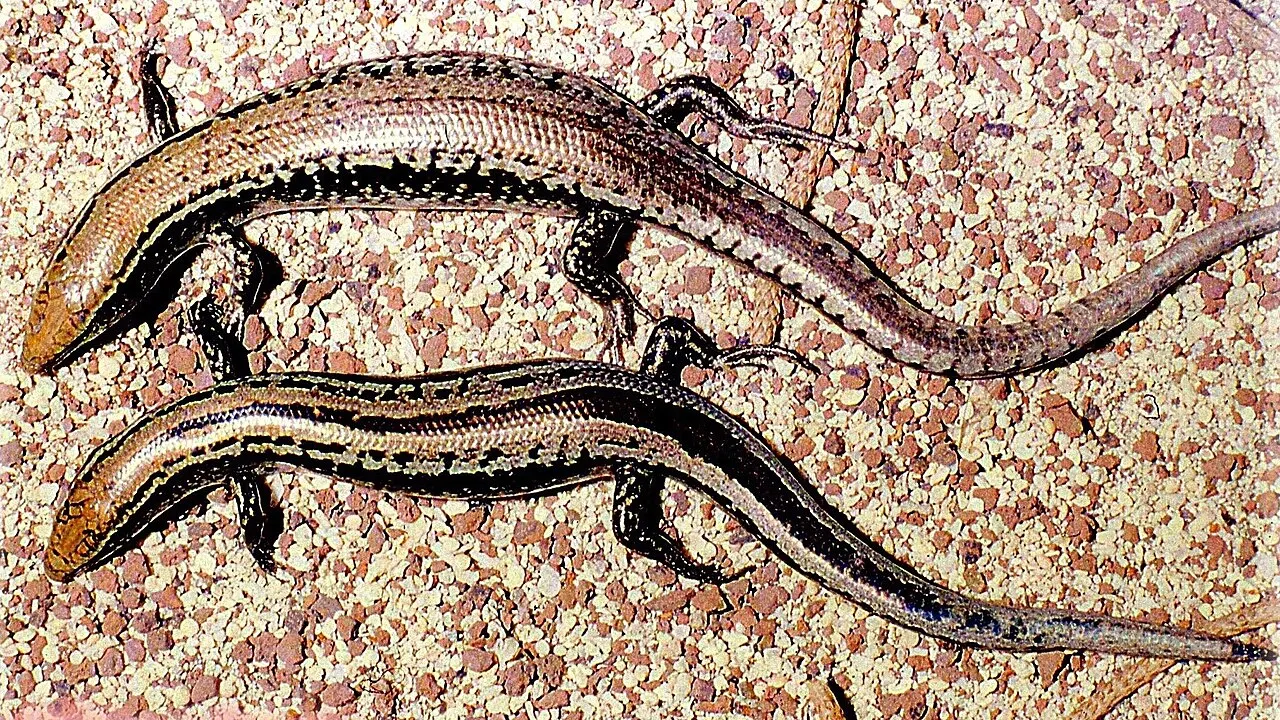
Bojer's skink (Gongylomorphus bojerii) is a small lizard that survives only on a handful of offshore islands around Mauritius. It once lived on the Mauritian mainland too. The IUCN Red List rated it Critically Endangered in 2022, with a stable trend across just 8 locations after a steep past decline.
How to recognise it
This is a small, ground-dwelling skink, about 11 cm long including a tail of roughly 6 cm. It has five digits on each limb and a horizontal slit for an ear opening, which gives the genus its other name, the slit-eared skinks. It is active by day.
It was first described as Scincus bojerii by Desjardin in 1831, and it was long known as Scelotes bojeri. The name honours Wenzel Bojer, a Czech naturalist who collected in tropical Africa. It is the type species of its genus.
Where it lives
The skink is endemic to Mauritius. It survives on small islands off the coast, among them Round Island, Gunner's Quoin (Coin de Mire), Ilot Vacoas and Ile de la Passe, and has been moved to Ile aux Fouquets. The Red List counts 8 locations, an area restricted to a small footprint, and a range from sea level to about 280 m.
Its habitat is dry forest, dry shrubland and dry grassland. Genetic work shows two main lineages, one on islands north of Mauritius and one on islands in the south-east, where Ilot Vacoas became the main refuge. DNA from a recently extinct population on Ile aux Fouquets, and subfossil bones from the mainland, show that both lineages once lived together in the south-east.
A 2009 study in Zootaxa split the slit-eared skinks into three species. Gongylomorphus fontenayi lives in relict forest in the south-west of Mauritius, and G. borbonicus lived on Reunion and was extinct by about 1840. Bojer's skink is the one on the offshore islands.
Pins are Wikidata “endemic to” fields. Orange dots, when present, are GBIF occurrence tiles — survey bias included.
Why it is in trouble
The 2009 study suggests the genus shrank sharply across Mauritius in the nineteenth century, probably because of an introduced Asian wolf snake and possibly other exotic species. The Red List names introduced black and brown rats, mongooses and cats as past threats, and the Asian house shrew and wolf snake as ongoing ones. It records the shrew as having a high impact, with very rapid declines. Recreational activities and rubbish are also listed.
The assessment records an estimated past reduction of 88 percent in the population, with the cause understood but not ceased. Small islands carry their own risks: a species held on a handful of rocks can be wiped out by one storm, fire or boat-borne predator.
What is being done
Mauritian conservationists have moved skinks to safer islands. In a project backed by the Darwin Initiative, skinks from Ilot Vacoas were released on Ile aux Fouquets, with a second cohort of 20 following in January 2008. By the project's end the Fouquets population had more than doubled the total number of that south-eastern form.
Ile de la Passe is a more surprising case. A few skinks turned up there in 2009 on an island where the species was thought to be extinct. A 2019 study in Conservation Genetics by Zoe Melvin and colleagues traced them to the south-east, possibly to a single gravid female, and found that later translocations have not yet improved the population's genetic diversity. It recommends adding animals from other south-eastern islands.
The Red List records a recovery plan, systematic monitoring, invasive species control and a successful reintroduction. Most of the population is within protected areas.
Sources
Written for this catalog in our own words from the sources below, checked against them on 12 November 2026. Population figures are estimates and carry the year they were made. Status and assessment year: IUCN. 2026. The IUCN Red List of Threatened Species. Version 2026-1. iucnredlist.org.




