Endangered
Andaman cat snake
Andaman cat snake
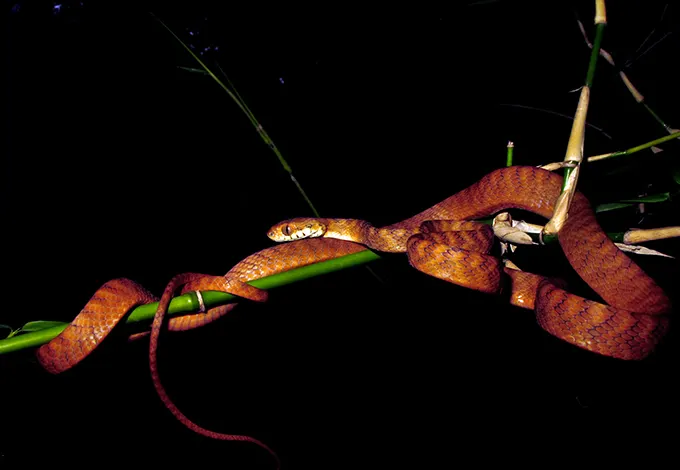
The Andaman cat snake is a slender, night-active tree snake found only on the Andaman Islands of India. The IUCN Red List rated it Endangered in 2021. It lives mainly in forest, and clearing for farms and housing is eating into its small range.
How to recognise it
The Reptile Database describes the back as reddish, brownish or pale greenish, with an unpatterned underside and 21 scale rows at midbody. The body is reportedly thin and flattened from side to side, the head clearly wider than the neck, and the large eyes have vertical pupils. Adults reportedly average about 0.85 m in total length, with the largest reaching about 1.49 m.
Colour varies. A 2022 review of the islands' snakes by Chandramouli recognised three morphs: ashy green, brown and bright red. Green and brown are common in adults, juveniles are reddish, and the inside of the mouth is pink.
Where it lives
The species is endemic to the Andaman Islands in the Bay of Bengal. The IUCN lists North, Middle and South Andaman, and Chandramouli's review reports seven specimens from South Andaman, Long Island, Havelock and Middle Andaman. Frank Wall described it in 1909 as Dipsadomorphus andamanensis. M. A. Smith later treated it as the same species as Boiga ceylonensis, but recent authors regard it as valid.
The IUCN puts its extent of occurrence at about 3,000 square km and gives an upper elevation limit of 100 m. It is associated with tropical evergreen and moist deciduous forest, and may depend on forest. Chandramouli also lists secondary forest and low shrubs. The IUCN describes the population as severely fragmented.
Pins are Wikidata “endemic to” fields. Orange dots, when present, are GBIF occurrence tiles — survey bias included.
How it lives
The Reptile Database calls the species fully arboreal and egg-laying, and Chandramouli describes it as nocturnal. It reportedly hunts at night, mostly in trees and bushes and sometimes on the ground, taking geckos, small lizards (especially Calotes) and rodents, with tree frogs and bats now and then. It is reportedly rear-fanged, with a mild venom that can paralyse small prey.
It is reportedly mild-mannered, but when provoked it raises the front of its body, coils, vibrates its tail and bites readily. Chandramouli calls it uncommon overall and rather uncommon around human dwellings, though it has reportedly been found in thatched roofs.
Why it is in trouble
The IUCN names small-holder farming and housing and urban development as the threats. Both convert and degrade the forest the snake lives in, and the area it occupies is still shrinking. The IUCN calls it uncommon, with few specimens known, and suspects the population is declining.
It was listed as Endangered because its extent of occurrence is small, its range is severely fragmented across three small islands, and its forest is continuing to decline in extent and quality.
What is being done
The IUCN says it is not known for certain whether the snake lives in any protected area, though populations may lie within the Mount Harriet and Saddle Peak protected areas. It lists protection of forest habitat as the action needed, along with further study of the snake's distribution, natural history and threats. No species-specific conservation programme is documented.
Sources
Written for this catalog in our own words from the sources below, checked against them on 12 November 2026. Population figures are estimates and carry the year they were made. Status and assessment year: IUCN. 2026. The IUCN Red List of Threatened Species. Version 2026-1. iucnredlist.org.




