Critically Endangered
Bog turtle
Glyptemys muhlenbergii
Bog turtle is a turtle in the family Emydidae — Glyptemys muhlenbergii, recorded as Critically Endangered and tied to United States.
Appearance
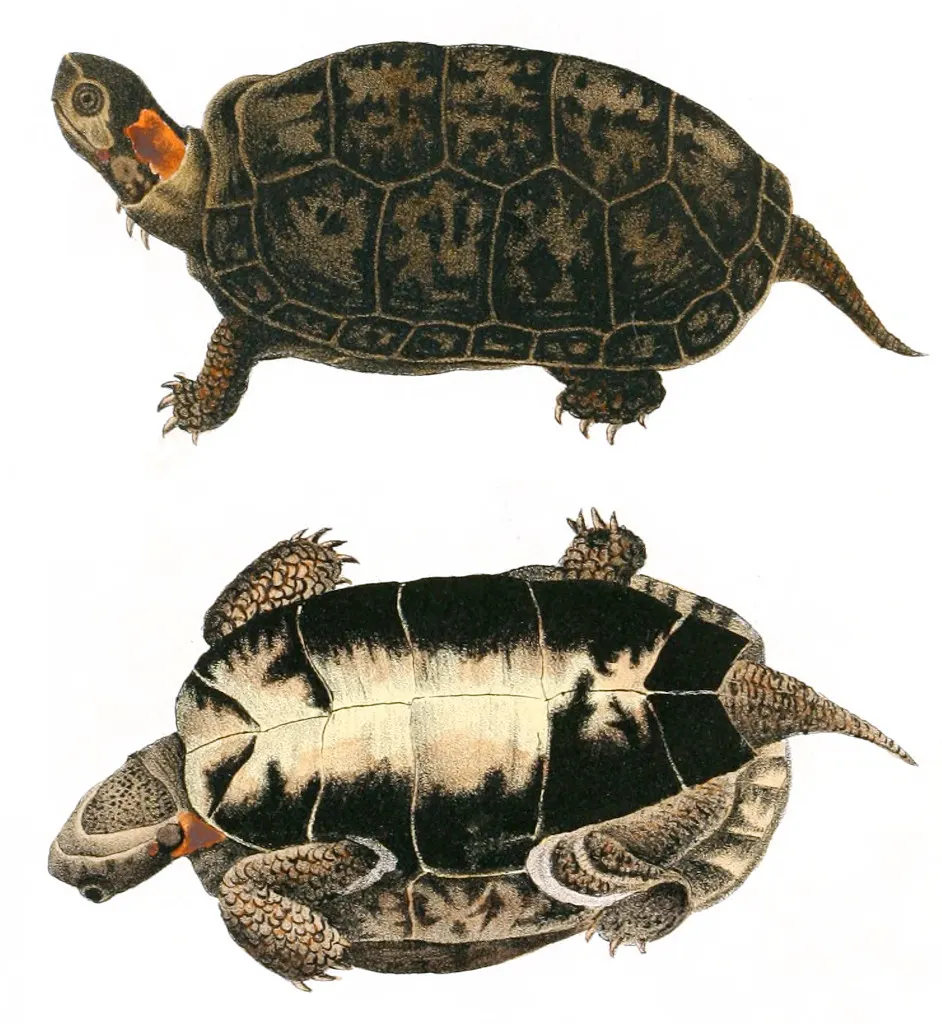
It does not have a prominent snout. Its head is dark brown to black, and it has a bright yellow, orange, or red spot on each side of its neck. The bog turtle has a dark skin color with an orange-red wash on the inside of the legs of some individuals.
The bog turtle is the smallest species of turtle in North America.
The adults weigh approximately 110 grams (3.9 oz) when fully grown.
It was first scientifically described in 1801 after an 18th-century survey of Pennsylvania.
Range and habitat
The bog turtle is native only to the eastern United States, congregating in colonies that often consist of fewer than 20 individuals. It prefers calcareous wetlands (areas containing lime), among them meadows, bogs, marshes, and spring seeps, that have both wet and dry regions. Its habitat is often on the edge of woods.
Pins are Wikidata “endemic to” fields. Orange dots, when present, are GBIF occurrence tiles — survey bias included.
Habits
The bog turtle is primarily diurnal, active during the day and sleeping at night. Diurnal and secretive, it spends most of its time buried in mud and – during the winter months – in hibernation.
In crisis
Considered threatened at the federal level, the bog turtle is protected under the United States' Endangered Species Act. Various private projects have been undertaken in an attempt to reverse the decline in the turtle's population. The northern and southern bog turtle populations are separated by a 400-kilometer (250 mi) gap over much of Virginia, that lacks bog turtle colonies.
The southern population is much smaller in number (only about 96 colonies have been located), living in the states of North Carolina, South Carolina, Georgia, Virginia, and Tennessee. The turtles in this population are even more scattered than in the northern population and live at higher elevations, up to 1,373 meters (4,505 ft).
CITES lists this taxon on Appendix I. Confirm the current appendix on the CITES checklist.
Bog turtle is Critically Endangered on the IUCN Red List (assessed 2011, criteria A2cd+4ce). Confirm the official criteria and any later count on the assessment page.
Sources
Adapted from the English Wikipedia article on Bog turtle (CC BY-SA 4.0; authors are listed in the article history; changes were made), Wikidata item Q72105. Family and order context is original field-guide writing about the group, not a copied assessment of this one species. Not an IUCN assessment. Counts, when quoted, can change — confirm them on the recovery programme and on iucnredlist.org. Status and assessment year: IUCN. 2026. The IUCN Red List of Threatened Species. Version 2026-1. iucnredlist.org.