Endangered
Blue shiner
Cyprinella caerulea
The blue shiner is a small freshwater minnow from the Coosa and Cahaba river systems of the southeastern United States. The IUCN Red List assessed it as Endangered in 2013. It now survives in just four watersheds in Alabama, Georgia and Tennessee, and silt and polluted water remain its main problems.
How to recognise it
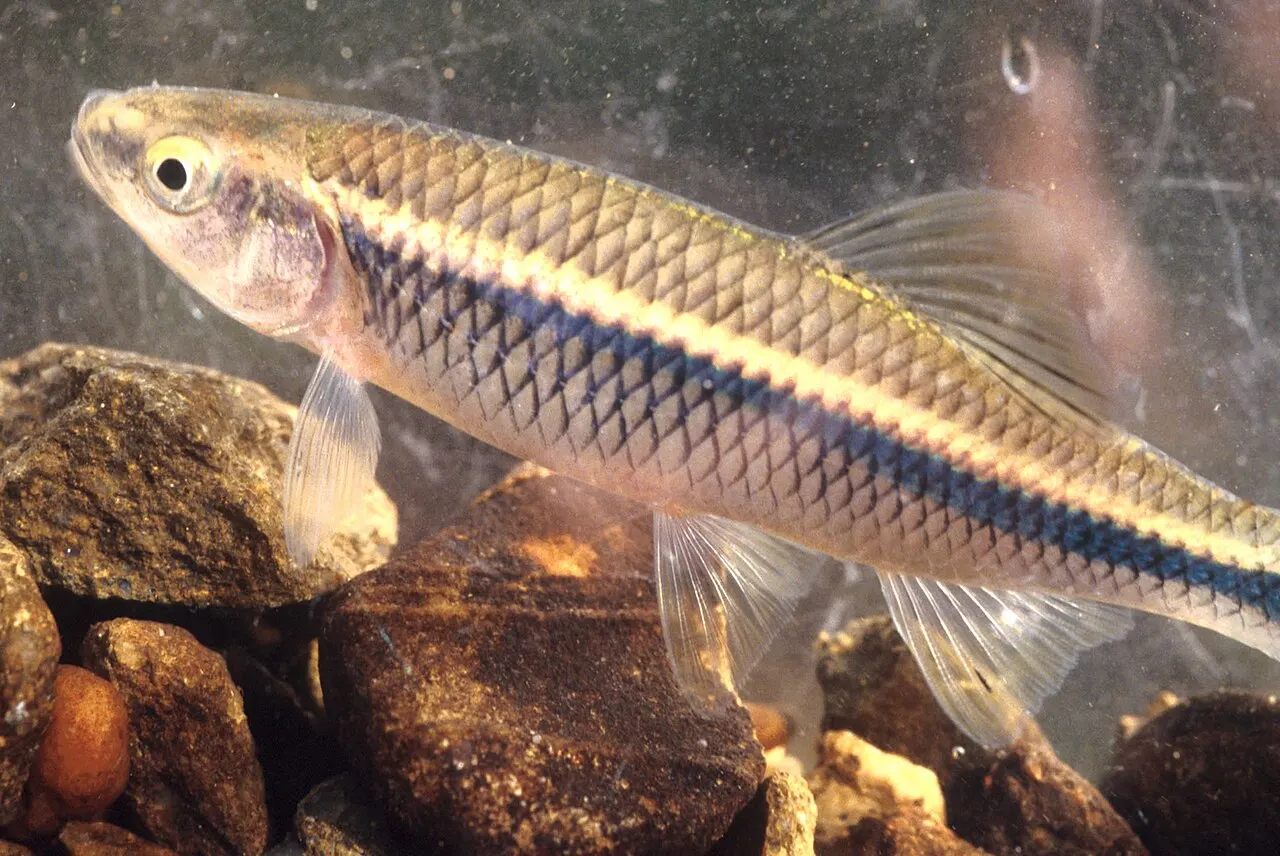
A medium-sized minnow, it reaches about 100 mm (4 inches) in total length, with males larger than females. Outside the breeding season adults are dusky blue with pale yellow fins, and the diamond-shaped scales are outlined in dark pigment.
Breeding males change. They grow small bumps called nuptial tubercles, their fins turn yellowish and they take on a metallic blue sheen. Females do not develop tubercles or breeding colours.
Where it lives
The species belongs to the Mobile River basin. Today it is found in four watersheds: Choccolocco Creek, the West Fork of the Little River and Weogufka Creek in Alabama, and the Conasauga River in Georgia and Tennessee, including the lower Jacks River. The Conasauga holds the largest population.
It has disappeared from the Cahaba River watershed (considered gone since 1971) and from Big Wills Creek (since 1958). Older records also include the Coosawattee and Oostanaula rivers in Georgia.
The fish prefers small to mid-sized streams with slow to moderate current and clear water, over sand, gravel and sometimes cobble. It is usually found in water 0.15 to 1 m deep.
Pins are Wikidata “endemic to” fields. Orange dots, when present, are GBIF occurrence tiles — survey bias included.
How it lives
It is a visual feeder, taking invertebrates drifting in the water. Spawning runs from early May to late August. A male holds a territory and females come to lay eggs, forcing them into crevices in bedrock and wood. There is no parental care, and a female can lay more than one clutch in a season.
The lifespan is about three years, and two-year-old fish produce the most eggs.
Why it is in trouble
The IUCN lists the population as decreasing and names dams, soil erosion and sedimentation, and nutrient loads among the threats. Excess silt makes feeding harder, and the spawning crevices need clear flow to stay open. Conservation Fisheries also lists deforestation, impoundments, mining and pollution.
Laboratory toxicity work in 2008, reported by Conservation Fisheries, found the blue shiner roughly ten times more sensitive to chlorides than fathead minnows. Chloride spikes linked to gas extraction hit the Cahaba River around the time the shiner vanished there.
What is being done
The US Fish and Wildlife Service listed the blue shiner as threatened under the Endangered Species Act in 1992 and published a recovery plan in 1995. The IUCN says a recovery plan is in place and lists habitat restoration, site protection, captive breeding, reintroduction and species recovery among the actions that apply.
Conservation Fisheries, working with the Cherokee National Forest, USGS and the Service, propagated the fish in 1997 and 1998 and has monitored populations in 1993 to 2017 and again in 2022 to 2024.
Sources
Written for this catalog in our own words from the sources below, checked against them on 12 November 2026. Population figures are estimates and carry the year they were made. Status and assessment year: IUCN. 2026. The IUCN Red List of Threatened Species. Version 2026-1. iucnredlist.org.