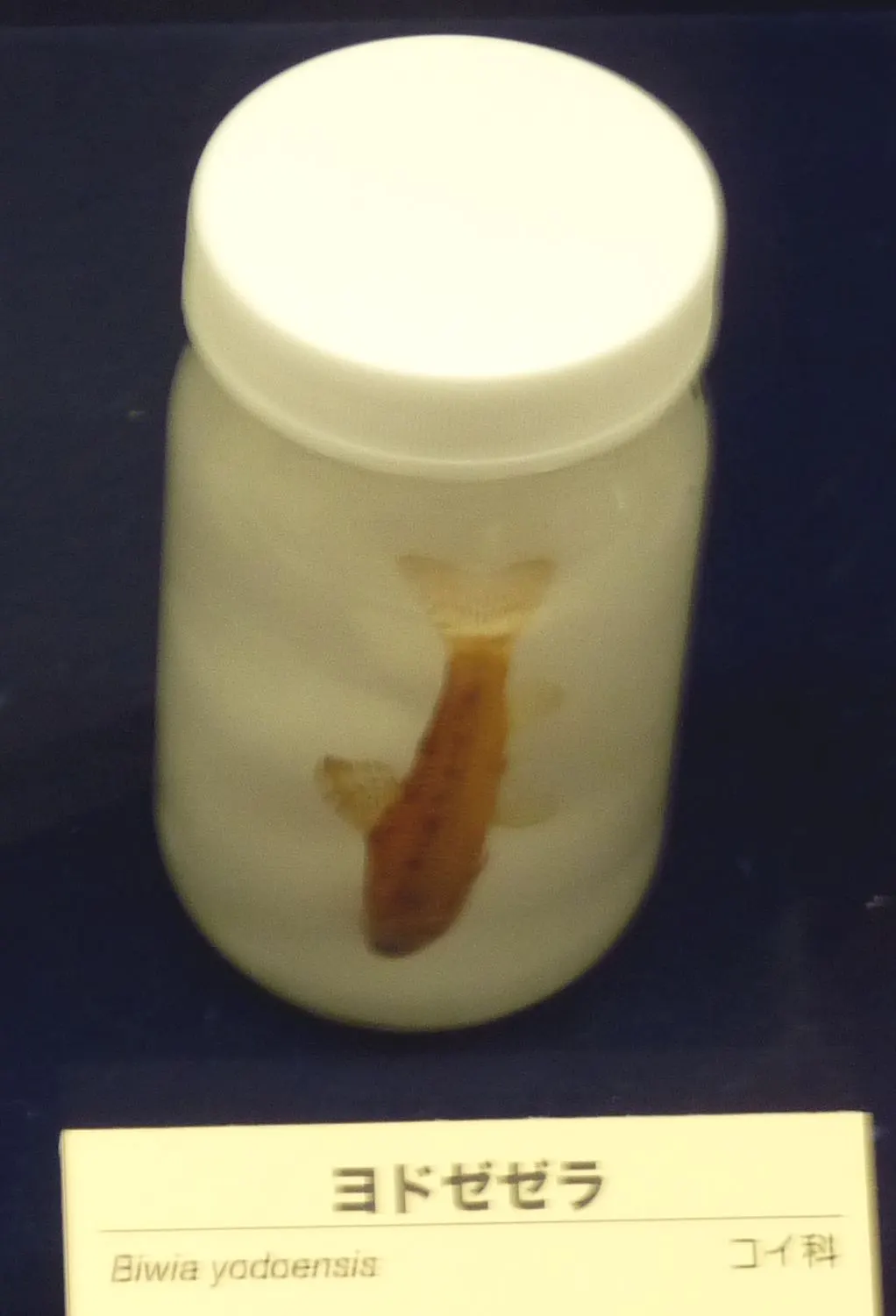
Endangered
Yodo Gudgeon
Biwia yodoensis
The Yodo gudgeon (Biwia yodoensis, Japanese name yodozezera) is a slender 5 cm freshwater fish found only in the Lake Biwa and Yodo River system of Honshu, Japan. The IUCN Red List assessed it as Endangered in 2019, as the slow, muddy backwaters it needs have been engineered away.
How to recognise it
It's a small, slim minnow-like fish, about 5 cm long, with the front of the body slightly flattened from top to bottom and the rear flattened from side to side. Dark blotches run along the sides and back. There are 34 or 35 scales along the lateral line.
It looks a lot like a close relative, the zezera (Biwia zezera), but the Yodo gudgeon has a smaller eye and a deeper body and tail stalk. Males have a well-developed dorsal fin that bulges and has a serrated edge. In breeding males the blotches fade, the body turns silvery-black, and two rows of enlarged tubercles appear on the front edge of the pectoral fins. The species wasn't formally described until 2010.
Where it lives
It occurs only in the Lake Biwa and Yodo River system on Honshu. The IUCN counts three locations and an estimated extent of occurrence of around 200 square km. In Kyoto Prefecture it was probably widespread in the middle and lower Katsura, Uji and Kizu rivers, but it can no longer be found in the Uji. Populations remain in the lower Katsura and parts of the Kizu, though its range has shrunk.
Its home is slow water over sand or mud: river side-pools called wando and tamari, secondary channels and farm irrigation ditches.
Pins are Wikidata “endemic to” fields. Orange dots, when present, are GBIF occurrence tiles — survey bias included.
How it lives
Spawning runs from April to early July. Males hold territories around the roots of emergent plants such as reeds and cattails, and females lay their eggs there. Both sexes are mature after one year.
Why it is in trouble
The IUCN lists dams and other ecosystem modification as the threats, and reports a continuing decline in both population and habitat area. Kyoto's Red Data Book gives more detail: paddy fields lost to construction and urban development, river works that remove or degrade floodplain backwaters, and predation by invasive fish.
Japan's Ministry of the Environment rates it Endangered (Category IB), while Kyoto Prefecture lists it more leniently as Near Threatened.
What is being done
The IUCN notes that habitat restoration, site management and protection are the conservation needs, and that the species isn't known from any protected area. Kyoto's Red Data Book recommends restoring backwaters and pools, keeping secondary channels and their links to the main river, limiting paddy development and removing invasive fish.
Sources
Written for this catalog in our own words from the sources below, checked against them on 12 November 2026. Population figures are estimates and carry the year they were made. Status and assessment year: IUCN. 2026. The IUCN Red List of Threatened Species. Version 2026-1. iucnredlist.org.




