Endangered
Northern bettong
Bettongia tropica
The northern bettong is a small, grey, hopping marsupial of far northeast Queensland, Australia. It lives in a narrow band of open forest beside rainforest and digs up underground fungi at night. The IUCN Red List assessed it as Endangered in 2025, with the wild population still decreasing.
How to recognise it
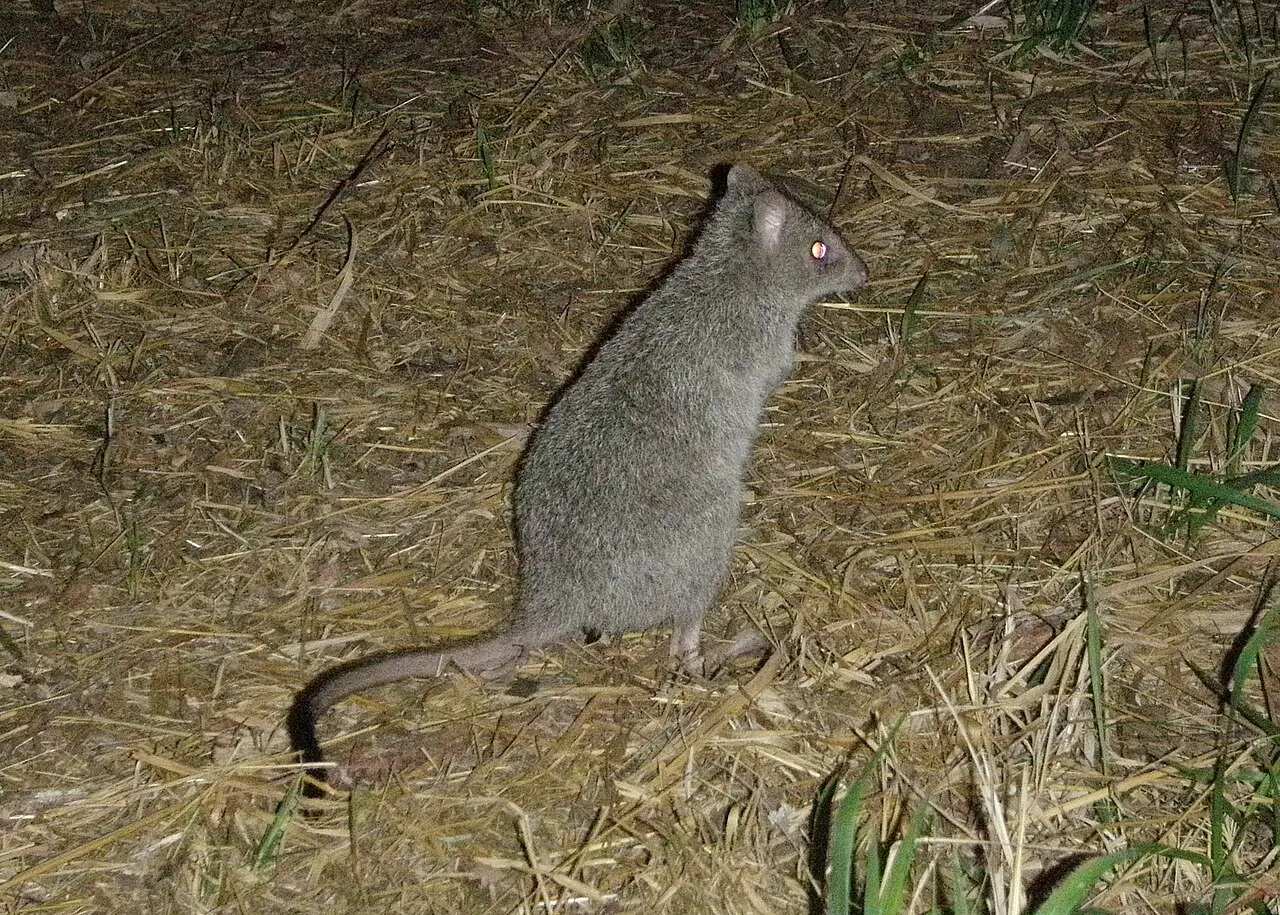
The northern bettong is a rat-kangaroo, a relative of the potoroos, and it's small: a little over 30 cm long with a tail up to about 34 cm, and an average weight near 1.2 kg. The fur is grey with a cream belly, and the tail ends in a black crest.
It hops in a low, springy way, holds its forepaws tight against its chest, and can bolt quickly if startled. Biologists first described the species in 1967.
Where it lives
The species is found only in the Wet Tropics of Queensland, in open eucalypt woodland and casuarina forest that borders rainforest. The IUCN lists moist montane forest and drier forest as its habitats, at roughly 800 to 1,200 m above sea level.
It was once more widespread. Its range has since shrunk to two locations, with an extent of occurrence of about 6,000 square km and an area actually occupied of about 173 square km (2025 assessment). Two of its four known wild populations disappeared over roughly the last two decades, leaving two.
Pins are Wikidata “endemic to” fields. Orange dots, when present, are GBIF occurrence tiles — survey bias included.
How it lives
Bettongs are solitary and nocturnal. By day one sleeps in a concealed nest of grass, leaves and bark, built under a tree or in a grass clump, and it carries the nesting material in its prehensile tail.
At night it forages by smell, digging with its front claws. For most of the year the staple is the fruiting bodies of truffle-like fungi that grow underground. In the driest months it switches to the tubers of cockatoo grass and lilies, along with herbs, invertebrates, fruit and seeds.
Scattering fungal spores as it feeds makes the bettong something of an ecosystem engineer for the forest. Females can breed all year when conditions are good, usually raising a single young that stays in the pouch for about 100 days.
Why it is in trouble
The 2025 assessment estimates 800 to 1,600 animals in about five subpopulations, and it records a continuing decline in numbers and in the area they occupy. Plantations, grazing and farming, drought, and more frequent or intense fires are all listed as threats.
Fire cuts both ways here. Where burning has been reduced, rainforest plants and weeds have crept into the eucalypt forest and shaded out the grassy understorey the bettong depends on. Feral cats are thought to be hurting the species, and cattle, horses and pigs compete for food and strip away cover.
What is being done
A recovery plan and a monitoring scheme are in place, and the IUCN reports that about 41 to 50 percent of the population lies inside protected areas. A recovery team brings together government agencies, scientists, volunteer groups and Traditional Owners.
In May 2023 the Australian Wildlife Conservancy moved 49 bettongs into a 950 hectare fenced area free of feral predators at Mount Zero-Taravale Wildlife Sanctuary. It was described as northern Australia's first safe haven of that scale. The same group has restored a fire regime meant to keep the wet eucalypt forest open.
Sources
Written for this catalog in our own words from the sources below, checked against them on 12 November 2026. Population figures are estimates and carry the year they were made. Status and assessment year: IUCN. 2026. The IUCN Red List of Threatened Species. Version 2026-1. iucnredlist.org.




