Endangered
Small Restio Grasshopper
Betiscoides parva
The small restio grasshopper (Betiscoides parva) is a small, wingless grasshopper of South Africa's Western Cape, described in 1937 from the Cape Peninsula. The IUCN Red List lists it as Endangered (assessed 2012), with only three known locations, a fragmented population and a shrinking habitat.
How to recognise it
This is a small grasshopper in the family Lentulidae, described by K.H.L. Key in 1937 in the Annals of the South African Museum. The name parva is Latin for small. The male holotype, collected on the Cape Peninsula in December 1930, is kept at the Natural History Museum in London.
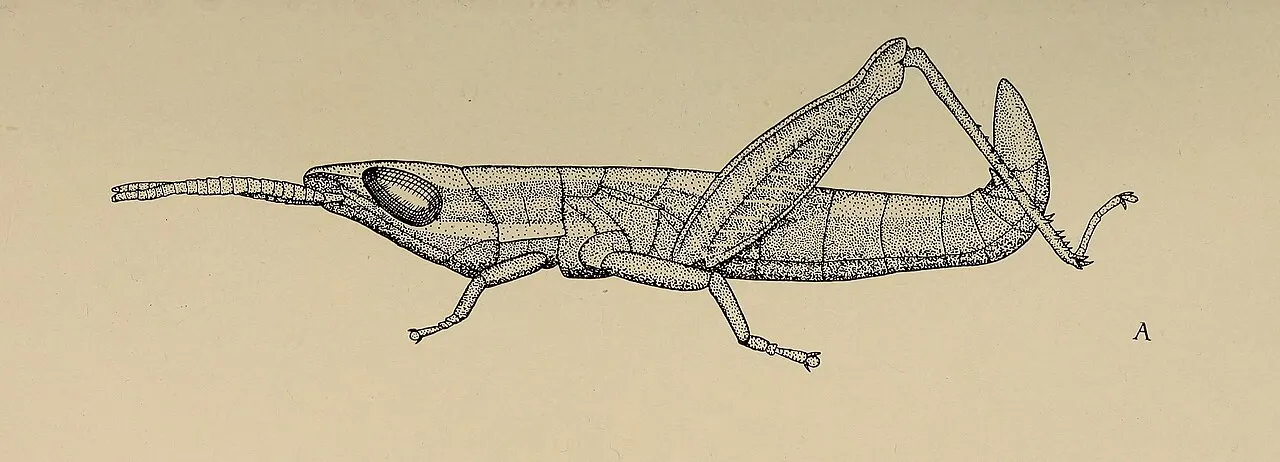
A 2024 revision by Matenaar in Evolutionary Systematics lists its features as small body size, thick sword-shaped antennae, large prominent oval eyes and relatively large feet, about half the length of the hind shin. It is fairly hairy, especially at the tip of the abdomen, which Key's description had missed.
A close relative, Betiscoides nova, was described in the same paper. It is the nearest genetic match to B. parva, but it is smooth rather than hairy and lacks the big feet.
Where it lives
The type locality is the Cape Peninsula, and one paratype came from Hermanus. The 2024 revision assigned specimens from the Twelve Apostles section of Table Mountain National Park to this species. The IUCN assessment lists the Western Cape and counts three locations.
The whole genus is endemic to the Cape Floristic Region. The Red List gives wetland and seasonally wet grassland as its habitat.
Pins are Wikidata “endemic to” fields. Orange dots, when present, are GBIF occurrence tiles — survey bias included.
How it lives
Very little has been published about its day-to-day biology. Lentulidae are wingless, so a population cannot easily reach other patches, and the IUCN describes this one as severely fragmented. It is not migratory.
Two of its relatives, B. nova and B. muris, were found in wetland dominated by restios, the wiry reed-like plants of the Cape, where they were abundant in patches with water over bare ground. That is the likely source of the common name, though the same detail has not been published for B. parva itself.
Why it is in trouble
The Red List lists increased fire frequency, drought, nomadic grazing, housing development and tourism and recreation areas as pressures. Fire, grazing, housing and tourism affect a minority of its range today. Drought is expected to affect all of it in future. Each is rated as causing slow but significant decline.
The assessment records a continuing decline in the area the species occupies, and gives the population trend as unknown. Other pressures may be at work, since the assessment also lists an unspecified threat.
What is being done
Conservation sites have been identified over part of its range, and it occurs in at least one protected area. The recommended actions are control of invasive plants and site management. There is no recovery plan and no systematic monitoring scheme listed.
Sources
Written for this catalog in our own words from the sources below, checked against them on 12 November 2026. Population figures are estimates and carry the year they were made. Status and assessment year: IUCN. 2026. The IUCN Red List of Threatened Species. Version 2026-1. iucnredlist.org.




