Endangered
Betic midwife toad
Alytes dickhilleni
The Betic midwife toad (Alytes dickhilleni) is a small, dusty-grey toad found only in the mountains of south-eastern Spain, where the male carries the eggs on his back legs. The IUCN Red List assessed it as Endangered in 2024, with numbers falling as breeding water dries up and disease spreads.
How to recognise it
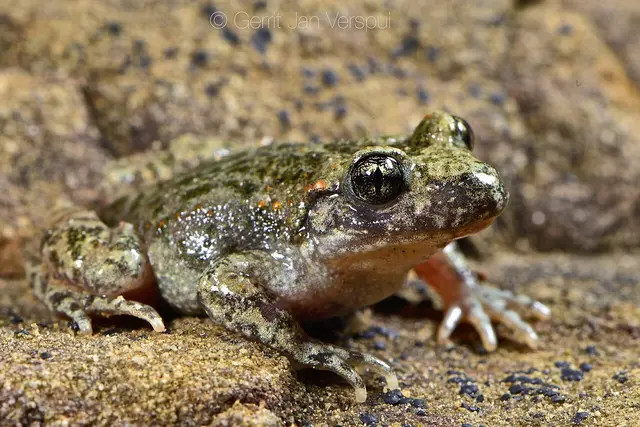
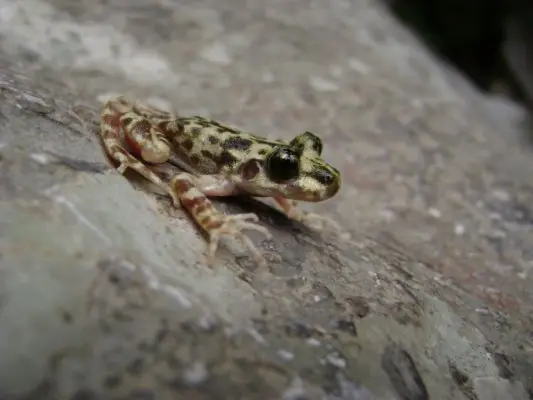
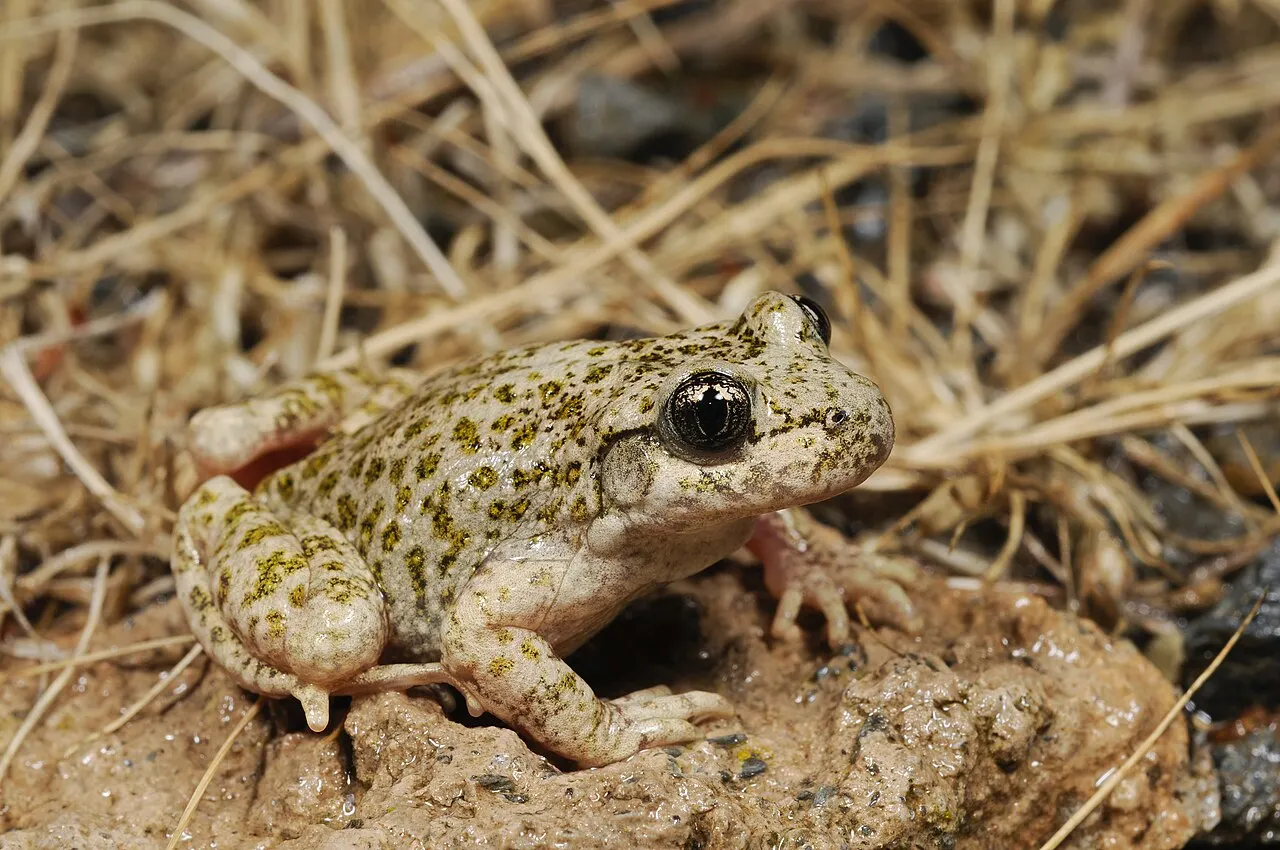
This is a stocky little toad with short legs, a big head and a short, tall snout. The back is grey, speckled with small dark and pale spots that give it a powdery look, and the skin is smooth but studded with whitish or greyish granules. The eyes are prominent, with vertical pupils. Sources give different sizes: English-language references say about 3.5 cm, while a Spanish government fact sheet says up to 6 cm.
Its tadpoles are large, with a fairly long tail, and their colour runs from pale grey to dark brown. The species was described only in 1995, by Jan Arntzen and Mario Garcia-Paris, after morphological and allozyme work on midwife toads.
Where it lives
It is endemic to Spain, limited to mountain systems in the south-east, from the Cazorla and Segura ranges to the Sierra Nevada and the mountains around Malaga. The IUCN records it at 700 to 2,510 m, while a 2006 IUCN summary gave a top figure of 2,140 m. A Spanish government climate report adds that it is also found almost at sea level.
Populations are patchy, often cut off from each other on separate mountains. The toad is relatively common in the Alcaraz, Segura and Cazorla mountains and scarce in the drier Filabres, Baza and Gador ranges, where it sticks close to springs and some groups may be only a few adults. It is present in the Sierra Nevada and Cazorla, Segura and Las Villas protected areas, and the 2024 assessment records it in at least one protected area.
Pins are Wikidata “endemic to” fields. Orange dots, when present, are GBIF occurrence tiles — survey bias included.
How it lives
Adults live in pine and oak woods and in open, stony ground, mostly on limestone. They hide in rock cracks, under stones and in earthy banks, never far from clean, permanent water, and they are active mostly at dusk and at night. Ants, spiders and other arachnids, and beetles are the main food.
After mating on land, the female passes her clutch to the male. He carries it for about a month, then goes to the water's edge and releases the larvae. Breeding sites include mountain streams, springs, pools, reservoirs and cattle troughs, and the tadpoles can take a long time to mature. Almost all known breeding sites are human-made water bodies.
Why it is in trouble
The 2024 assessment uses criterion A2ace, an observed or suspected population decline, and lists the trend as decreasing, with an estimated past reduction of 63.8 percent. In 2004 the IUCN had rated it Vulnerable, and it has rated it Endangered since 2022. Droughts, groundwater pumping for farming and agro-industry are named threats. Farming has also changed. Cattle troughs and other artificial water sources, which many toads use for breeding, have been abandoned as farming practices modernised.
Chytrid fungus is now a concern too. A 2021 study in Biological Invasions found that the fungus, detected in only three localities about a decade earlier, had spread across the toad's entire range. Infection prevalence had risen by 30 to 50 percent, and it suggested that moving infected animals into clean breeding sites was the most plausible way it spread. The spread is linked to mass deaths, declines and local extinctions.
Climate projections add to the worry. A Spanish government climate-impact report, using older climate models, projects that the toad's suitable range could shrink by roughly 28 to 82 percent by 2041 to 2070, depending on the model and scenario.
What is being done
The toad is listed on Appendix III of the Berne Convention and in regional red data books. In Castilla-La Mancha and Andalusia, restoring breeding sites and building new ones has been under way. The 2024 assessment lists site and area management and control of problem species among actions in place, and records that the species is also held in ex-situ conservation.
Sources
Written for this catalog in our own words from the sources below, checked against them on 12 November 2026. Population figures are estimates and carry the year they were made. Status and assessment year: IUCN. 2026. The IUCN Red List of Threatened Species. Version 2026-1. iucnredlist.org.
- IUCN Red List assessment, Alytes dickhilleni (2024)
- IUCN Mediterranean amphibian species summary, Alytes dickhilleni (2004 assessment)
- Spanish environment ministry fact sheet, sapo partero betico
- Spanish environment ministry climate impact report, vertebrate fauna (Alytes dickhilleni)
- Thumsova, Gonzalez-Miras, Faulkner and Bosch 2021, Biological Invasions (CSIC summary)
- Betic midwife toad, encyclopedia entry