Endangered
Alytes maurus
Alytes maurus
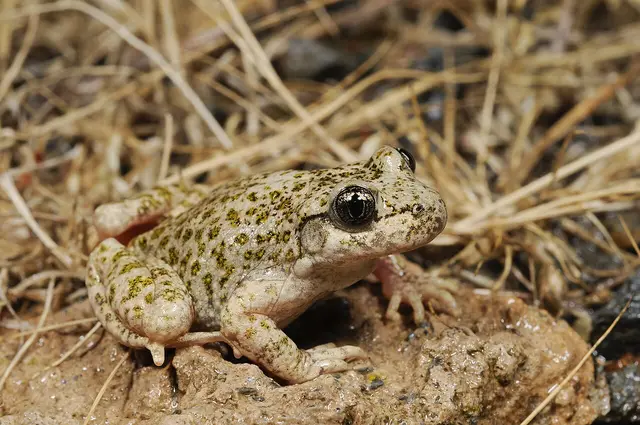
The Moroccan midwife toad is a small, stocky frog of the Rif and Middle Atlas mountains in northern Morocco, where males carry strings of eggs on their back legs. The IUCN Red List moved it from Near Threatened to Endangered in 2021, as its habitat shrinks and disease spreads.
How to recognise it
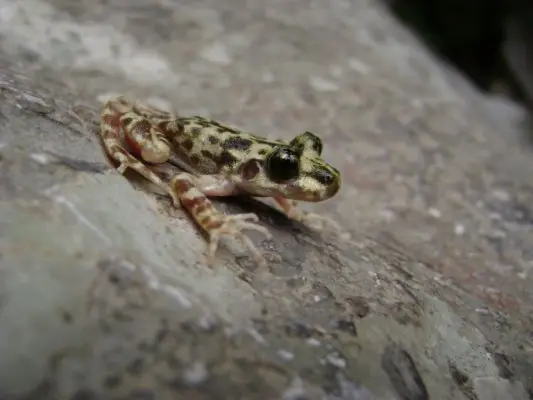
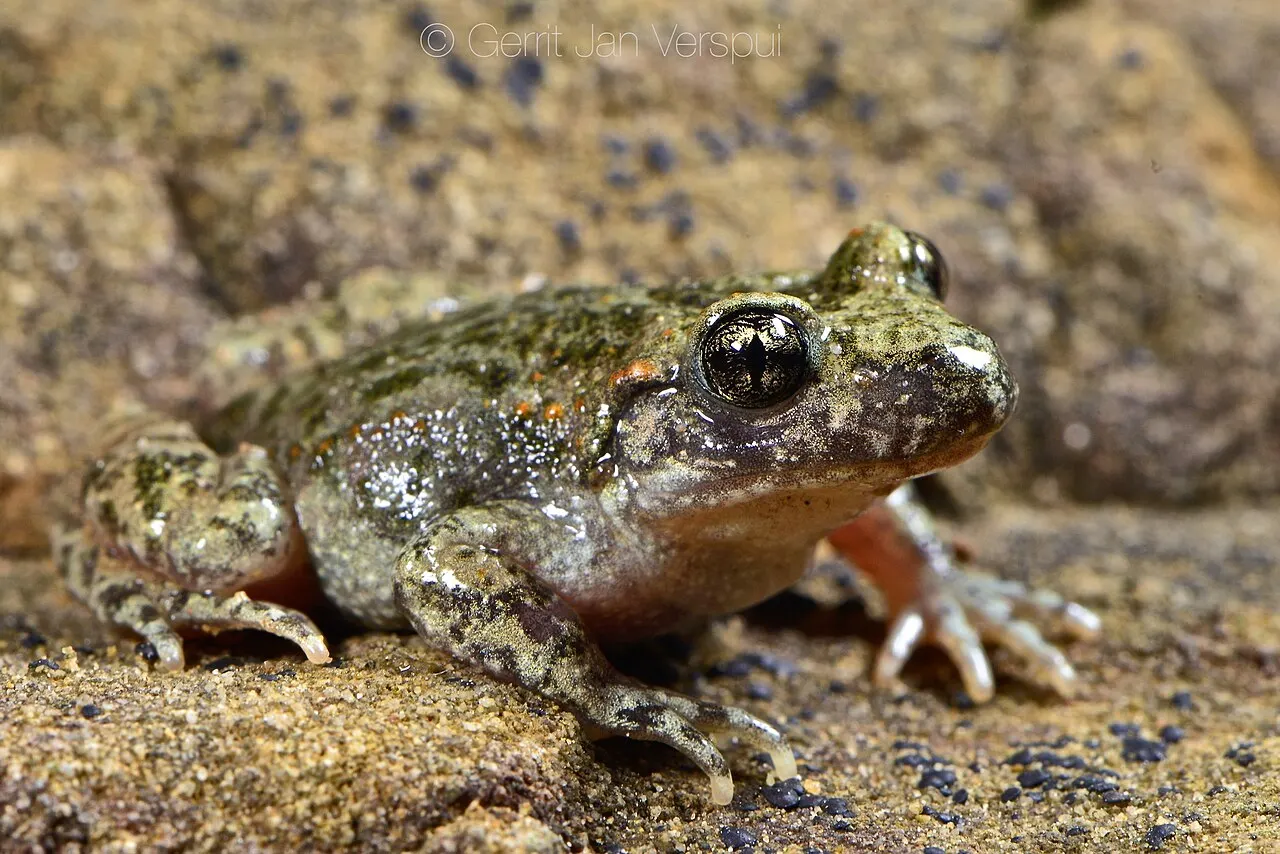
Alytes maurus is a small, stocky frog. The back may be brown, green or whitish, sometimes with dark spots. Males are 34 to 45 mm long at Bab Taza in the Rif, and seven males measured on Jebel Tazekka averaged 40 mm. Two females measured 36 and 47 mm, and metamorphs measure about 25 mm.
Compared with the common midwife toad (Alytes obstetricans) of Europe, it is smaller and more slender, with longer, thinner toes. Georges Pasteur and Jacques Bons described it in 1962.
Where it lives
It is found only in northern Morocco, in the Rif Mountains, which include its type locality at Talassemtane, and in the Middle Atlas, where it is limited to the Tazekka and Bouiblane massifs. Records run from about 200 m to roughly 2,000 m above sea level, mostly at middle elevations. The IUCN lists Algeria as well. A species review treats the Algerian record as doubtful, because it rests on misidentified animals, and recent searches near Tlemcen did not find the species.
Within those mountains it lives on karst and rocky ground, in forest, scrub, grassland, stone walls and rural gardens, usually close to small streams, pools or springs. The IUCN estimates its extent of occurrence at about 14,500 square kilometres and the area it actually occupies at 104 to 499 square kilometres.
Pins are Wikidata “endemic to” fields. Orange dots, when present, are GBIF occurrence tiles — survey bias included.
How it lives
It is a nocturnal, ground-living frog that shelters in crevices, caves and under stones, mostly near small streams. Males call at dusk and through the night with a short whistle, even while carrying eggs. It is the only North African frog or toad with highly developed parental care.
The male winds a string of eggs around his ankles and carries it for about three weeks. Clutches usually hold 25 to 30 eggs, although a male on Jebel Tazekka carried about 35 and one at Jebel Ajnane carried 60 to 70. When the tadpoles' internal gills have developed, he enters the water and the eggs hatch. Breeding seasons vary by region, from early February on the Tingitana Peninsula in the far north to February to April in the western Rif.
Why it is in trouble
The 2021 assessment records a decreasing population trend and a fragmented population. It lists small-scale farming, commercial and tourism development, drought, extreme temperatures, more frequent fires, and water taken from streams for homes and farms. Breeding pools are shrinking, and in some places larval numbers have dropped sharply, which may signal local losses. In the peri-urban Rif, pollution, overgrazing and the introduced mosquitofish (Gambusia holbrooki) add to the pressure.
Disease is a further worry. A study led by Barbora Thumsova in the African Journal of Herpetology found the chytrid fungus Batrachochytrium dendrobatidis at several distant sites in Morocco and reported the first evidence of deadly chytridiomycosis in this toad, although it recorded no population declines. Its niche model rated the Rif and Middle Atlas as highly suitable for the fungus. A five-year monitoring study, cited in a species review, heard calling at only 1 of 7 known populations.
What is being done
The toad occurs in at least one protected area, and the IUCN calls for site protection and management and for resource and habitat protection. Only about 7 percent of its range lies inside protected areas, according to a 2013 estimate. The IUCN's earlier rating was Near Threatened, in 2009, and the species review notes that its limited range suggests it may be more threatened than that rating implied.
Sources
Written for this catalog in our own words from the sources below, checked against them on 12 November 2026. Population figures are estimates and carry the year they were made. Status and assessment year: IUCN. 2026. The IUCN Red List of Threatened Species. Version 2026-1. iucnredlist.org.