Endangered
Bernier's Vanga
Oriolia bernieri
Bernier's vanga (Oriolia bernieri) is a stout, blue-billed forest bird found only in the lowland rainforest of north-eastern Madagascar. It is the only species in its genus. The IUCN Red List rated it Endangered in 2018, with an estimated 2,500 to 9,999 mature birds and a population that is still falling.
How to recognise it
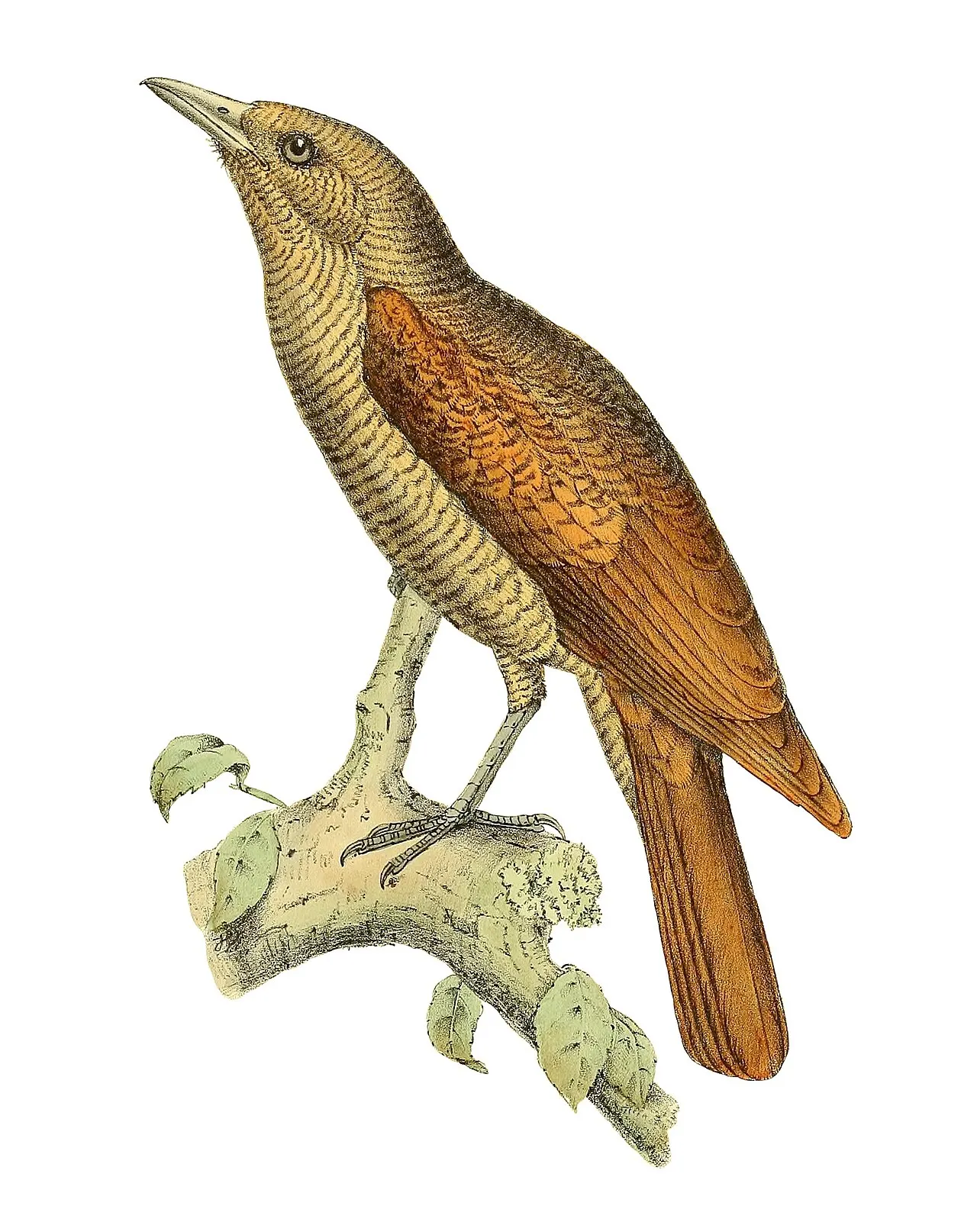
This is a medium-sized vanga, about 23 cm long and weighing roughly 52 to 59 g. The sexes look completely different. The male is glossy black with a blue-green sheen, a pale eye and a stout, pale blue bill. The female is dark tan-rufous, finely barred with black above and on the breast, which gives her a scaled look. Juveniles resemble females, but have dark brown eyes.
A male could be mistaken for a crested drongo, but the pale eye and bill and very different behaviour set it apart. The loud call is a repeated, harsh note, written as schrip. Wing noise in flight has been described as a loud whirring.
Where it lives
It is endemic to Madagascar and lives in lowland evergreen rainforest, mostly undisturbed primary forest. The IUCN gives an elevation range of sea level to 900 m. One description of its range runs from Marojejy National Park in the north-east southward to roughly the Rianala River, and it is rare to uncommon and patchy within that area.
The IUCN counts 11 to 100 locations and describes the population as severely fragmented.
Pins are Wikidata “endemic to” fields. Orange dots, when present, are GBIF occurrence tiles — survey bias included.
How it lives
Bernier's vanga forages high in tall trees. It can cling to near-vertical trunks like a woodpecker, levers bark and moss off branches, and picks prey from the leaf bases of pandanus and palms. It's seen in pairs or in mixed flocks, mostly with larger vangas. It eats spiders, crickets and cockroaches, plus small vertebrates, particularly geckos.
Most of what's known about breeding comes from four nests on the Masoala Peninsula, found between 1997 and 1999 and described in a paper in the journal Ostrich by Russell Thorstrom and Lily-Arison Rene de Roland. The cup nests are made of roots, palm fibre, dry leaves and moss and are reported to sit 10 to 14 m up in palm clumps. A clutch of 3 eggs is reported. At one nest incubation took 17 days and the young fledged 17 days after hatching. Of 82 prey items identified at nests, 91% were invertebrates.
Parenting can be a group effort. At the 1998 nest the female incubated about 53% of the time, an adult male about 32% and an immature male about 4%. That nest failed when a Madagascar harrier-hawk ate the eggs on day 13 of incubation.
Why it is in trouble
Forest is the whole story. The IUCN lists habitat alteration and shifting agriculture as threats, along with large-scale unintentional harvest. It records a continuing decline in habitat area and a population that is falling. Its Endangered rating (criteria A3bc) rests on a projected population reduction of 50 to 79% in future. The 2018 population estimate of 2,500 to 9,999 mature birds is a range, not a count.
What is being done
The species occurs in at least one protected area, and the IUCN notes that conservation sites have been identified across its whole range. Awareness work is listed as a conservation need, but the assessment records no recovery plan, no systematic monitoring scheme, no recent education programme, no captive breeding, and no international legislation or trade controls.
Sources
Written for this catalog in our own words from the sources below, checked against them on 12 November 2026. Population figures are estimates and carry the year they were made. Status and assessment year: IUCN. 2026. The IUCN Red List of Threatened Species. Version 2026-1. iucnredlist.org.




