Endangered
Benitochromis ufermanni
Benitochromis ufermanni
Benitochromis ufermanni is a small cichlid fish known only from rivers and creeks in north-west Cameroon, close to Korup National Park. The IUCN Red List has it as Endangered (assessed 2010). Both parents look after the eggs and young in their mouths, and little else about its life has been studied.
How to recognise it
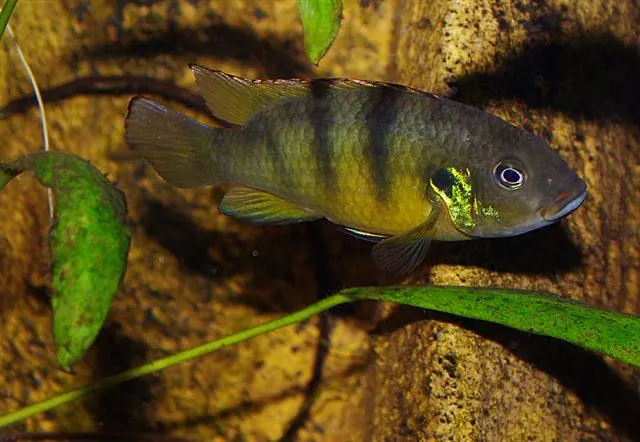
This is a modest fish. Males top out at about 8 cm standard length (body length without the tail fin). The dorsal fin membrane is pale rather than carrying a dense black band, and the bars along the flanks are usually strongly marked.
Males show rows of dark spots across the tail fin. Females tend to have a yellow-orange belly. Anton Lamboj described the species in 2001, the same year he set up its genus.
Where it lives
It is recorded from rivers and creeks in north-west Cameroon, in the region around Korup National Park. The Red List counts Cameroon as its only country, treats it as endemic there, and lists permanent rivers and streams, as well as seasonal or intermittent ones, as its habitat. The assessment records that it occurs in at least one protected area. GBIF holds only 11 occurrence records for the species, a small number that points to how little it has been surveyed.
The genus Benitochromis has six species and ranges across Cameroon and Equatorial Guinea, including Bioko Island. The genus name comes from the Benito River in Equatorial Guinea.
Pins are Wikidata “endemic to” fields. Orange dots, when present, are GBIF occurrence tiles — survey bias included.
How it lives
In aquarium terms it is a pair-bonding mouthbrooder that spawns on open ground rather than in a cave. The female takes up the eggs a little after laying, and both parents can then carry and guard the brood. FishBase describes it as living in tropical fresh water, between the bottom and open water.
Diet and wild breeding seasons are not described in the sources available for this species.
Why it is in trouble
The Red List places it in the Endangered category under criteria B1ab(iii)+2ab(iii). That is a range-based listing: the fish occupies a small area, and the quality of its habitat is judged to be declining. The population trend is recorded as unknown, and no population estimate exists.
The assessment names ecosystem degradation as the stress on the species and lists a future threat of unrecorded motivation, scored as negligible in impact. No specific conservation actions are listed for it.
Name
The species name honours Alfred Ufermann, a German aquarist who died in 2002 and who helped draw Lamboj into the study of West and Central African cichlids.
Sources
Written for this catalog in our own words from the sources below, checked against them on 12 November 2026. Population figures are estimates and carry the year they were made. Status and assessment year: IUCN. 2026. The IUCN Red List of Threatened Species. Version 2026-1. iucnredlist.org.




