Endangered
Yenyuan stream salamander
Batrachuperus yenyuanensis
The Yenyuan stream salamander (Batrachuperus yenyuanensis) is a long-tailed salamander of cold, high mountain streams and ponds in southwestern Sichuan, China. The IUCN Red List rated it Endangered in 2020, with a decreasing population, and names deliberate collection of the animals as a threat.
How to recognise it
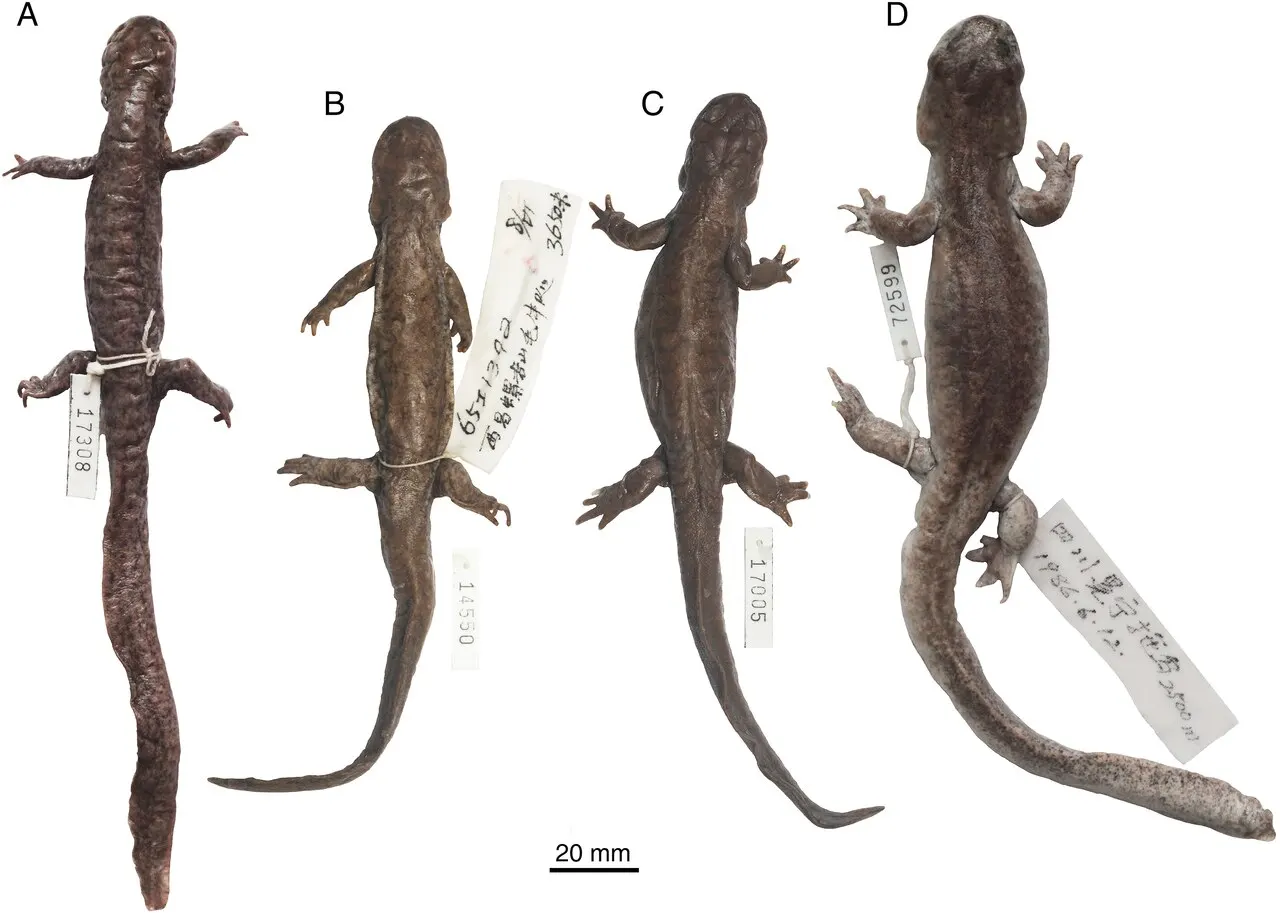
It's a member of the family Hynobiidae, the Asian salamanders. A 2019 study in PLoS One gives adults as 144 to 231 mm long in total, with a tail longer than the head and body. The male specimen on which the species was named in 1950 measured 168 mm, of which 79 mm was snout to vent.
Where it lives
The species is endemic to Sichuan, along the eastern edge of the Qinghai-Tibetan Plateau. It has been recorded around Yanyuan, Xichang, Mianning and Puxiong, and the 2019 study also lists sites in Yuexi and Jiulong counties. The type locality, near Yanyuan, is called Shuangertang in the 2019 study and Bailinshan in older sources.
It lives high. The IUCN gives an elevation range of 2,900 to 4,400 m, while the 2019 study reports records from 2,440 to 4,025 m. Fieldwork in 2018 re-measured the two ponds where the original specimens were collected and put them at 3,902 m and 4,025 m, well below the roughly 4,420 and 4,570 m given in 1950. The Red List lists permanent rivers and streams, freshwater lakes and small freshwater marshes and pools as habitat.
Pins are Wikidata “endemic to” fields. Orange dots, when present, are GBIF occurrence tiles — survey bias included.
How it lives
It is nocturnal, and adults often spend the day hidden under rocks in the water. They eat mainly freshwater shrimp and insects, with some algae and plant seeds. The IUCN records it as not migratory.
Why it is in trouble
The assessment gives a decreasing population trend and uses criterion A2d, which rests on actual or potential levels of exploitation. It records a past population reduction of about 50 percent. The listed threat is intentional use with the salamander itself as the target, and the stresses are animal deaths and degraded ecosystems. The animal is used in human and veterinary medicine, nationally and for subsistence. No population size is given, and the species is not considered severely fragmented. Assessors used a generation length of 5 to 7 years.
What is being done
It occurs in at least one protected area. The assessment also lists several conservation actions, among them harvest and trade management, awareness work, livelihood alternatives for people who collect it, and captive breeding.
Sources
Written for this catalog in our own words from the sources below, checked against them on 12 November 2026. Population figures are estimates and carry the year they were made. Status and assessment year: IUCN. 2026. The IUCN Red List of Threatened Species. Version 2026-1. iucnredlist.org.



