Endangered
Baronia
Baronia brevicornis
The short-horned baronia is a Mexican butterfly that stands alone in its genus and its subfamily, a lineage sister to all other swallowtails. It lives in patches of tropical dry forest in south-western Mexico and is listed as Endangered (2018 assessment).
A lone survivor of an old lineage
Baronia brevicornis is the only species in the genus Baronia and the only member of its own subfamily, Baroniinae. A 2018 molecular study placed it as the sister group to all other swallowtails. A 2021 paper on a Morelos population calls it the oldest known butterfly species endemic to Mexico.
The genus is named for Oscar Theodor Baron, who collected the first specimen in the Sierra Madre. Osbert Salvin described the species in 1893. Two subspecies are recognised, one of them (rufodiscalis) from Chiapas.
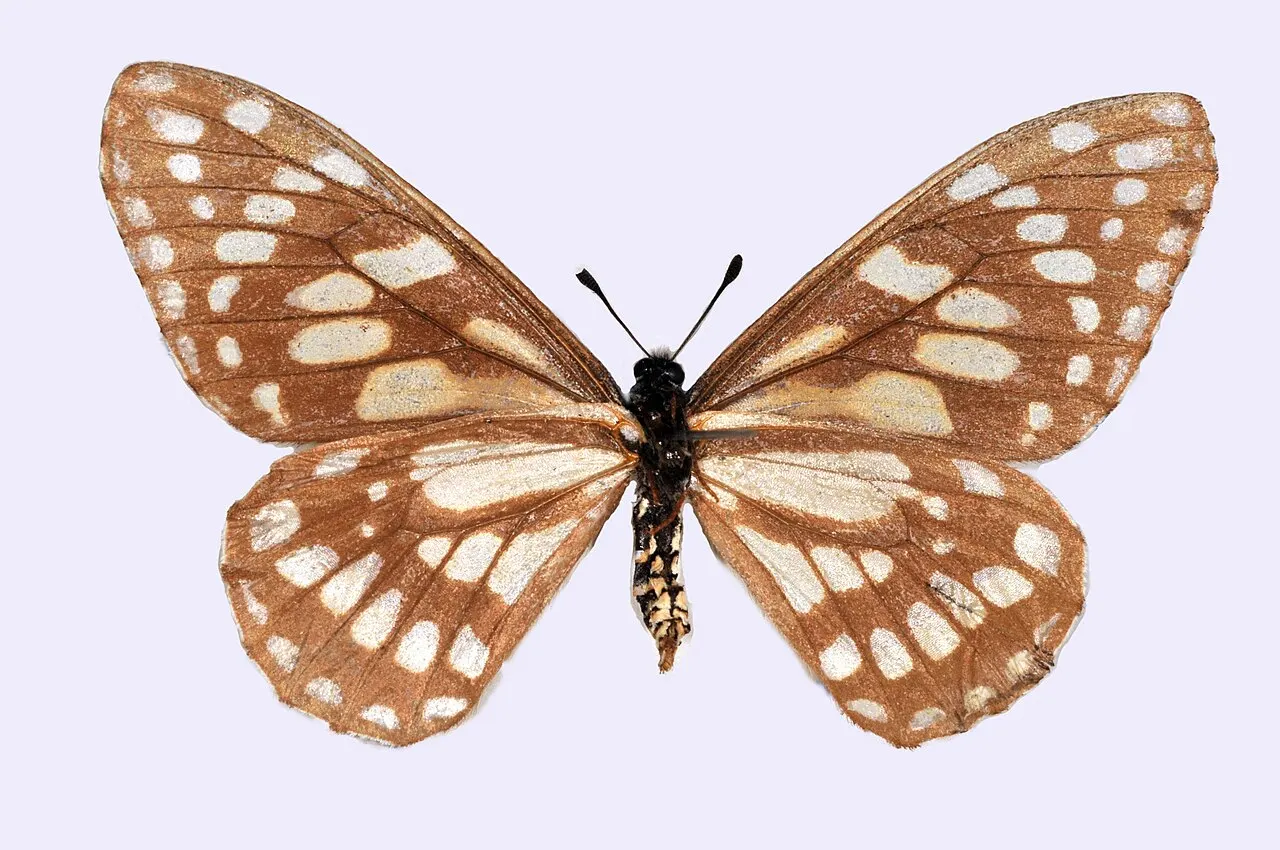
Adults vary a lot in colour. In the Morelos population, males came in three morphs (dark brown, light brown and yellow) and females in three (brown, melanic and orange). The paper suggests this may be the most complex polymorphism reported for a species from such an old lineage. Females reportedly carry a scent organ on the abdomen.
Where it lives
The Red List records it from Chiapas, Colima, Guerrero, Jalisco, Michoacan, Morelos, Oaxaca and Puebla, an estimated 15 to 26 locations between sea level and about 1,400 m. The extent of occurrence is put at roughly 202,870 square kilometres, but the area actually occupied is estimated at only 308 square kilometres.
That gap is the heart of its story. The butterfly lives in tropical dry forest, and field studies show it occurs in small, scattered patches rather than across the forest. Each occurrence site seems to be its own separate population.
Pins are Wikidata “endemic to” fields. Orange dots, when present, are GBIF occurrence tiles — survey bias included.
A fussy diet
Caterpillars feed on the acacia-type tree Vachellia campechiana (also known as Acacia cochliacantha), a host plant reportedly unique among swallowtails and their relatives. The tree is common in Mexican dry forest, yet a 2015 study in The Canadian Entomologist found no butterfly populations where the tree covers less than two thirds of a locality. Even in the most favourable zones the butterfly occupied no more than 2.5% of the available habitat. In good patches, adult density averaged about 840 per hectare.
A 3-year study in the Sierra de Huautla, Morelos (sampling in 2014, 2015 and 2017) found adults only on host-tree patches that also had nectar plants nearby. Adults fed at five plants, including Bursera copallifera, Pithecellobium dulce and Guazuma ulmifolia. Patches with no nectar sources held no butterflies. Males made up about 81% of 1,577 captured adults in 2014 and 2015, and 87% of 1,430 marked adults in 2017.
Why it is in trouble
The Red List lists intentional use (collection of the butterfly itself), housing and urban development, and habitat shifting and alteration among the ongoing pressures, though the size of each effect is unknown. The population trend is also unknown. Because the butterfly needs both a particular tree and nearby flowers, and occurrence sites look like separate populations, losing a small patch of forest may remove a whole population.
What is being done
The species occurs in at least one protected area, and the Red List gives site and area management as a conservation action. Researchers on the Morelos population recommend predictive models that account for the food plants of both caterpillars and adults (and soil hardness, which affects adult emergence), checked in the field with mark-release-recapture monitoring and genetic work, to inform conservation plans.
Sources
Written for this catalog in our own words from the sources below, checked against them on 12 November 2026. Population figures are estimates and carry the year they were made. Status and assessment year: IUCN. 2026. The IUCN Red List of Threatened Species. Version 2026-1. iucnredlist.org.




