Endangered
Rough-necked Alligator Lizard
Barisia rudicollis
The rough-necked alligator lizard (Barisia rudicollis) is a live-bearing lizard found only in Mexico, in cool, moist mountain forest in the central highlands. The IUCN Red List assessed it as Endangered in 2007 because of its small range. It remains one of the least studied lizards in its genus.
How to recognise it
This is an alligator lizard, a member of the family Anguidae, a group of long-bodied, armoured-looking lizards. It reaches about 125 mm from snout to vent. The scientific name combines Latin words for rough and neck.
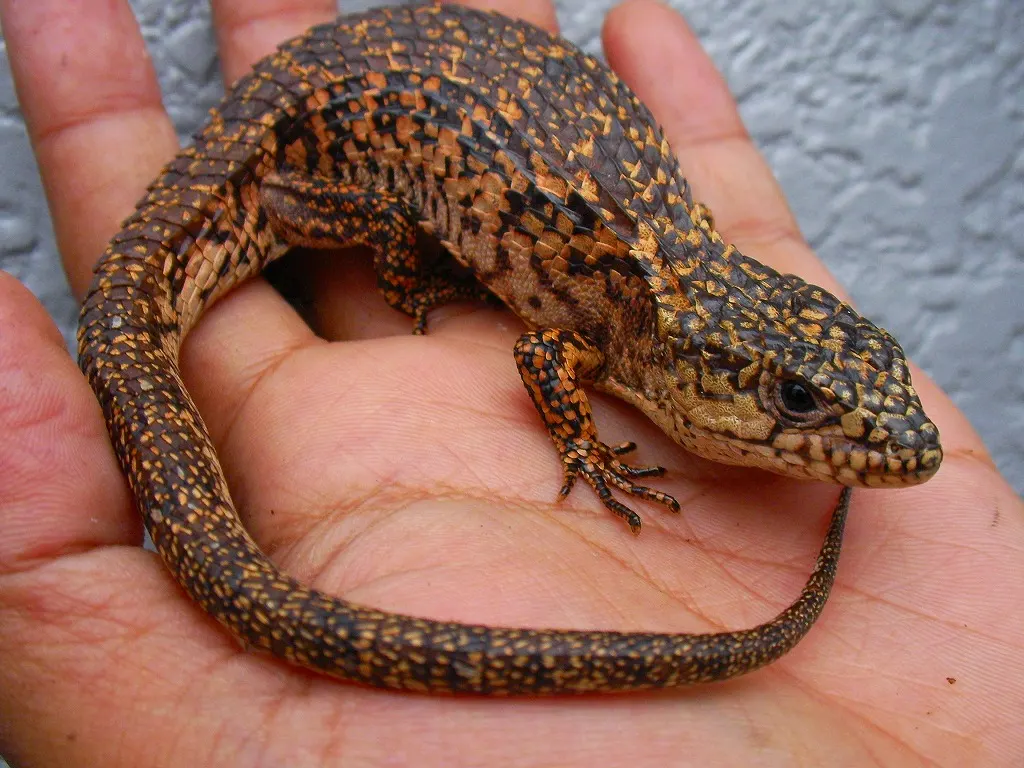
Herpetologists separate it from relatives by scale counts: 14 rows of scales down the back and 14 along the belly, with the nostril scales touching the scale at the tip of the snout. Its close relative Herrera's alligator lizard has a different look. Rough-necked lizards have a dark stripe on the lip and below the eye, dark spots on the throat and sides, a pale to dark brown or greyish back and larger white marks on the head and limbs, while Herrera's has an olive-green back and no dark marks below the eye.
Where it lives
It is found nowhere outside Mexico. A thesis on the genus places it in moist forest in the central part of the Trans-Mexican Volcanic Belt, in the State of Mexico and Michoacán, and the IUCN assessment lists subtropical or tropical moist montane forest as its only suitable habitat.
Wiegmann described the species in 1828 with a type locality of just "Mexico". In 1950 Smith and Taylor narrowed it to Hacienda de la Gavia, in the State of Mexico. Public database records (89 in GBIF) include the State of Mexico, Morelos and Michoacán, but the Morelos ones may belong to a different species.
Pins are Wikidata “endemic to” fields. Orange dots, when present, are GBIF occurrence tiles — survey bias included.
A species that was split in two
For years, lizards from more than one place were filed under this name. In 2002 Alejandro Zaldívar-Riverón and Adrián Nieto-Montes de Oca published a study of variation in the species that also described a new lizard from central Mexico, Herrera's alligator lizard (Barisia herrerae). Its type locality is near Ocuilán, in the State of Mexico, at about 2,350 m.
The thesis, written before the new species had a name, reports that specimens of it had been mislabelled as rough-necked lizards in Mexican collections, and places it in Morelos and neighbouring parts of the State of Mexico. Some older Morelos records under this name may therefore belong to Herrera's. The thesis found the two lizards look alike, but sequence data suggested a less close relationship than that. It also counted 35 mitochondrial DNA differences found only in the rough-necked alligator lizard.
How it lives
Very little has been written about its daily life. Females are ovoviviparous, meaning the eggs are kept inside the body and the young are born live. Beyond that, the published record is thin. A 1990 note described observations of one animal and its habitat, and a 2001 paper in the Southwestern Naturalist by Zaldívar-Riverón and Nieto-Montes de Oca covered its natural history and distribution. No population estimate exists.
Why it is in trouble and what is being done
The 2007 assessment rated it Endangered under criterion B1ab(iii), which applies to a small geographic range combined with declining habitat quality. The threats it lists are all scored as low impact: crop farming, grazing and ranching, tourism and recreation areas, and persecution by people. The population trend was recorded as stable at that time, though no counts back this up.
The assessment names site protection, site management and awareness-raising as relevant conservation actions, and lists none in place. No dedicated program for this species is described. The assessment is now close to two decades old.
Sources
Written for this catalog in our own words from the sources below, checked against them on 12 November 2026. Population figures are estimates and carry the year they were made. Status and assessment year: IUCN. 2026. The IUCN Red List of Threatened Species. Version 2026-1. iucnredlist.org.




