Endangered
Jerdon's baril
Barilius canarensis
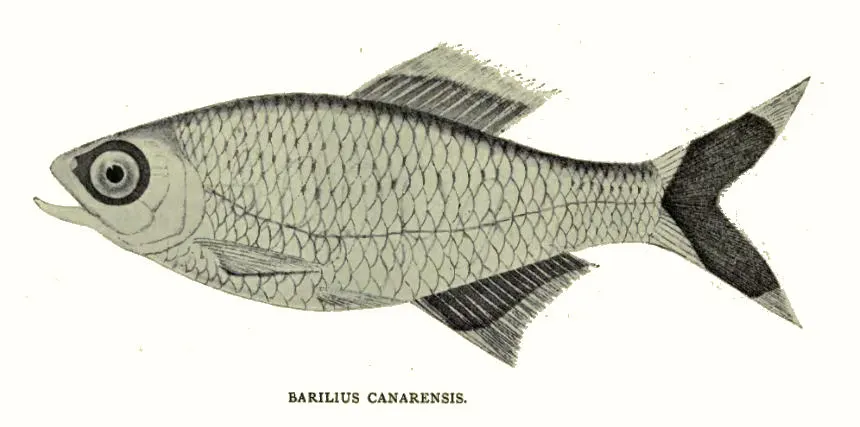
Jerdon's baril (Opsarius canarensis, formerly Barilius canarensis) is a small river fish of south-west India, found in Karnataka and probably northern Kerala. The IUCN Red List rated it Endangered in 2011, with a decreasing population and four locations.
How to recognise it
This is a slim, streamlined minnow relative. Two rows of bluish-green spots run along the body, with 9 to 13 spots in the upper row and 3 or 4 smaller ones near the front in the lower row. The dorsal and anal fins have broad white edges.
Females are duller and slightly larger than males, and thicker-bodied when carrying eggs. Breeding males grow small bumps on the head and show orange on the lower body. It reaches about 13 cm in standard length.
Where it lives
Thomas Jerdon described the species in 1849 from the Canara region of southern India, a stretch of coast roughly 300 km long. It probably occurs across southern Karnataka and northern Kerala, but it has been confirmed with certainty only from the Netravathi and Tungabhadra river systems in Karnataka. The IUCN lists Kerala as a place where its presence is uncertain.
It favours clean, well-oxygenated, moderate to fast streams with gravel, cobbles, boulders or bare rock. One recorded site was a stream at about 650 m in Kudremukh National Park. The IUCN assessment gives an area of occupancy of 300 to 400 square kilometres.
Pins are Wikidata “endemic to” fields. Orange dots, when present, are GBIF occurrence tiles — survey bias included.
How it lives
In the wild it feeds mainly on insects taken at the water surface. It is a fast, vigorous fish that lives in shoals with a pecking order, and a strong jumper. Hobbyists report that large, cool water changes can trigger spawning, but no reports of young being raised in aquariums appear to exist.
Why it is in trouble
The assessment records a decreasing population and a continuing decline in the area it occupies. Listed threats are large-scale harvesting and herbicides and pesticides. Other sources add domestic and industrial pollution, introduced species and large-scale sand mining in its rivers.
In the aquarium trade the name has also been applied to two related fishes, Opsarius ardens and O. malabaricus, which blurs the picture of how much of this species is collected.
What is being done
The assessment lists resource and habitat protection, captive breeding, livelihood alternatives for harvesters and a genome resource bank among conservation actions. It records no recovery plan, no monitoring scheme and no captive population, and conservation sites had been identified over only part of its range.
Sources
Written for this catalog in our own words from the sources below, checked against them on 12 November 2026. Population figures are estimates and carry the year they were made. Status and assessment year: IUCN. 2026. The IUCN Red List of Threatened Species. Version 2026-1. iucnredlist.org.




