Critically Endangered
Barbados Leaf-toed Gecko
Phyllodactylus pulcher
The Barbados leaf-toed gecko (Phyllodactylus pulcher) is a small, cream-coloured lizard found only on Barbados. It was feared extinct until a pair was found in 2011. The IUCN Red List assessed it as Critically Endangered in 2016, with a declining, fragmented population occupying about 0.31 square kilometres.
How to recognise it
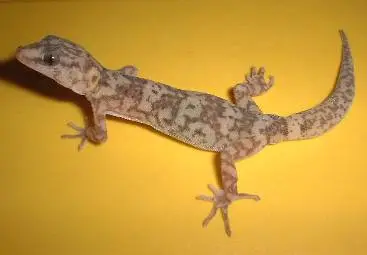
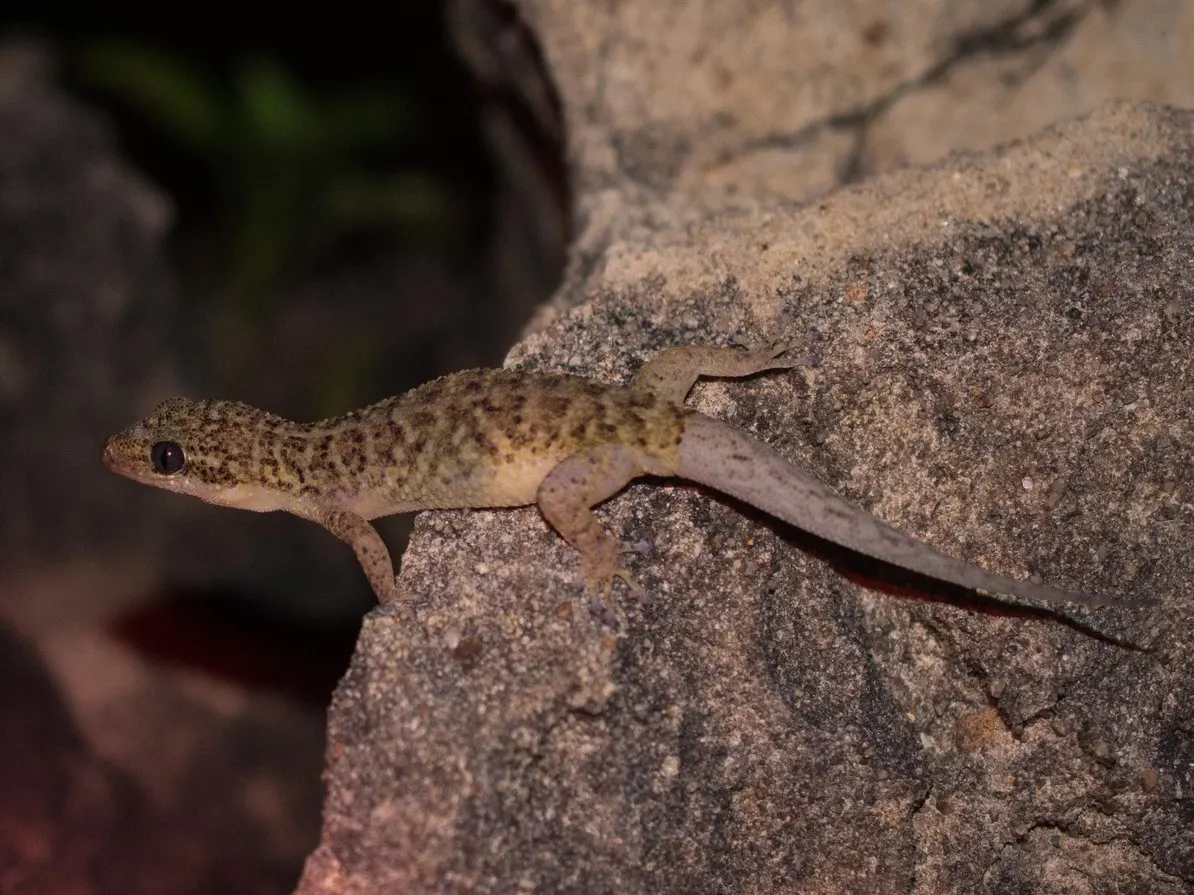
It's a modest gecko, reaching at most 62 mm from snout to vent. The base colour is cream, with a dark stripe running from the nostril through the eye to the shoulder. The back varies between individuals, carrying brown mottling, broad brown crossbands or lengthwise brown lines.
It is the only leaf-toed gecko in the Lesser Antilles. John Edward Gray described it in 1830.
Where it lives
The species is endemic to Barbados. Recent records come from rocky coastal areas with crevices, within about 50 m of the sea but outside the spray zone, and from Culpepper Island, a tiny uninhabited islet off the Atlantic coast in St Philip parish. The IUCN assessment describes four subpopulations, at least one of them almost certainly too small to survive on its own.
A night-time survey of microhabitats found the gecko strongly favours structurally complex rocky ground with plenty of natural crevices. Older accounts suggest it was once widespread and often seen in and around houses, but it has since vanished from built-up places.
Pins are Wikidata “endemic to” fields. Orange dots, when present, are GBIF occurrence tiles — survey bias included.
How it lives
The gecko is active at night, eats insects and spends its time climbing. It has been found on rocks, and occasionally on palm and white cedar trunks near cliff edges.
A University of the West Indies project funded in 2014 by the Mohamed bin Zayed Species Conservation Fund set out to measure its distribution, abundance, diet and microhabitat use, and how much it overlaps with the introduced house gecko.
Rediscovery
The gecko was familiar in the 1700s but has been recorded only rarely since the 1970s, and it was considered probably extinct by 1979. Two animals found in buildings in St Philip in the early 1990s were the last sightings until 2011.
On 2 October 2011 the Barbadian naturalist Damon Corrie and his family found a pair. A local news report of the time did not name the site, saying the family feared collectors would go there. Other sources place the find on Culpepper Island, where the IUCN says the gecko lives in an area of only about 130 square metres, with a mark-recapture estimate of as few as 10 to 20 animals.
Why it is in trouble
Resort and residential development along the coast is the main threat to its remaining habitat. The introduced house gecko (Hemidactylus mabouia) is listed as a threat linked to rapid declines, and other exotic animals, including rats, cats and cane toads, have been seen hunting where the gecko survives.
A 2020 study in Neotropical Biodiversity by Williams, Horrocks and Pernetta adds nuance. The house gecko appears to succeed because it uses a wider range of habitats, rather than by pushing the native gecko off cliffs. The study called natural cliff habitat the native gecko's last refuge and recommended protecting it and tightening biosecurity.
What is being done
A recovery plan was prepared in 2013. The IUCN lists site protection, site management and captive breeding as actions needed, along with control of invasive species and resort planning that takes the gecko into account. The 2014 project also aimed to identify retreat-site preferences, to inform habitat management and possible future reintroductions.
Sources
Written for this catalog in our own words from the sources below, checked against them on 12 November 2026. Population figures are estimates and carry the year they were made. Status and assessment year: IUCN. 2026. The IUCN Red List of Threatened Species. Version 2026-1. iucnredlist.org.