Endangered
Austrolebias adloffi
Austrolebias adloffi
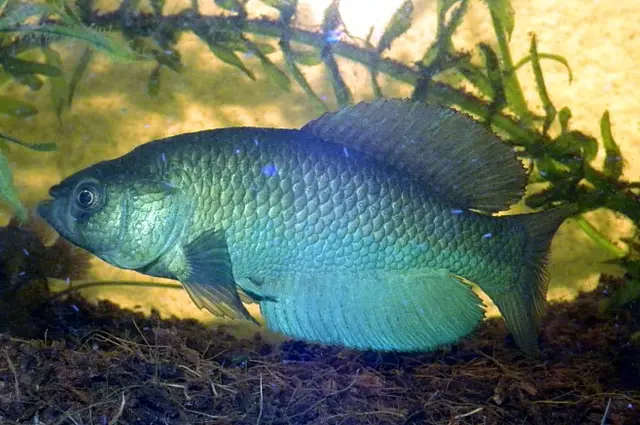
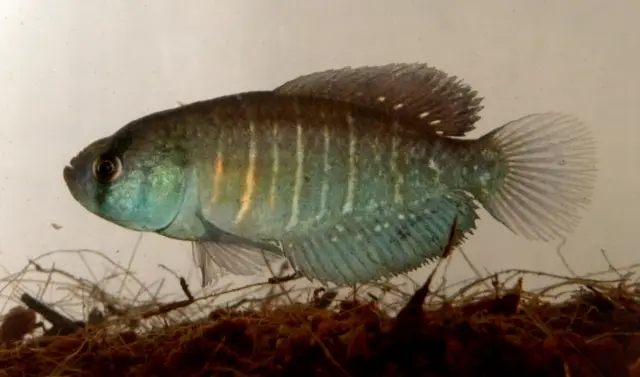
Austrolebias adloffi is a small annual killifish from the lowlands around Porto Alegre in southern Brazil, where it lives in seasonal pools and wetlands. The IUCN Red List rated it Endangered in 2022. Males are blue with dark bars, and it is the type species of its genus.
How to recognise it
As in most killifish, males are larger and showier than females. The biggest male measured in a 2022 taxonomic study was 45.9 mm (standard length), the biggest female 37.3 mm. Males have light blue sides crossed by 7 to 14 narrow black bars, dark bars on the head, and dark fins with a black rear edge. Females are light yellowish brown, with pale grey bars or rows of dark grey spots.
Technical features that separate it from its relatives include a dorsal fin that starts behind the start of the anal fin in both sexes, and 27 to 30 vertebrae.
Where it lives
The species is known from the lower Jacui and Guaiba basin in Rio Grande do Sul, including the lower Gravatai, dos Sinos and Cai river drainages of the Laguna dos Patos system. Museum and survey records cluster around Porto Alegre, with others from places such as Eldorado do Sul, Gravatai, Alvorada and Sao Leopoldo. The type locality is Porto Alegre itself.
Specimens have been collected from a flooded area and a swamp in the Gravatai river basin. The IUCN assessment lists permanent streams, seasonal pools under 8 hectares and shrub wetlands as habitat, and gives the extent of occurrence as about 550 km2. Some references place the species in Santa Catarina, but the IUCN assessment and the occurrence records point to Rio Grande do Sul.
Pins are Wikidata “endemic to” fields. Orange dots, when present, are GBIF occurrence tiles — survey bias included.
How it lives
It is an annual killifish, a group tied to pools that fill with rain and later dry out. FishBase describes this species as a bottom spawner, with eggs taking roughly 3 to 5 months to incubate, and lists its water temperature range as 20 to 24 degrees C.
A laboratory study of fish hatched at 22 degrees C reportedly found an average lifespan of around 11 months, with none surviving beyond 14 months.
Why it is in trouble
The Red List assessment records a severely fragmented population and a continuing decline in habitat area. It names two ongoing threats, modification of natural ecosystems and an unspecified other threat, both rated low impact. The trend in numbers is listed as unknown. Small seasonal wetlands near a large city are easy to lose.
What is being done
The species occurs in at least one protected area, and conservation sites have been identified across part of its range. A systematic monitoring scheme is recorded as in place. The assessment lists resource and habitat protection, site protection, and national-level action as the measures needed, and calls for research on population size, threats and life history.
Sources
Written for this catalog in our own words from the sources below, checked against them on 12 November 2026. Population figures are estimates and carry the year they were made. Status and assessment year: IUCN. 2026. The IUCN Red List of Threatened Species. Version 2026-1. iucnredlist.org.