Endangered
Yellow-spotted Ground Snake
Atractus duboisi
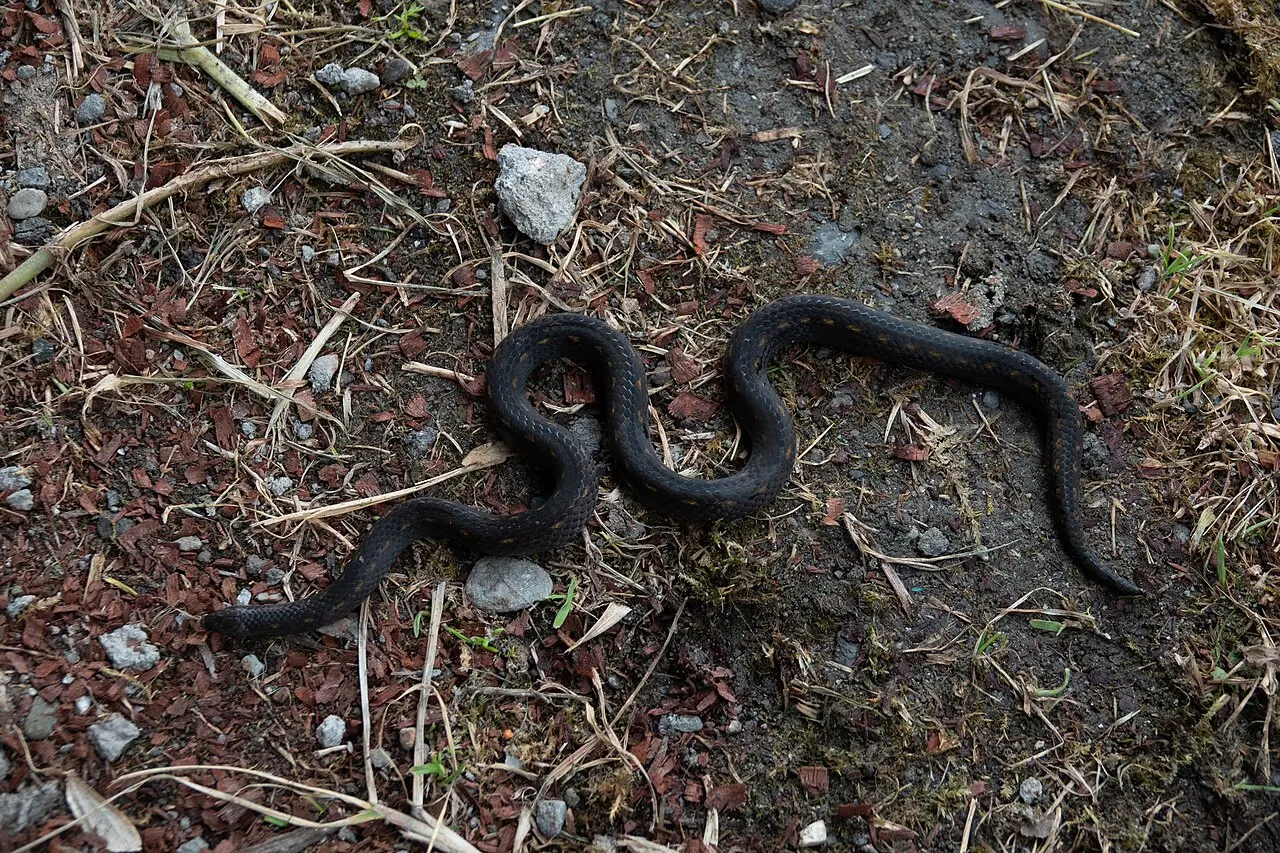
The yellow-spotted ground snake, Atractus duboisi, is a small, semi-burrowing snake found only on the eastern slopes of the Andes in northern Ecuador. It has a dark brown back with yellowish spots and a bright yellow belly. The IUCN Red List assessed it as Endangered in 2017 because its range is tiny.
How to recognise it
Adults are small, reaching about 46 cm in males and 49 cm in females, measured nose to tail tip. The head is rounded and about as wide as the neck, the eyes are small, and the body has 15 rows of scales at midbody. The back is dark brown with small yellowish spots along the sides. The belly is bright yellow with a black line down the middle.
Three similar ground snakes share its range, Atractus touzeti, A. ukupacha and A. zgap. They have lines or crossbars on the back rather than spots, and their bellies lack a lengthwise line.
Where it lives
The snake is endemic to Ecuador, known only from the Cordillera Real on the Amazon side of the Andes in Napo Province, from around Baeza to the Cordillera de Guacamayos. One Ecuadorian reference puts its range at about 925 square kilometres. The IUCN estimates its extent of occurrence at about 567 square kilometres, with two locations between roughly 1,500 and 2,200 m above sea level.
It lives in cloud forest, from old growth to heavily disturbed patches, and also turns up in clearings, cultivated fields and around rural houses. The IUCN lists lowland and montane moist forest as habitat and says it occurs in at least one protected area. The Ecuadorian reference reports that about 73 percent of its potential distribution lies within three protected areas: Antisana Ecological Reserve, Cayambe Coca National Park and Sumaco National Park.
Pins are Wikidata “endemic to” fields. Orange dots, when present, are GBIF occurrence tiles — survey bias included.
How it lives
This is a semi-burrowing snake that is usually active at night, and it is often seen crossing roads and trails. By day it hides under logs, rocks and soft soil. When threatened it tries to flee or tucks its head beneath its coils, and it may jab with its tail when handled. It is listed as egg-laying, though that is not directly confirmed, and one gravid female carried two eggs. The only known predator is the barred hawk.
Why it is in trouble
The range is small and shrinking. The 2017 assessment records a continuing decline in the area it occupies, and names large dams as an ongoing threat to a minority of the range, with very rapid declines expected where they apply. The Ecuadorian reference also cites expansion of farming and deaths on roads. The population trend is listed as unknown, and no population counts exist.
The species has a muddled history. Georges Boulenger described it as Rhabdosoma duboisi in 1880, from a male specimen in a Belgian museum that was received as a gift in 1874 with no locality recorded. Savage folded it into another species in 1960, and a 2009 study by Passos and colleagues restored it as a valid species.
Sources
Written for this catalog in our own words from the sources below, checked against them on 12 November 2026. Population figures are estimates and carry the year they were made. Status and assessment year: IUCN. 2026. The IUCN Red List of Threatened Species. Version 2026-1. iucnredlist.org.




