Endangered
San Lorenzo harlequin toad
San Lorenzo harlequin toad
San Lorenzo harlequin toad, the San Lorenzo harlequin toad, lives only in cloud forest streams of the Sierra Nevada de Santa Marta in northern Colombia. The IUCN Red List classed it as Endangered in 2023 (it was Critically Endangered in 2004). Its range is small, and the deadly chytrid fungus has not yet been detected there.
How to recognise it
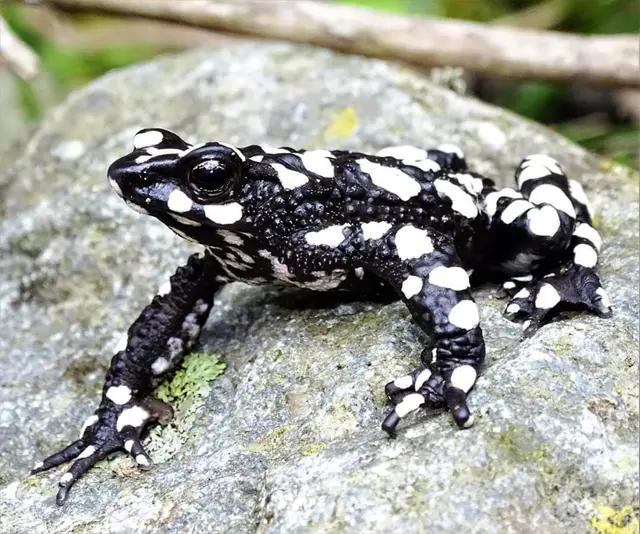
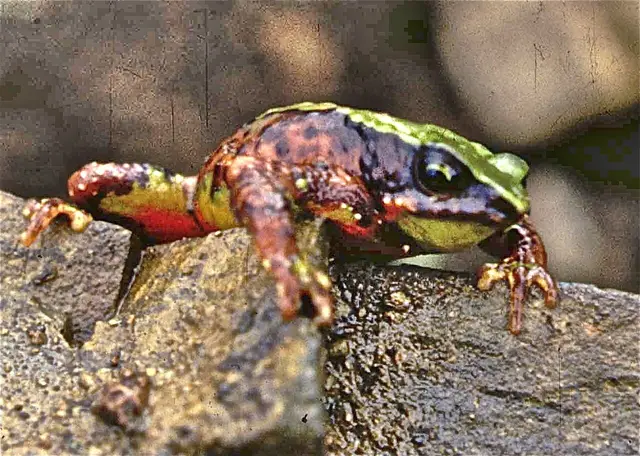
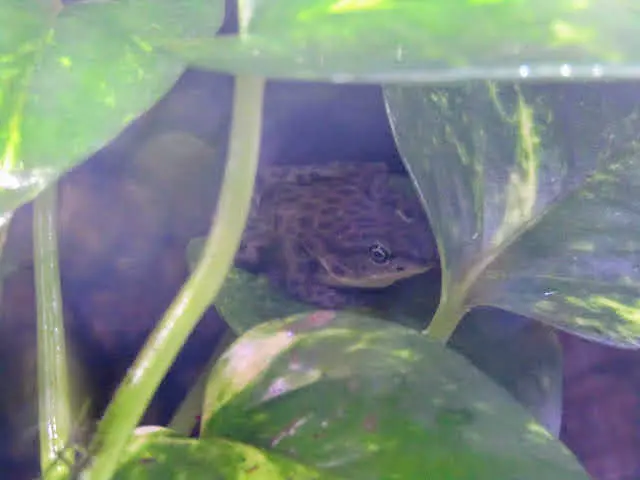
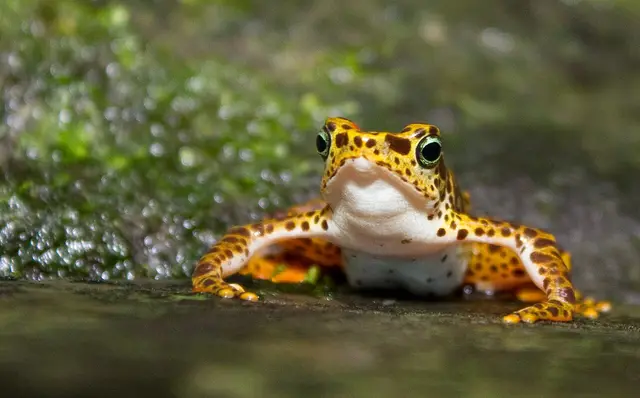
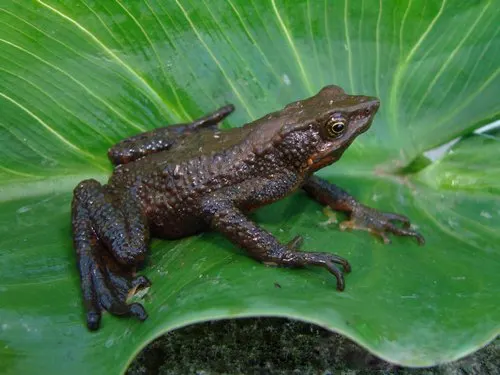
A small, stocky toad. Males measure 32 to 37 mm from snout to vent and females are larger at 45 to 51 mm. The colour runs from light to dark brown, with or without spots, and a brown X-shaped mark can sit over the shoulders. Some animals have a dark stripe down the middle of the back. The back is mostly smooth with granules and small warts. The snout is pointed, there is no visible eardrum, and the toes are webbed.
Where it lives
It is found only in the Sierra Nevada de Santa Marta, an isolated coastal mountain range in the departments of Magdalena, La Guajira and Cesar. The 2023 assessment counts five locations over an extent of about 3,300 square km and gives an elevation range of 1,400 to 2,800 m.
The toad lives in humid montane forest, including streamside forest and closed secondary forest, and breeds in streams. It occurs in Sierra Nevada de Santa Marta National Park and in the El Dorado Nature Reserve next to it.
Pins are Wikidata “endemic to” fields. Orange dots, when present, are GBIF occurrence tiles — survey bias included.
How it lives
Very little is known. At the San Lorenzo research station, surveys between 2008 and 2014 recorded just 10 individuals: 2 males in 2008, 1 female in 2013, and 3 males and 4 females in 2014. Rueda-Solano and colleagues (2016) called it ecologically rare there and suggested the station's high elevation (2,200 m) may be the reason. At lower sites near 1,500 m it is reported as the more common of the two harlequin toads, and Atelopus laetissimus is the rare one.
The survey table lists it as using the ground and shrubs and being active by day and at night.
Why it is in trouble
The Red List assessment lists herbicides and pesticides, small-scale farming, small-scale grazing and ranching, and unintentional effects of large-scale harvest as ongoing threats, and records a continuing decline in the area it occupies.
The biggest worry is the chytrid fungus Batrachochytrium dendrobatidis (Bd), which has wiped out many harlequin toads elsewhere. The assessment lists it as a future threat. So far, surveillance at San Lorenzo from 2008 to 2014 found no Bd and no mass deaths. A 2026 bioRxiv preprint, not yet peer reviewed, tested about 2,200 swabs from 34 localities in and around the range and found no Bd either, though it detected a hypervirulent strain in a water DNA sample from the Serranía de Perijá, less than about 20 km east.
The same preprint sequenced the genomes of 19 A. nahumae from one site and read the results as a large, genetically diverse population, while noting that the data cannot rule out a recent decline followed by a recovery. Its infection trials did not include this species, so how well it would survive the fungus is untested.
What is being done
Part of the range lies inside a national park and a nature reserve. Biosecurity protocols have applied to everyone entering the San Lorenzo station since 2008, and amphibians there were screened for disease twice a year. The Red List assessment lists habitat protection and site protection as conservation actions.
Sources
Written for this catalog in our own words from the sources below, checked against them on 12 November 2026. Population figures are estimates and carry the year they were made. Status and assessment year: IUCN. 2026. The IUCN Red List of Threatened Species. Version 2026-1. iucnredlist.org.
- IUCN Red List assessment, San Lorenzo harlequin toad (2023)
- San Lorenzo harlequin toad (Wikipedia)
- Rueda-Solano et al. 2016, Epidemiological surveillance and amphibian assemblage status at the Estacion Experimental de San Lorenzo, Amphibian & Reptile Conservation 10(1)
- bioRxiv preprint 2026, Imminent invasion of the chytrid fungus threatens the last naive amphibian biodiversity hotspots