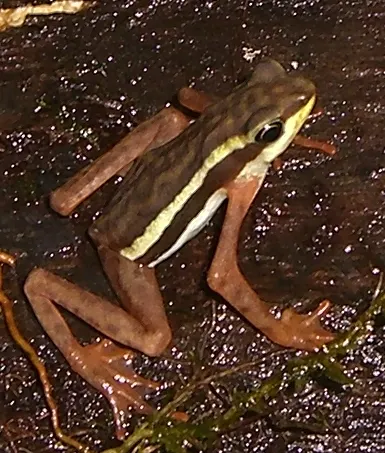
Endangered
Elegant stubfoot toad
Atelopus elegans
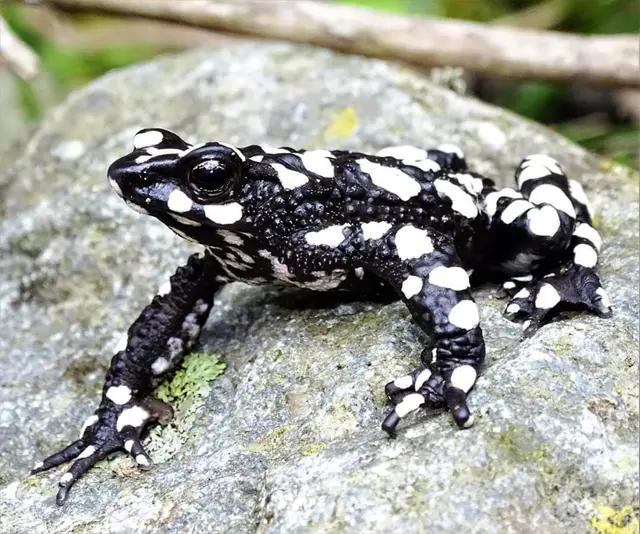
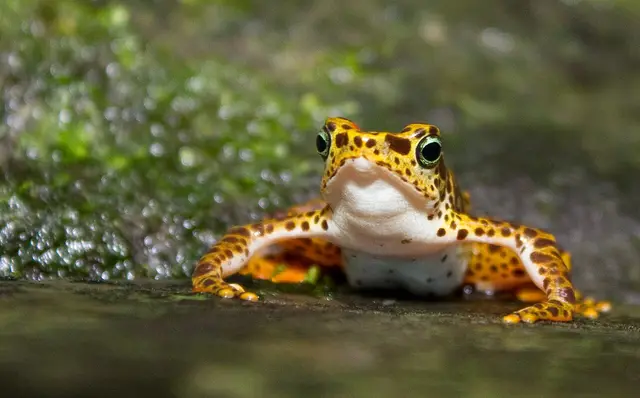
The elegant stubfoot toad (Atelopus elegans), also called the Pacific jambato frog, is a small, brightly marked harlequin toad from northwest Ecuador and Colombia's Gorgona Island. It is listed as Endangered (2019 assessment), after earlier Critically Endangered listings in 2004 and 2010, and has declined sharply in Ecuador.
How to recognise it
Males are tiny, around 21 to 23 mm from snout to vent. Females are noticeably bigger at 31 to 35 mm.
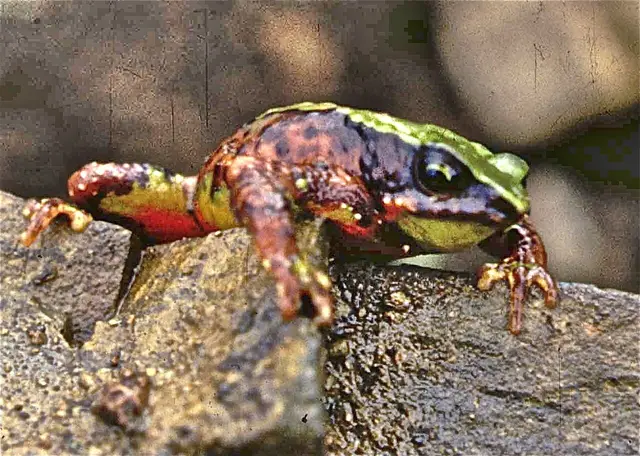
Mainland toads range from dark olive green to bright yellow on the back, with sharp black spots or blotches, and the belly is yellow. Toads on Gorgona Island are brown, a colour difference that has fed a long argument about whether they are really the same species.
Where it lives
On the mainland the species ranges across lowlands and Andean foothills of northwest Ecuador, from about 300 up to 1,140 m. Its habitat is humid lowland and foothill rainforest with permanent streams. Recent Ecuadorian records come from patches of secondary forest, flooded ground, and pastures beside secondary forest.
The other population lives on Gorgona Island, off Colombia's southwest coast, where the toad is reportedly very common. The Red List counts only two locations overall.
Pins are Wikidata “endemic to” fields. Orange dots, when present, are GBIF occurrence tiles — survey bias included.
How it lives
Like other harlequin toads, its tadpoles are gastromyzophorous, meaning they have a sucker on the belly for gripping rocks in flowing water. A 2020 paper in Neotropical Biodiversity described the tadpoles of this species and of Atelopus palmatus, including the sucker, mouth and lateral line system. The tadpoles of the elegant stubfoot toad are tan with brown marks scattered along the body and tail.
Why it is in trouble
Harlequin toads have been hit hard by chytridiomycosis, a fungal skin disease, and it is a possible cause of the elegant stubfoot toad's decline in Ecuador. Only one population there, in Esmeraldas Province, is reportedly known to survive. The Red List also names farming, cattle grazing, housing, and mining as pressures that clear or degrade the forest, and gives the population trend as decreasing.
The Gorgona toads are a puzzle. Researcher Vicky Flechas began working with them in 2007 and found a surprisingly high rate of chytrid infection, yet the toads were still surviving. Antifungal bacteria on their skin killed the fungus in a petri dish, which is the proposed explanation.
What is being done
A captive colony has been set up for conservation. In 2011 and 2012, Centro Jambatu in Ecuador made three breeding attempts with wild-caught elegant stubfoot toads. Only one produced a clutch of eggs, from a female given a hormone injection, while two untreated females produced none.
The Red List records captive breeding, habitat protection, and site management as conservation actions, and says a recovery plan is in place.
Sources
Written for this catalog in our own words from the sources below, checked against them on 12 November 2026. Population figures are estimates and carry the year they were made. Status and assessment year: IUCN. 2026. The IUCN Red List of Threatened Species. Version 2026-1. iucnredlist.org.
- IUCN Red List assessment
- Elegant stubfoot toad, Wikipedia
- Rewild, the confounding lives of Colombia's mountain-dwelling harlequin toads
- Marcillo-Lara et al. 2020, tadpoles of Atelopus elegans and A. palmatus
- Coloma and Almeida-Reinoso 2012, ex situ management of Atelopus in Ecuador, Conservation Evidence