Endangered
Asthenocnemis linnaei
Asthenocnemis linnaei
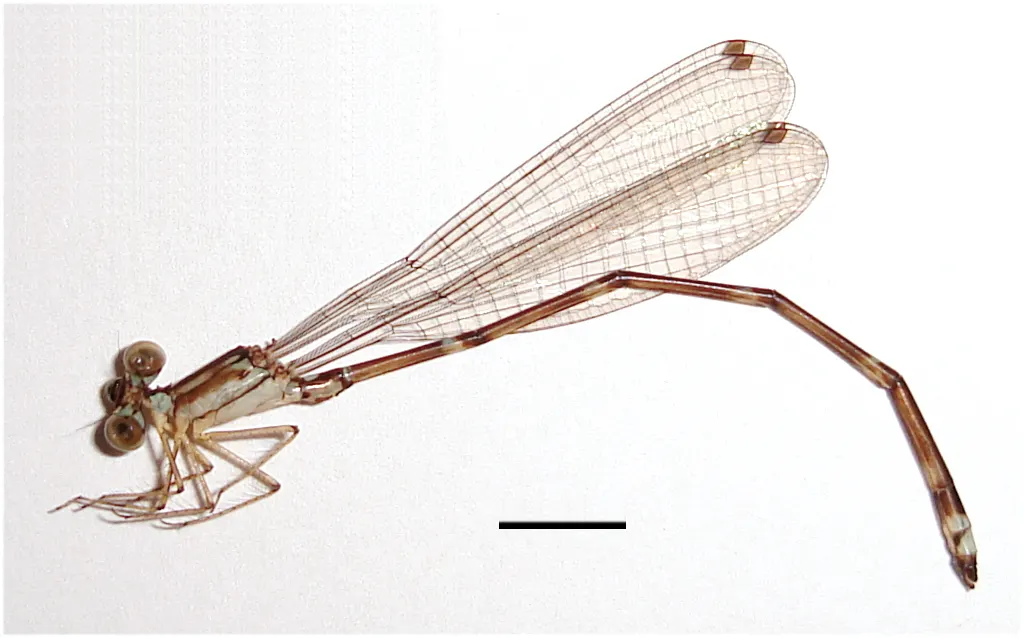
Asthenocnemis linnaei is a medium-sized damselfly, largely brown with blue markings, known only from Dumaran Island in the Philippines. It was described in 2008 from nine males collected in 1995 and 1997. The IUCN Red List rated it Endangered in 2020, with deforestation as the main threat.
How to recognise it
The male is largely brown with blue markings on the head, thorax and abdomen, and yellowish-white legs. Its wings are clear apart from a brown pterostigma. In the eight males measured for the original description, forewings ran 24 to 26 mm and the abdomen 35 to 39 mm.
Two features set it apart from other damselflies of the Palawan region. The inner process of the upper male abdominal appendages carries two teeth, and the prothorax has two nipple-shaped horns. The female has never been described.
Where it lives
All known specimens come from Dumaran, an island in the northeast of the Palawan region, near Araceli. Five males were collected at a creek between 20 and 25 December 1995 at 80 to 150 m, and four on Opoy Hill at 50 m between 28 and 30 March 1997.
The Red List counts two locations. It records nothing about the habitat but treats the species as forest-dependent and classes it under tropical moist lowland forest. The only other species then in the genus, A. stephanodera, is also known from Palawan.
Pins are Wikidata “endemic to” fields. Orange dots, when present, are GBIF occurrence tiles — survey bias included.
Why it is in trouble
The Red List names rampant deforestation on Dumaran, presumably for agriculture and perhaps logging. Satellite images show scattered patches of original forest, and a 1997 survey cited in the species description already described the island's forests as cut into small scattered patches.
Because the forest is shrinking, the Red List infers a continuing decline, although no population has been counted. The assessor notes the species may need to be listed as Critically Endangered if more populations are not found. The describers wrote that it was probably threatened with extinction, and named it after Linnaeus partly to mark the plight of taxonomists who describe species likely to vanish soon.
What is being done
The Red List says the species occurs in no protected area. Its stated priority is to protect the forest that remains on Dumaran, along with searches on the island and in adjacent parts of Palawan for further populations.
Sources
Written for this catalog in our own words from the sources below, checked against them on 12 November 2026. Population figures are estimates and carry the year they were made. Status and assessment year: IUCN. 2026. The IUCN Red List of Threatened Species. Version 2026-1. iucnredlist.org.




