Endangered
Aspidura trachyprocta
Aspidura trachyprocta
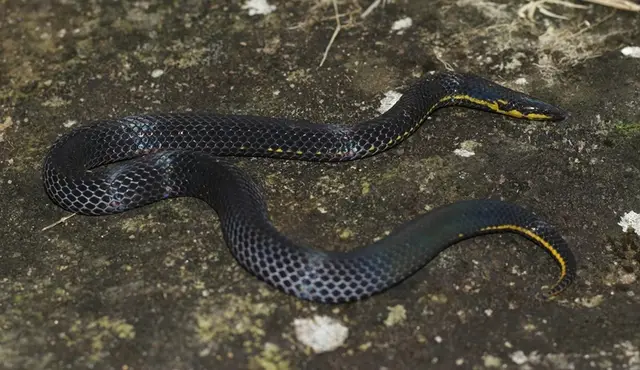
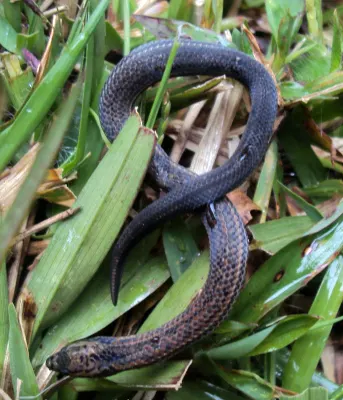
The common rough-sided snake (Aspidura trachyprocta) is a small, burrowing snake found only in the central highlands of Sri Lanka. The IUCN Red List rated it Endangered in 2021 and records a decreasing population. Its colours vary a lot, from blackish brown to light reddish brown, and it often turns up in leaf litter and farmland.
How to recognise it
This is a small, stout, cylindrical snake with a short pointed tail and a head that barely stands out from the neck. Body length (snout to vent) runs from about 85 to 383 mm, and the tail adds only 8 to 40 mm. It has 15 rows of scales around the middle of the body.
Colour is the unreliable part. The back ranges from blackish brown to light reddish brown, usually with stripes along the sides and two or three rows of dark spots down the back. The belly can be heavily blotched with black or pale yellow with a reddish tint. An older general account describes everything from bright red to near black, sometimes in the same locality.
Females have more belly scales and shorter tails than males, though the two sexes reach the same total length. Edward Drinker Cope described the species in 1860. Reports from the Maldives are regarded as erroneous.
Where it lives
The species is endemic to Sri Lanka, meaning it occurs nowhere else. It lives in the central hills, from mid-elevation slopes up into montane areas, and recorded localities include Horton Plains National Park, Nuwara Eliya, Kandy, Hakgala and Ramboda.
Elevation figures differ by source. Published accounts give about 750 to 2,100 m, while the IUCN assessment lists 1,500 to 2,200 m. The assessment gives its main habitat as subtropical or tropical moist montane forest and treats rural gardens as a marginal one. It estimates the area the snake actually occupies at about 499 square kilometres and describes the population as severely fragmented.
Pins are Wikidata “endemic to” fields. Orange dots, when present, are GBIF occurrence tiles — survey bias included.
How it lives
It spends its time in piles of humus, leaf litter and rotting timber, including on farmland. An older general account reports it can be abundant in some tea plantations and in marshy or irrigated ground, with females laying eggs in soil cavities roughly 15 to 30 cm down. The same account says it appears to eat worms.
The species is oviparous. Clutches are reportedly 4 to 12 eggs, each about 16 by 25 mm.
A 2017 Zootaxa paper describing a new highland snake, Aspidura ravanai, identified A. trachyprocta as its likely sister lineage. The two split at least 6.2 million years ago, and the paper counted eight Aspidura species known from Sri Lanka.
Why it is in trouble
The Endangered listing (criteria B1ab(iii)+2ab(iii)) rests on a small, fragmented range and a continuing loss of habitat, not on a head count. No population size has been published.
The assessment lists droughts and one further unspecified threat as ongoing, each affecting most of the population and causing slow but significant declines. Roads and railways are listed too, with their effect unknown. The pressures recorded for the snake itself are habitat conversion, habitat degradation and direct mortality.
What is being done
The assessment records that the snake occurs in at least one protected area, and it lists habitat protection as the conservation action needed. It also calls for research on the threats, the snake's life history and ecology, and population trends.
Sources
Written for this catalog in our own words from the sources below, checked against them on 12 November 2026. Population figures are estimates and carry the year they were made. Status and assessment year: IUCN. 2026. The IUCN Red List of Threatened Species. Version 2026-1. iucnredlist.org.