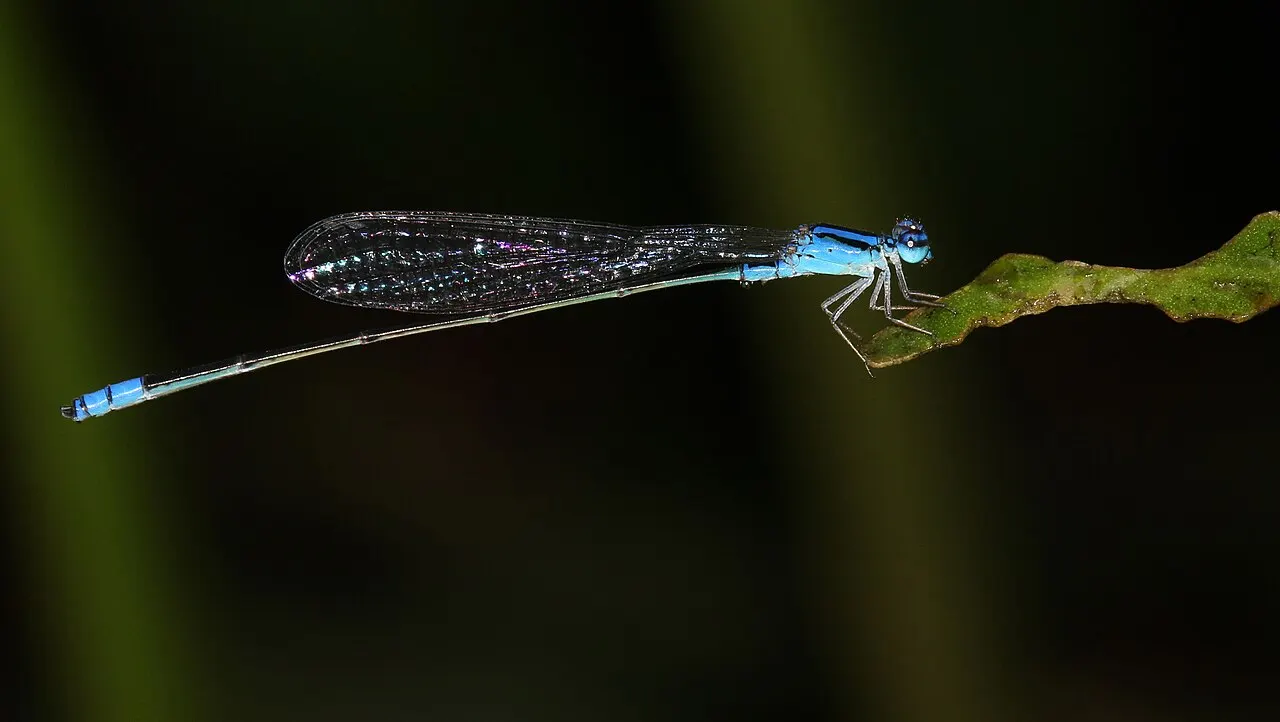
Endangered
Lieftinck's Sprite
Archibasis lieftincki
Lieftinck's sprite (Archibasis lieftincki) is a damselfly found only in Sri Lanka, where it lives along small forest streams in the wet zone. It was described as a new species in 2013. The IUCN Red List rated it Endangered in 2021, with a decreasing population.
What it is
Lieftinck's sprite is a damselfly in the family Coenagrionidae, the narrow-winged relatives of dragonflies. K. Conniff and M. Bedjanic described it in 2013 in the journal Odonatologica (volume 42, issue 3).
Because the description is so recent, little has been published on its biology. Most of what is known concerns where adults are seen and what kind of habitat they use.
Where it lives
The species is endemic to Sri Lanka and tied to the island's wet zone forests. The Red List gives its habitats as permanent rivers and streams and tropical moist lowland forest, from sea level up to about 450 metres. Adults perch on vegetation along the margins of small forest rivulets, and one has been photographed at the edge of a pond.
Records are scattered. A 2016 paper by Sumanapala, Podduwage and Dayananda lists Pahiyangala, Indikada Mukalana, Thotaha and Walallawita, and a Sri Lankan nature blog shows photographs from Gilimale forest reserve and Sinharaja forest reserve. GBIF holds only two research-grade sightings, one in Ratnapura district in 2016 and one in Kegalle district in 2021.
Pins are Wikidata “endemic to” fields. Orange dots, when present, are GBIF occurrence tiles — survey bias included.
Why it is in trouble
The Red List estimates the area the damselfly actually occupies at somewhere between 20 and 500 square kilometres, within a broader range of roughly 3,200 to 5,900 square kilometres. Its populations are severely fragmented, and both the area and quality of its habitat are still declining.
The pressures named are change to its habitat and the taking of surface water. The 2016 blog also warns that anything altering conditions inside forest ecosystems could threaten it. Whether it occurs in a protected area is recorded as unknown.
The assessment calls for site protection and management, habitat restoration and awareness work, but no species-specific programme is described.
Sources
Written for this catalog in our own words from the sources below, checked against them on 12 November 2026. Population figures are estimates and carry the year they were made. Status and assessment year: IUCN. 2026. The IUCN Red List of Threatened Species. Version 2026-1. iucnredlist.org.




