Endangered
Oranssiviiripyrstö
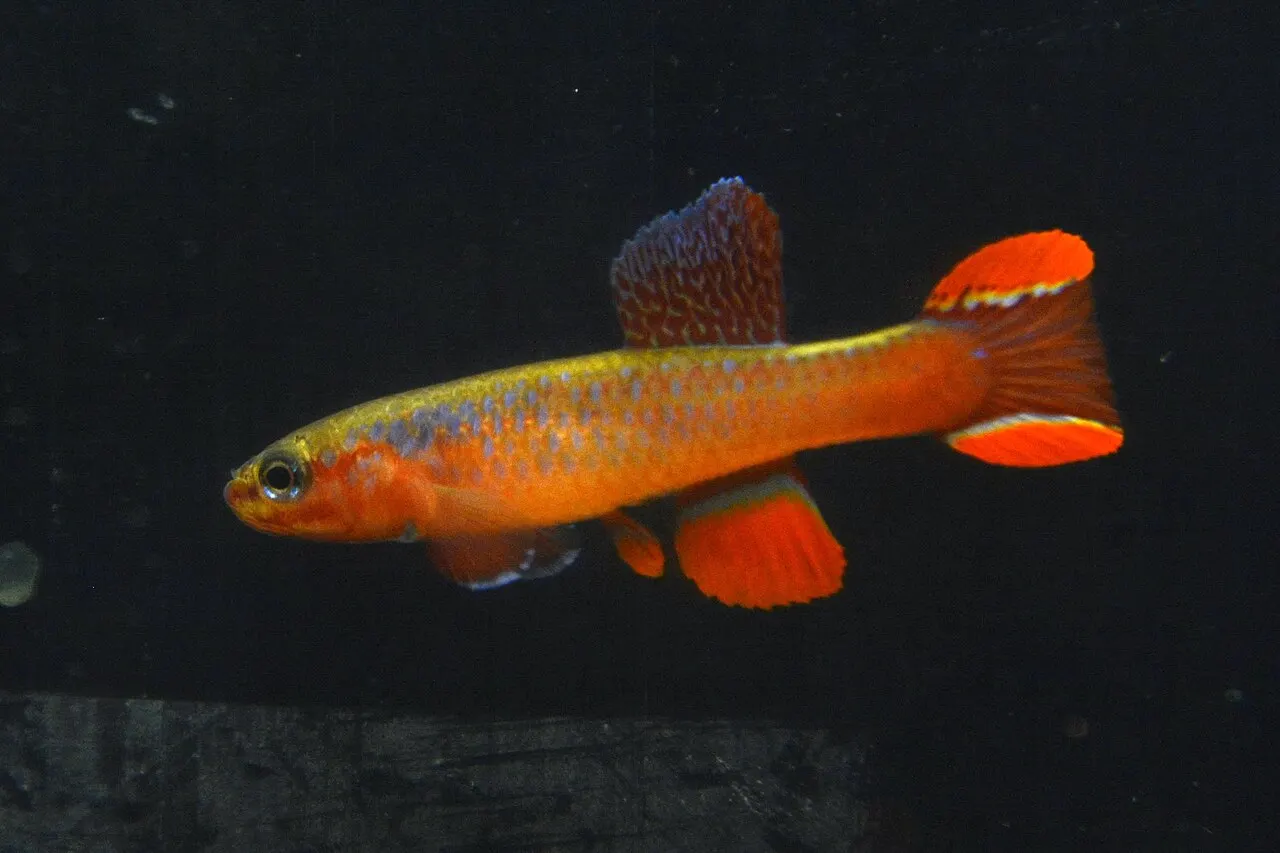
Aphyosemion fulgens
Aphyosemion fulgens is a tiny freshwater killifish from the rainforest streams of northern Gabon, in central Africa. It grows to about 3.5 cm. The IUCN Red List listed it as Endangered in 2010 because it occupies a very small area where mining, farming and silt are degrading its streams.
What it is
This is a member of the African rivuline family Nothobranchiidae, a group of small, often brightly coloured fishes. Its genus name comes from Greek words meaning roughly 'anchovy' and 'mark'. The species was described in 1975 by A. C. Radda in the British Killifish Association's magazine Killi News, in a paper on Gabonese killifishes. The original description placed it with Aphyosemion georgiae, and it is now treated as a species in its own right.
Its placement is not settled everywhere. The Catalog of Fishes now lists it under the genus Diapteron, while GBIF and the IUCN still use Aphyosemion. Males and unsexed fish top out at about 3.5 cm in total length, so it is a very small animal.
Where it lives
The fish is known only from the Ivindo River drainage in northern Gabon. The type locality, where the original specimens were collected, is a rainforest brook near Esenkelle, about 52 km west of the town of Makokou. The IUCN lists Gabon as the only country and puts its extent of occurrence under 5,000 square kilometres and its area of occupancy under 500.
It lives in small, mostly swampy forest brooks, and the IUCN names marshes and swamps along with seasonal and permanent streams as its habitats. FishBase gives its temperature range as 18 to 22 degrees C and describes it as a mid-to-bottom water swimmer that does not migrate.
Pins are Wikidata “endemic to” fields. Orange dots, when present, are GBIF occurrence tiles — survey bias included.
How it lives
Unlike many killifish, it is not a seasonal species, so it does not depend on pools that dry out. FishBase describes it as very difficult to keep in aquariums.
Why it is in trouble
The IUCN assessed the species under criteria B1ab(iii)+2ab(iii), which refer to a small range and shrinking habitat quality. The threats it lists are mining and quarrying, shifting agriculture, soil erosion and sedimentation, and small-scale harvest. The population trend is recorded as unknown.
No population estimate has been published and no conservation actions are recorded in the assessment. The IUCN records its population size as unknown.
Sources
Written for this catalog in our own words from the sources below, checked against them on 12 November 2026. Population figures are estimates and carry the year they were made. Status and assessment year: IUCN. 2026. The IUCN Red List of Threatened Species. Version 2026-1. iucnredlist.org.




