Critically Endangered
Red-legged Fire-Millipede
Aphistogoniulus corallipes
The red-legged fire-millipede (Aphistogoniulus corallipes) is a Madagascan millipede that lives in lowland moist forest in the island's southeast. The IUCN Red List assessed it as Critically Endangered in 2017, estimating it occupies just 10 square kilometres, an area that was still shrinking.
How to recognise it
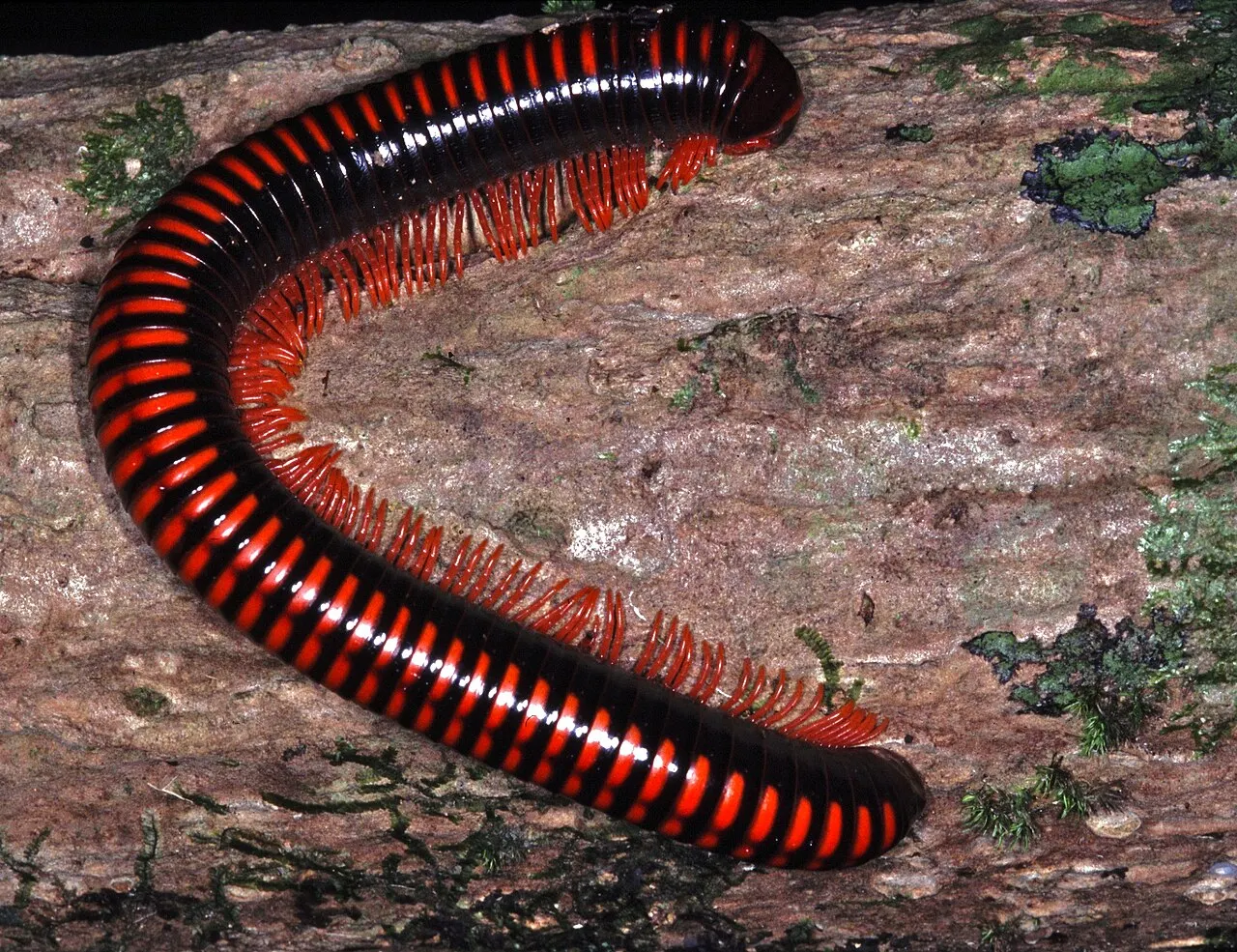
It belongs to Aphistogoniulus, the giant fire-millipedes, a genus found only in Madagascar. A 2011 study in PLoS ONE describes members of the genus as striking, with a pitch-black and blood-red warning pattern, sometimes with golden legs, and the largest reach 185 mm. Size and pattern specific to this species aren't described in the sources.
The species was first described as Spirobolus corallipes by Henri de Saussure and Leo Zehntner in 1902 and later moved to Aphistogoniulus.
Where it lives
The IUCN assessment lists Madagascar as the only country and lowland moist forest as the habitat. It treats all individuals as one subpopulation at a single location, with an extent of occurrence and an area of occupancy each estimated at 10 square kilometres.
Museum records in GBIF are a little broader than that. They include a 2007 specimen from the Manantantely forest in the far southeast and two 2025 specimens from the Lavasoa area, roughly 20 km to the southwest, plus older specimens with no precise locality, some dating back to 1890. The 2025 identifications haven't been checked here, so the true spread of the species may be somewhat wider than the assessment's single location suggests.
Pins are Wikidata “endemic to” fields. Orange dots, when present, are GBIF occurrence tiles — survey bias included.
How it lives
Little has been written about this species' daily life. The IUCN assessment gives a generation length of three to four years and records it as not a migrant, with no extreme fluctuations in its numbers.
Why it is in trouble
The assessment records an ongoing decline in the area the species occupies and its extent. The threats listed are small-holder farming, shifting agriculture and the unintended effects of small-scale subsistence harvesting, each rated as ongoing with a medium impact. These activities convert or degrade forest.
With such a small range, losing even a part of the remaining forest could remove a large share of the species.
What is being done
As of the 2017 assessment, there was no species recovery plan or monitoring scheme, it was not known from any protected area, and it was not held in captivity. The assessors listed four types of action as needed: site protection, resource and habitat protection, livelihood alternatives with linked enterprises, and awareness work.
Sources
Written for this catalog in our own words from the sources below, checked against them on 12 November 2026. Population figures are estimates and carry the year they were made. Status and assessment year: IUCN. 2026. The IUCN Red List of Threatened Species. Version 2026-1. iucnredlist.org.




