Endangered
Santa Cruz black salamander
Aneides niger
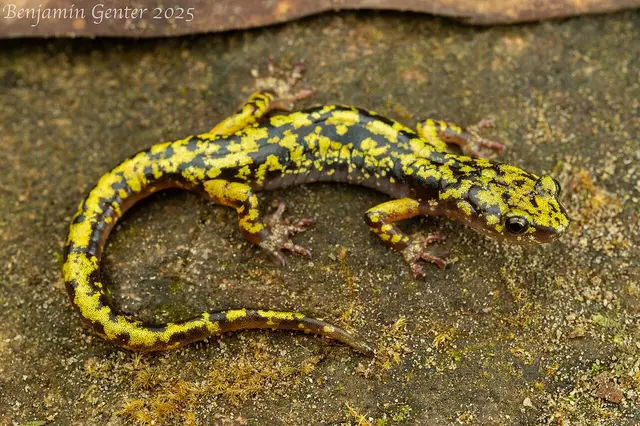
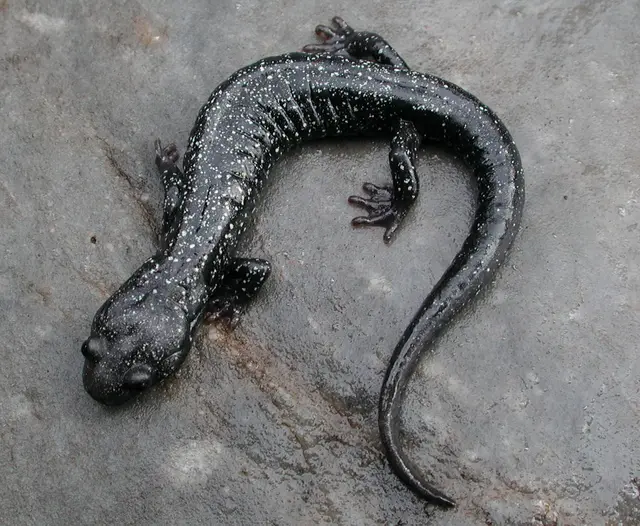
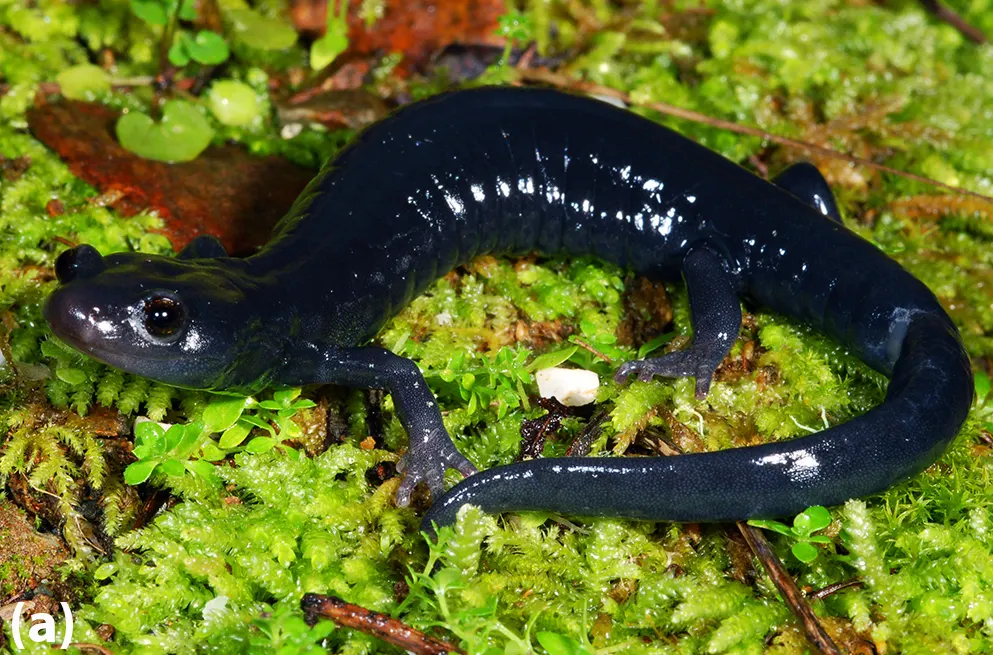
The Santa Cruz black salamander (Aneides niger) is an almost uniformly black, lungless salamander found only in the hills around Santa Cruz and the southern San Francisco Peninsula in California. It was listed as Endangered in 2022 (Red List), with a small range that is partly developed.
How to recognise it
Adults are medium-sized and solid black on the back, with at most a few fine white specks. They measure 5.1 to 9.5 cm from snout to vent, and the total length, tail included, can reach about 14 cm. Males have a broader head than females. Young salamanders are black with many tiny white spots, which fade as they grow. Unlike other members of its species complex, the adult is almost uniformly black.
It has long toes with climbing-adapted tips and a rounded, grasping tail, features that help it climb.
Where it lives
This species is found nowhere outside California. Its range covers Santa Cruz County, western Santa Clara County and southern and eastern San Mateo County, and it is the southernmost member of its group and separated from the others. It occurs from near sea level to about 800 m.
Habitat includes mixed deciduous woodland, conifer forest and coastal grassland. It is usually found under rocks beside streams, in talus (loose rock slopes) and under damp logs, and is rarely met far from water. The Red List puts its extent of occurrence at about 4,687 square kilometres, divided among four or five locations.
Pins are Wikidata “endemic to” fields. Orange dots, when present, are GBIF occurrence tiles — survey bias included.
How it lives
Adults forage on the ground at night in wet weather, taking small invertebrates such as millipedes, ants and termites. In dry periods most go underground, though in the south of its range some may stay active along streams all year. Adults appear to be aggressively territorial. Captive animals have lived as long as 20 years.
Breeding happens on land. Females probably lay 8 to 25 eggs in moist underground cavities in July and August and stay with them until they hatch. The young develop fully inside the egg and emerge as tiny salamanders, with no aquatic larval stage.
Why it is in trouble
Its range is small, and much of it has been developed. The Red List records a decreasing population and a continuing decline in habitat area. It lists housing and urban development, agriculture, drought, and shifting or altered habitat among the threats. Water diversions and severe wildfires such as the CZU Lightning Complex fires are also cited, and the area it lives in is already hotter and drier than the homes of its relatives, so climate change is a further worry. Logging, spring capping and road building affect its habitat.
The animal was described in 1948 as a subspecies of the speckled black salamander. A 2019 study of that group found it was a species complex and recognised this form as a full species, which gave it its own Red List assessment.
What is being done
The Red List notes site and area protection and resource and habitat protection as actions in place, and the species occurs in at least one protected area. Since 2013, taking it under a sport fishing licence has been prohibited in San Mateo, Santa Clara and Santa Cruz counties. It is a California Species of Special Concern but is not listed under the federal or California endangered species acts.
Sources
Written for this catalog in our own words from the sources below, checked against them on 12 November 2026. Population figures are estimates and carry the year they were made. Status and assessment year: IUCN. 2026. The IUCN Red List of Threatened Species. Version 2026-1. iucnredlist.org.