Endangered
Anchovy sprat
Clupeonella engrauliformis
The anchovy sprat (Clupeonella engrauliformis), also called anchovy kilka, is a small schooling fish of the central and southern Caspian Sea. The IUCN Red List rated it Endangered in 2018, after its stock collapsed in the early 2000s. It's caught mainly for fish meal, canning and salted products.
How to recognise it
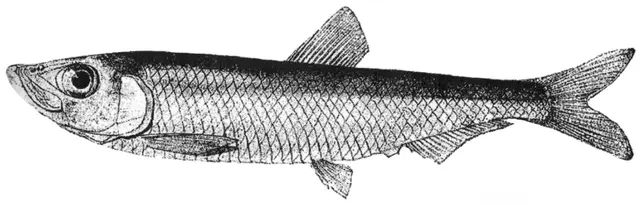
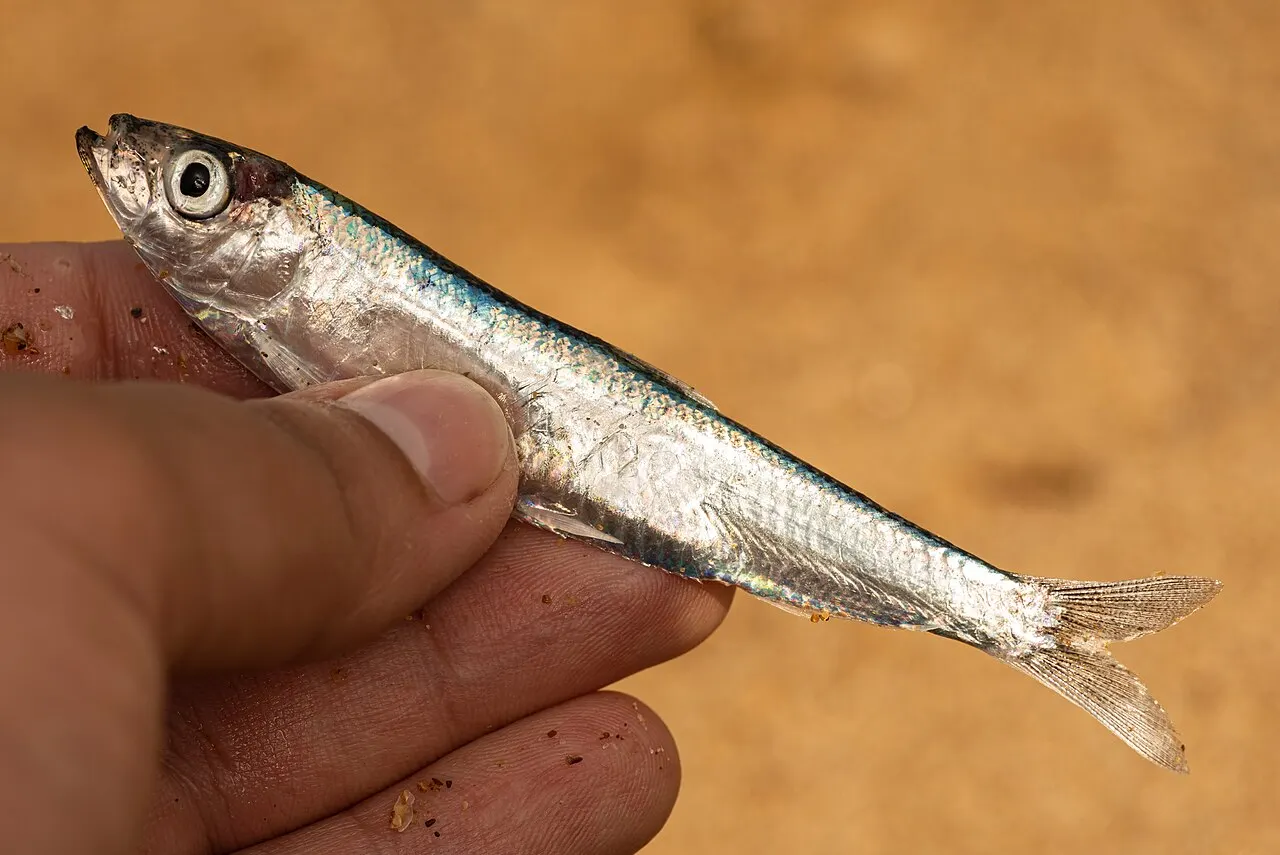
It's a slim, low-bodied fish, typically 12 cm long and no more than 16.5 cm, weighing up to about 26 g. The back is dark with a greenish tint, the belly is rounded and keeled, and the tail is nearly black and deeply notched. The head is short and wide with a small mouth, and the scales come off easily. Females run slightly larger than males.
Where it lives
It lives in the central and southern Caspian Sea, a brackish inland sea. The IUCN lists Azerbaijan, Iran and Turkmenistan as range countries. It's a fish of open water that only occasionally comes close to shore, and it forms large schools. The IUCN classes it as a full migrant that schools all year.
Pins are Wikidata “endemic to” fields. Orange dots, when present, are GBIF occurrence tiles — survey bias included.
How it lives
Most of the year it stays in the water column down to about 78 m. It rises toward the surface in spring and again in autumn, and makes daily vertical movements as well. Copepods are the main food, taken as zooplankton during the day, with smaller amounts of cladocerans, mysids and mollusc larvae.
Spawning is in the open sea in the upper layers and is spread over many months, running from spring into late autumn. A female lays roughly 10,000 to 55,000 pelagic eggs, each with an oil droplet. The IUCN gives a generation length of 4 to 5 years. Brazhnikov's shad, Caspian seals and sturgeons all eat it.
Why it is in trouble
Catches were once enormous. The mid-1970s fishery reportedly landed up to 350,000 tonnes, and catches in the 1990s peaked at up to 271,400 tonnes, with fishing mortality reaching 1.8 per year in 1999. The fish are caught using lights.
Then the stock fell apart. A 2007 study in the ICES Journal of Marine Science found that recruitment failed in 2001 and stayed very low, and the catch dropped to a record low of 54,300 tonnes in 2005. The study judged the most likely main cause to be the comb jelly Mnemiopsis leidyi, an invader that competes with and preys on young fish, with overfishing probably adding to the damage. The IUCN rates the trend as decreasing, estimates a past reduction of about 50 percent, and lists large-scale harvest, an introduced species and other impacts as ongoing threats.
What is being done
The IUCN assessment lists conservation actions at national and international level, including harvest management, policies and regulations, and species recovery. Whether invasive species control is in place is recorded as unknown.
Sources
Written for this catalog in our own words from the sources below, checked against them on 12 November 2026. Population figures are estimates and carry the year they were made. Status and assessment year: IUCN. 2026. The IUCN Red List of Threatened Species. Version 2026-1. iucnredlist.org.