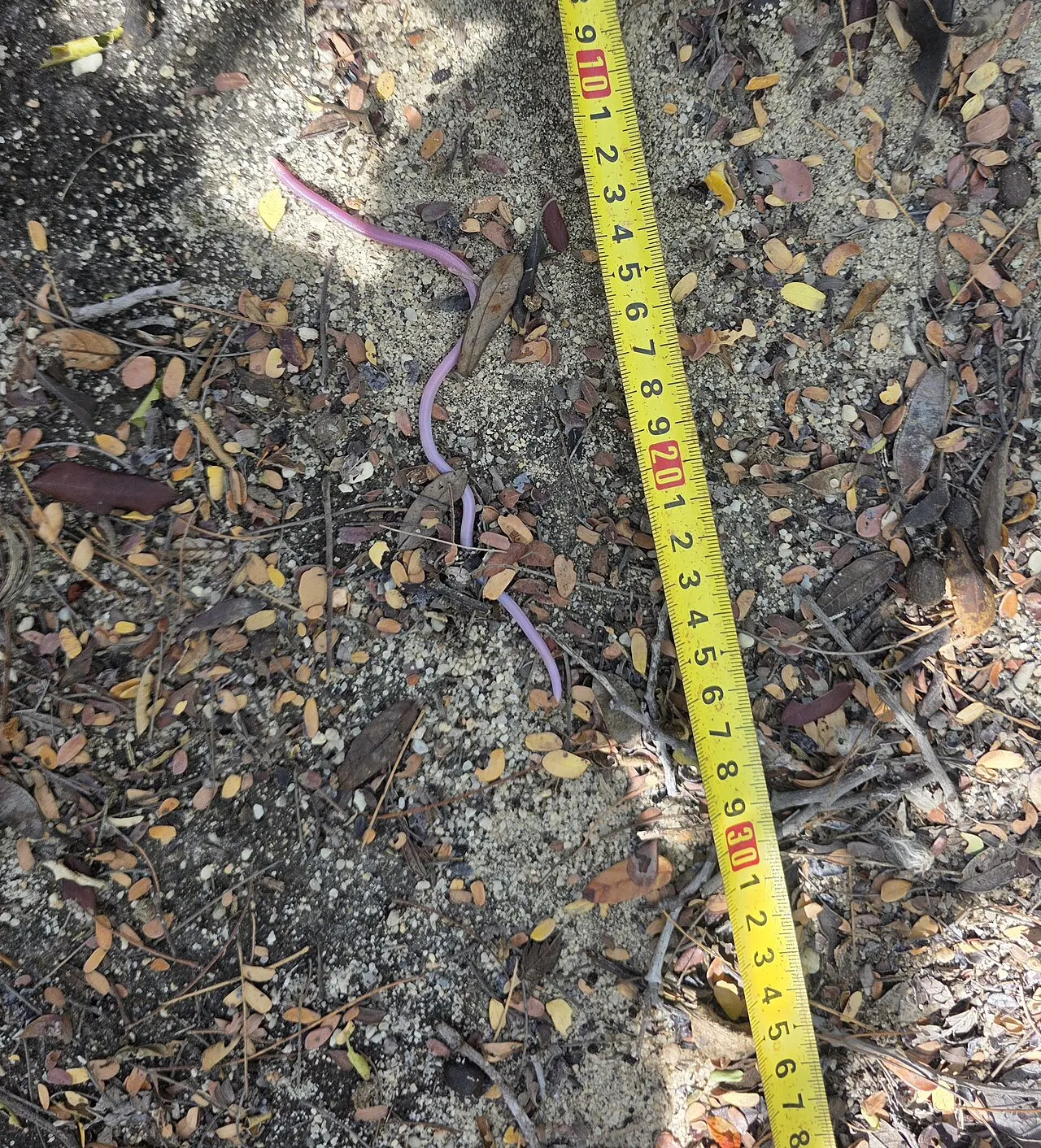
Endangered
Amphisbaena supernumeraria
Amphisbaena supernumeraria
Amphisbaena supernumeraria is a small, slender worm lizard that lives underground in the dry caatinga of Pernambuco, north-eastern Brazil. Described to science only in 2009, it is listed as Endangered on the IUCN Red List (assessed 2021) because its tiny range is being cleared for farming and housing.
How to recognise it
Worm lizards are legless, burrowing reptiles whose bodies are ringed with rows of scales called annuli, and this species has an unusual number of them. Four specimens described in 2009 had 333 to 337 body annuli and 22 or 23 on the tail, the highest count in its genus. The name supernumeraria, from Latin roots meaning beyond and number, refers to that.
It is described as small and slender, with four pores in front of the vent and a pointed or keeled tail tip. The frontal scales on top of the head form one large scale, and the nasal and prefrontal scales are fused with the scale at the snout tip. The anterior body rings are chevron-shaped, which, with the ring count, helps separate it from its relatives. In Portuguese it is called cobra-de-duas-cabeças (literally two-headed snake), or cobra-cega.
Where it lives
The species is known only from Brazil, in the state of Pernambuco. Mott, Rodrigues and Dos Santos described it from Fazenda Porto Seguro, inside Catimbau National Park in the municipality of Buíque. The park, created in December 2002, covers roughly 62,000 hectares of semi-arid caatinga.
The IUCN gives an extent of occurrence of about 577 square kilometres and lists its habitat as subtropical or tropical dry shrubland. Like other worm lizards it spends its life below ground.
Pins are Wikidata “endemic to” fields. Orange dots, when present, are GBIF occurrence tiles — survey bias included.
Why it is in trouble
The IUCN describes the population as severely fragmented, with its habitat area still shrinking. The threats listed are agro-industry farming and housing and urban development, which convert and degrade the dry shrubland. The assessment records the population trend as unknown, and gives no estimate of how many animals exist.
Because the animal lives underground and was only recently described, little else is documented about its diet, breeding or lifespan.
What is being done
The IUCN records that the species occurs in at least one protected area, presumably the national park where it was first found. No species-specific conservation actions are recorded in the assessment. Surveys to find out where else it lives and how many remain would be the first useful step.
Sources
Written for this catalog in our own words from the sources below, checked against them on 12 November 2026. Population figures are estimates and carry the year they were made. Status and assessment year: IUCN. 2026. The IUCN Red List of Threatened Species. Version 2026-1. iucnredlist.org.




