Endangered
Ameerega boehmei
Ameerega boehmei
Boehmei's poison arrow frog (Ameerega boehmei) is a small, black-and-yellow frog known only from two isolated sandstone ranges in the Chiquitania region of Santa Cruz, Bolivia. Described in 2009, it was rated Least Concern in 2011 but Endangered in 2020, mainly because of fire and grazing.
How to recognise it
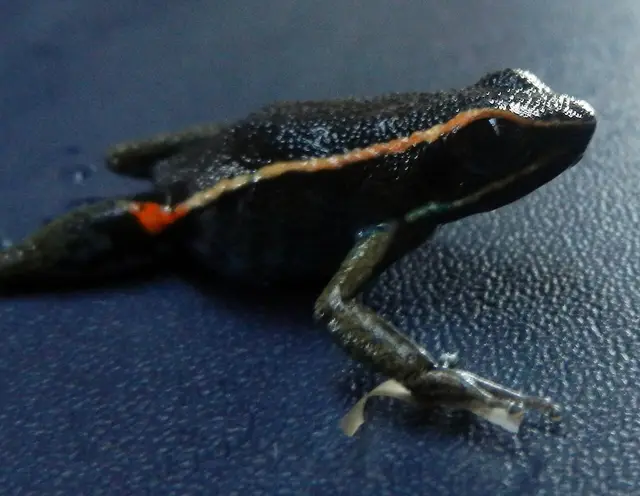
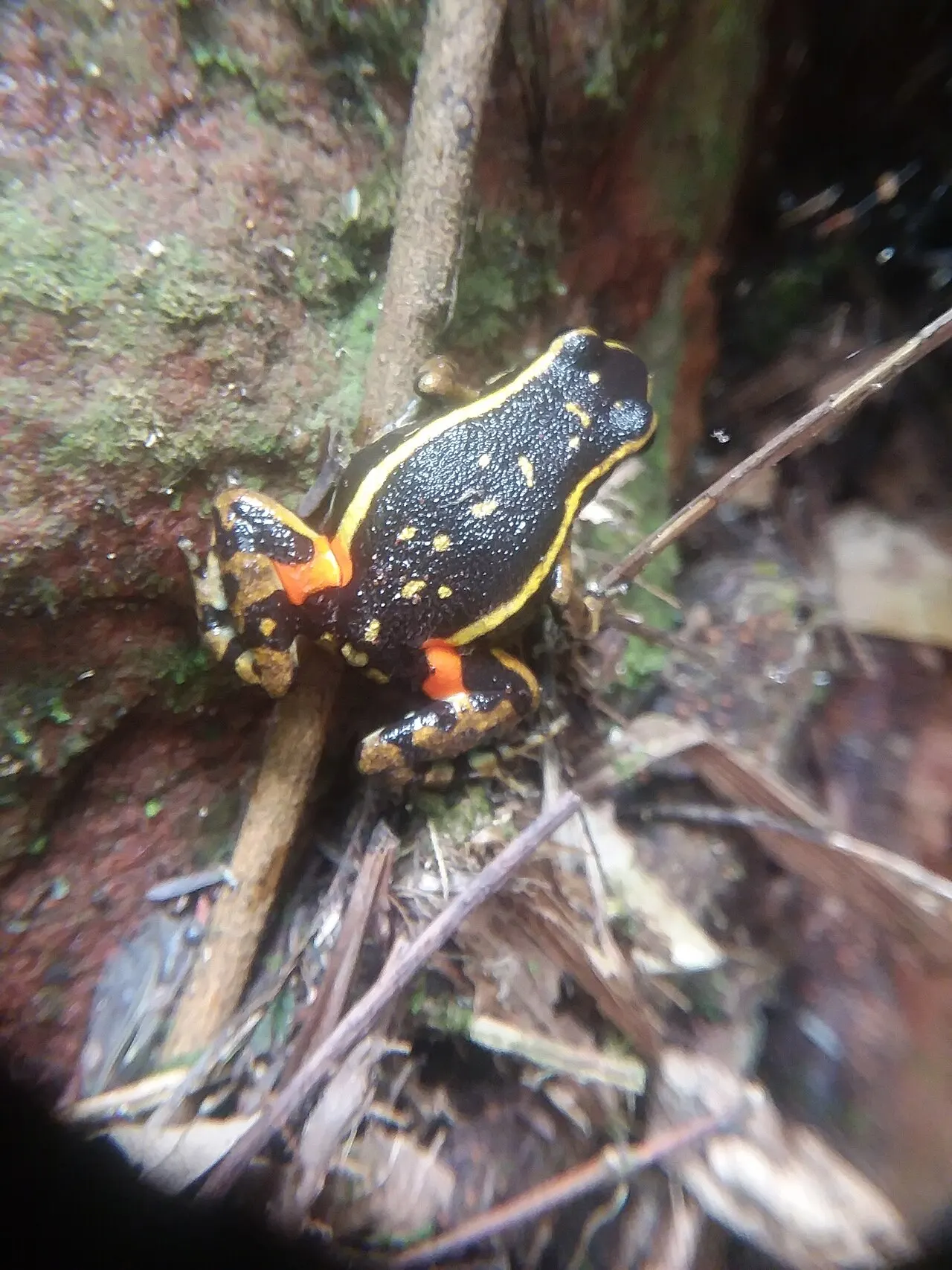
Adults are tiny, about 19 to 35 mm from snout to vent, with a slender body, a rounded snout and a head narrower than the body. The back is reportedly black with bright yellow lines along the sides and lips, plus yellow spots or dots down the middle. The limbs are brown or black with yellow markings, and the belly is light grey to light brown with black marbling.
It is easily confused with Ameerega flavopicta, a close relative from Brazil. The original 2009 description in Zootaxa separates them by belly colour (flavopicta's is yellowish white) and by voice: boehmei calls have longer notes, a slower repetition rate, fewer pulses per note and lower frequencies. The dominant frequency is reportedly about 2.7 to 3.2 kHz. The same description found only about a 2 percent difference in one mitochondrial gene (16S) between the two.
Where it lives
The species is endemic to Bolivia and is known from the Serranía de Santiago and the Serranía de Chochis, two isolated sandstone massifs in the Chiquitania. The IUCN counts 1 to 5 locations and records an elevation range of 500 to 1,200 m. It is reported from the Tucavaca Valley Municipal Reserve, and the IUCN records that its whole population is thought to lie inside protected areas.
The 2009 description found it near rocks, often close to running water. It reportedly lives in open dry savanna (cerrado), mostly near slow streams but sometimes up to 50 m from water, and is active by day. The IUCN also lists seasonal freshwater pools among its habitats.
Pins are Wikidata “endemic to” fields. Orange dots, when present, are GBIF occurrence tiles — survey bias included.
How it lives
Breeding reportedly happens in the wet season, from about November to April. As in many poison frogs, eggs are laid on land and adults later carry the tadpoles to shallow pools or temporary puddles. The frog can be locally common, but some populations appear to have fallen.
Why it is in trouble
Its whole known range is tiny. The IUCN names a rise in fire frequency and intensity, small-holder grazing and farming, and larger-scale ranching as the threats, and records a continuing decline in the area it occupies. The population trend is decreasing. Fires lit to clear and extend cattle pasture are the main concern.
In 2019, fires in Bolivia from mid-August to early October burned more than 7 million acres of the Chiquitania, according to the conservation group Re:wild, which named this frog as one of two species particularly vulnerable to extinction because it is known from only two populations.
The 2009 description recommended Least Concern, and the IUCN's 2011 assessment agreed. The 2020 reassessment moved it to Endangered under criterion B1ab(iii), which applies to a small range in few locations with declining habitat quality.
What is being done
The IUCN records that the species occurs in a protected area, and the Tucavaca Valley reserve covers part of its range. The assessment lists no further conservation actions and no captive programme.
Sources
Written for this catalog in our own words from the sources below, checked against them on 12 November 2026. Population figures are estimates and carry the year they were made. Status and assessment year: IUCN. 2026. The IUCN Red List of Threatened Species. Version 2026-1. iucnredlist.org.