Endangered
Palau Ground-Dove
Alopecoenas canifrons
The Palau ground dove (Pampusana canifrons) is a small forest pigeon found only in the island nation of Palau, in the western Pacific. It feeds on the forest floor and is solitary. The IUCN Red List assessed it as Endangered in 2018, with a population in the hundreds and still declining.
How to recognise it
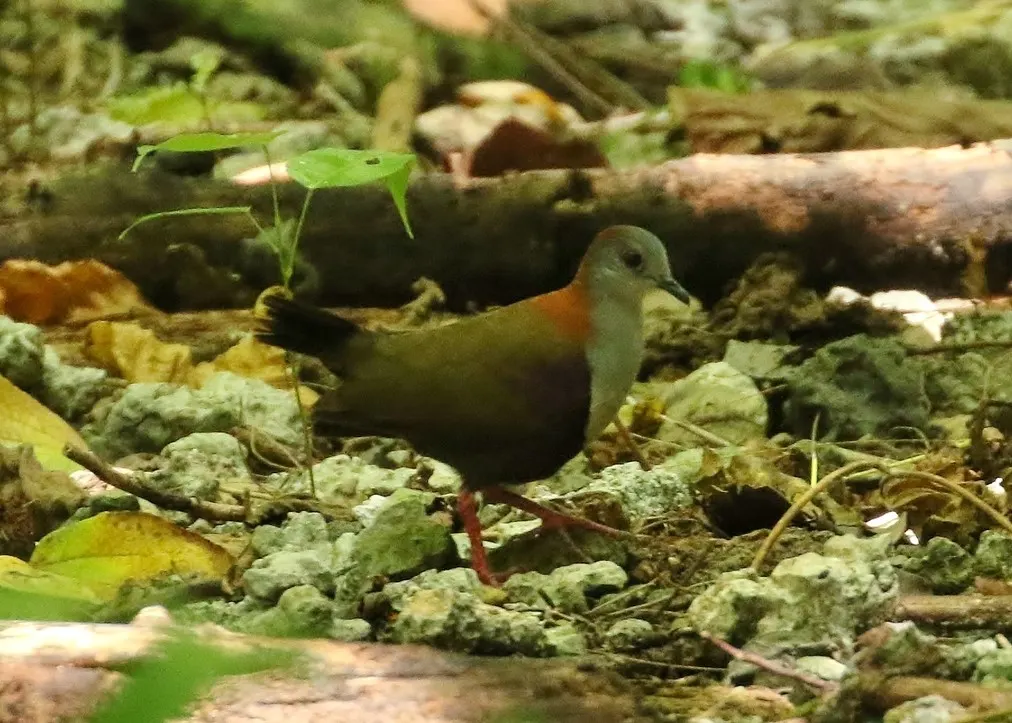
It's a compact pigeon about 21 cm long. The forehead and the area in front of the eye are ash grey, the crown is dark slate, and the nape and upper back are chestnut. The lower back is olive with a bronze sheen.
A purple patch on the wing is the best field mark. The legs are red, the bill blackish and the belly blackish brown. Young birds are duller on the face and throat and lack the purple wing patch.
Where it lives
Palau is its only home. The bird lives in dense forest and seems to prefer the limestone islands over the volcanic ones. A 2005 survey found birds on Babeldaob and Peleliu, and it is reported to be fairly common on some of the small limestone Rock Islands.
The IUCN puts its extent of occurrence at roughly 1,700 square kilometres and lists its habitat as moist lowland forest.
Pins are Wikidata “endemic to” fields. Orange dots, when present, are GBIF occurrence tiles — survey bias included.
How it lives
It forages on the ground, picking seeds and fruit from the leaf litter, and it tends to be solitary. Its voice is a monotonous coo, delivered from the same spot in the morning and evening, sometimes for up to two minutes.
Almost nothing is recorded about its breeding. The IUCN estimates a generation at about 6.6 years.
Why it is in trouble
Nobody has a precise count. A small survey in 2005 turned up only four birds, two on Babeldaob and two on Peleliu, which is too few to estimate from. The 2018 assessment puts mature adults at 250 to 999, with the largest single group at 51 to 250. Another published estimate gives 600 to 1,700, without a year.
Introduced rats and the brown tree snake are named as possible threats. Conservationists working on Ulong Island say invasive rats eat the eggs and chicks of native birds. The IUCN also lists housing and urban development, small-holder farming, roads and recreational activity as pressures on the species.
What is being done
The species occurs in at least one protected area, and the IUCN notes conservation sites have been identified across its range. As of the 2018 assessment there was no species recovery plan, no formal monitoring scheme and no invasive species control in place.
One encouraging result comes from Ulong Island in the Rock Islands. Rats were removed there in 2023 to 2024 by Koror State teams working with Island Conservation. Follow-up monitoring recorded more ground dove sightings, including chicks at landing sites where none had been seen before.
Sources
Written for this catalog in our own words from the sources below, checked against them on 12 November 2026. Population figures are estimates and carry the year they were made. Status and assessment year: IUCN. 2026. The IUCN Red List of Threatened Species. Version 2026-1. iucnredlist.org.




