Endangered
Allophryne relicta
Allophryne relicta
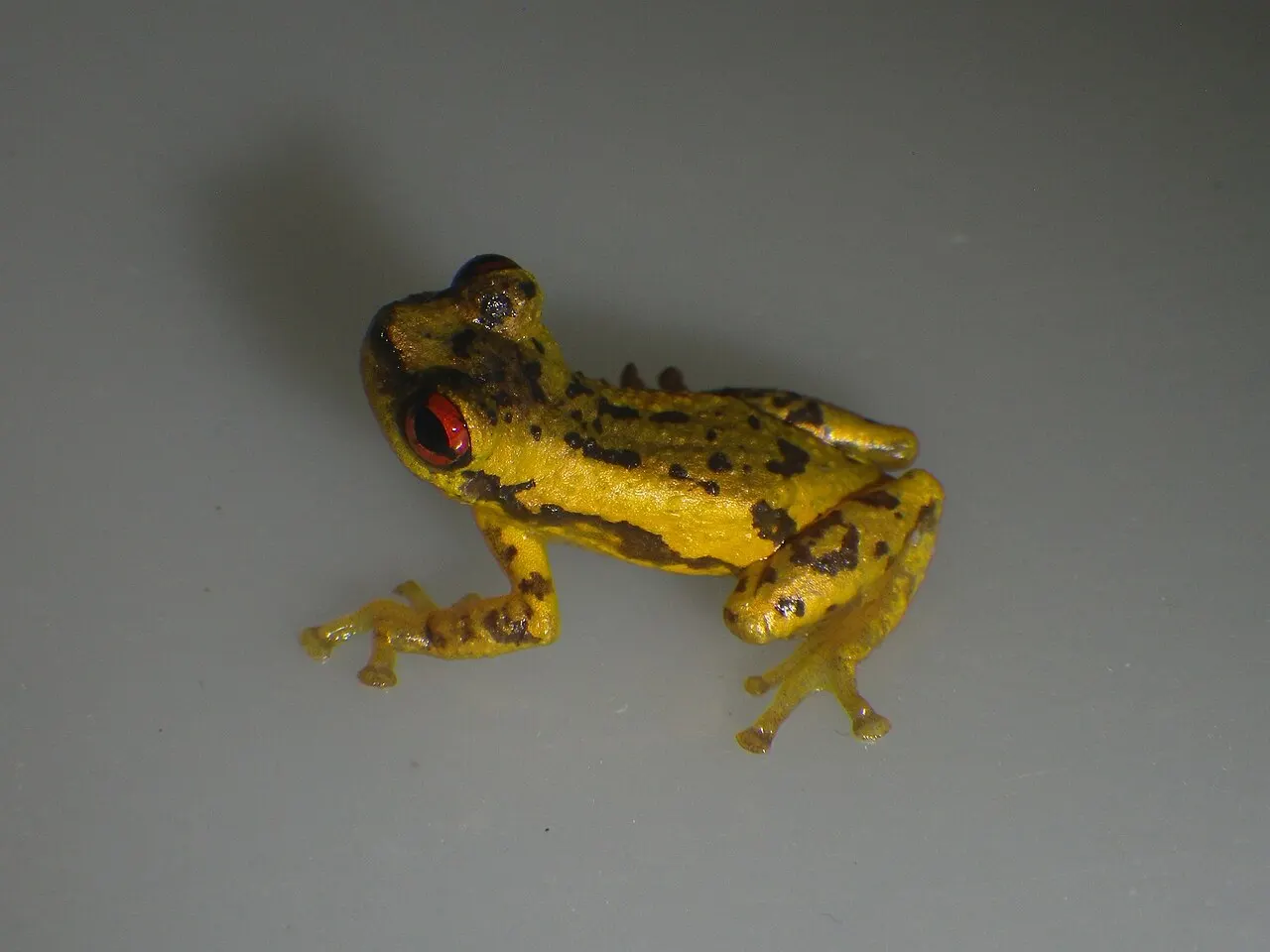
Allophryne relicta is a small frog with large red-orange eyes, known from the Atlantic Forest of Bahia in eastern Brazil, far from its Amazonian relatives. The IUCN rated it Endangered in 2023, with an estimated range of just 183 km2 and a decreasing population.
How to recognise it
Males are about 20 to 22 mm long from snout to vent. The head is large, roughly a third of the body length across, and the eyes are red-orange with a broad black bar across the iris. The back has few tubercles and many scattered black dots, the flanks are cream with dark brown, elongated, joined spots, and the belly is clear gray with small white tubercles. A line of tubercles runs along the forearm.
Males call with a multi-pulsed note lasting about half a second, with around 29 pulses per note. Notes come about every 1.3 seconds at a pitch near 3.8 kHz.
Where it lives
Scientists described it in 2013 from Uruçuca in southern Bahia. Unlike the rest of its genus, which lives in the Amazon basin, it was found in the Atlantic Rain Forest. DNA analysis in the original paper places it as the sister of a pair of Amazonian species, Allophryne resplendens and Allophryne ruthveni.
The Red List gives an estimated extent of occurrence of 183 km2 and an elevation range of 50 to 150 m. Its habitat is lowland moist forest, plantations and seasonal streams, and the population is considered severely fragmented.
GBIF holds 11 records, all from Bahia, mostly museum specimens collected in 2009 and 2010 plus observations up to 2026. Those with coordinates fall within a small area, between about 14.6 and 14.8 degrees south.
Pins are Wikidata “endemic to” fields. Orange dots, when present, are GBIF occurrence tiles — survey bias included.
Why it is in trouble
The Red List records a continuing decline in the area and quality of its habitat. Ongoing, low-impact pressures include small-holder farming and grazing, plantations, housing and commercial development, roads and utility lines. The 2023 assessment says the species does not occur in a protected area, and describes the population trend as decreasing. It gives no population estimate.
What is being done
The assessment lists site protection and habitat protection as actions needed, along with research on population size, distribution and trends and on habitat trends. It reports no protected area covering the frog and no recovery programme.
Sources
Written for this catalog in our own words from the sources below, checked against them on 12 November 2026. Population figures are estimates and carry the year they were made. Status and assessment year: IUCN. 2026. The IUCN Red List of Threatened Species. Version 2026-1. iucnredlist.org.




