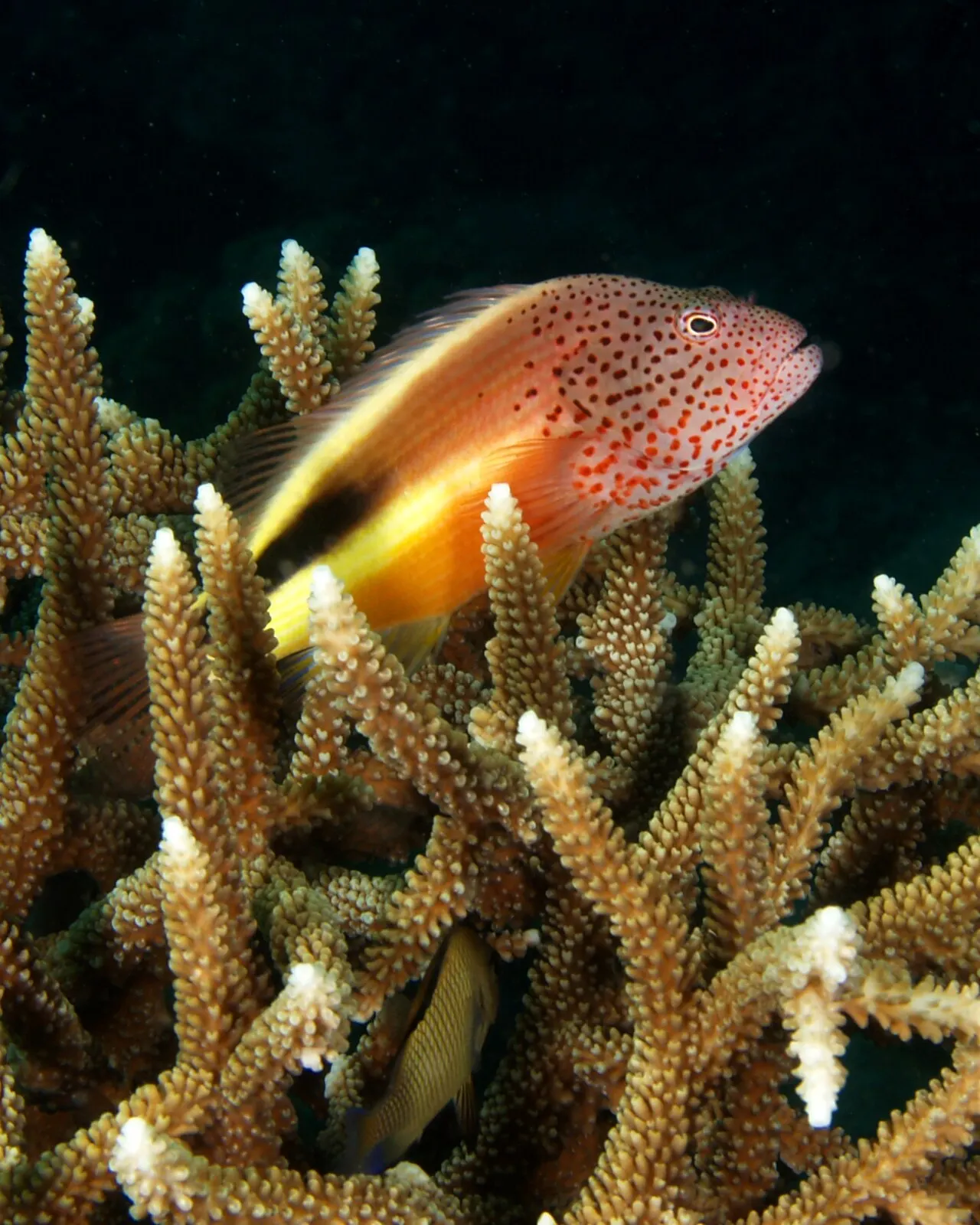
Endangered
Acropora grandis
Acropora grandis
Acropora grandis is a branching coral of shallow reefs and lagoons in the Indo-Pacific, from East Africa and the Red Sea to Australia, Japan and western Pacific islands. Colonies can form stands 7 metres across. After Least Concern ratings in 2008 and 2014, the 2024 Red List assessment moved it to Endangered, on projected losses of reef habitat.
How to recognise it
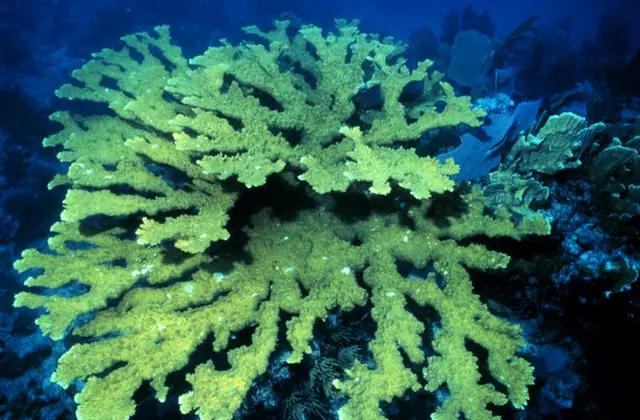
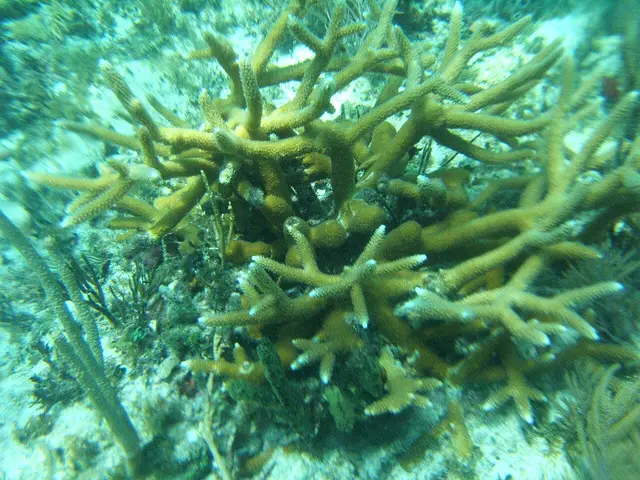
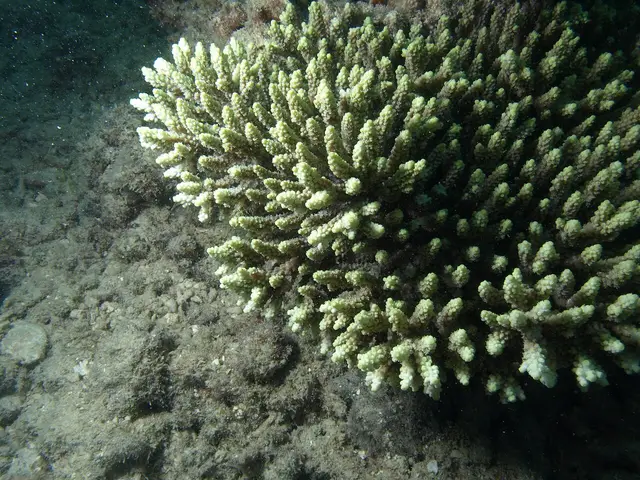
This is a thick-branched, bushy coral. In shallow water the colony grows as a tangled, low mat with short, compact branches. In deeper water the branches are more upright and open. Single colonies can form stands up to 7 metres across.
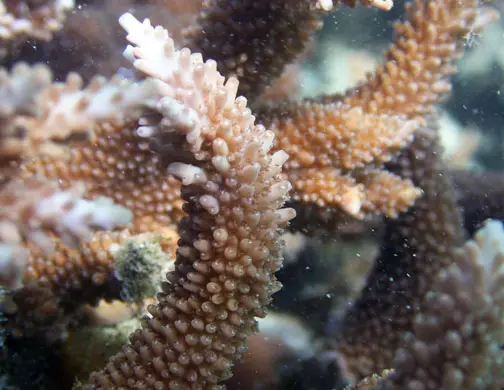
Colour is usually dark reddish-brown with pale branch tips, though blue, green and purple colonies also occur. The branch tips are very soft and easily crushed. Near the tips the side corallites, the small cups that hold the polyps, are long and tubular.
Acropora muricata has smaller corallites without that tubular form, and A. intermedia is smaller, with rasp-like side corallites. Brook described the species in 1892, under the name Madrepora grandis.
Where it lives
The Red List records it in 55 countries and territories across the Indo-Pacific, from Kenya, Madagascar and the Red Sea region to Indonesia, the Philippines, Japan, Fiji and Australia. Australia supplies 631 of the 1,061 records in the GBIF database, followed by Indonesia and New Caledonia.
It grows on coral reefs, mostly on upper reef slopes and in lagoons, and reportedly prefers bright water with strong current. The Red List gives a depth range of 3 to 35 metres, most commonly 5 to 25 metres.
Sources differ on how common it is. Corals of the World rates it common, while the 2024 Red List text calls it uncommon.
Pins are Wikidata “endemic to” fields. Orange dots, when present, are GBIF occurrence tiles — survey bias included.
How it lives
Like most reef-building corals, it hosts microscopic algae in its tissue that supply part of its food and give it colour. It reportedly spawns by releasing eggs and sperm into the sea in synchrony, in the northern part of its range four or five days after the full moon. The larvae then drift in the plankton before settling.
The Red List uses a generation length of 10 years.
Why it is in trouble
The 2024 assessment rates it Endangered under criterion A3ce, which is based on projected loss. It estimates a future reduction of about 62 percent, driven by falling habitat quality and by pathogens, pollutants and competitors. The area it occupies is already declining.
Threats listed include temperature extremes, storms and flooding, sediment from erosion, coastal housing and industry, shipping lanes, tourism and recreation, and unintended effects of small-scale harvest. The wider IUCN reassessment found 44 percent of 774 reef-building coral species threatened. Among Indo-Pacific Acroporidae, 191 of 279 species (68 percent) were rated Endangered.
That work used data up to 2020, so the global bleaching event of 2023 to 2025 is not counted.
What is being done
The Red List does not report any protection specific to this coral, and says it is unknown whether it occurs in a protected area. The actions it lists as needed are site protection and management, habitat restoration, species recovery, captive breeding and propagation, and a genome resource bank.
Sources
Written for this catalog in our own words from the sources below, checked against them on 12 November 2026. Population figures are estimates and carry the year they were made. Status and assessment year: IUCN. 2026. The IUCN Red List of Threatened Species. Version 2026-1. iucnredlist.org.