Endangered
Acropora aspera
Acropora aspera
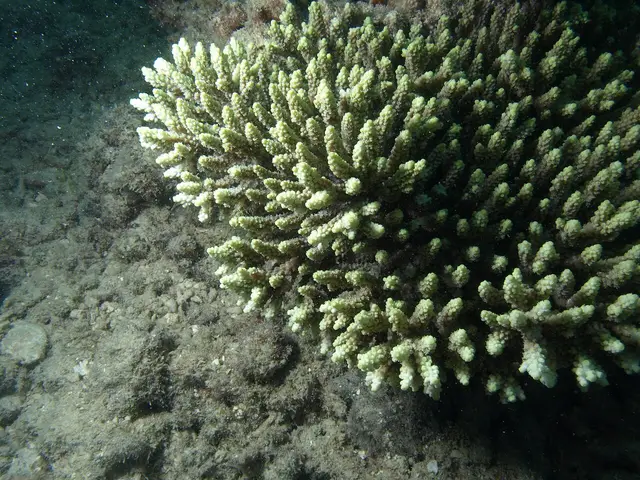
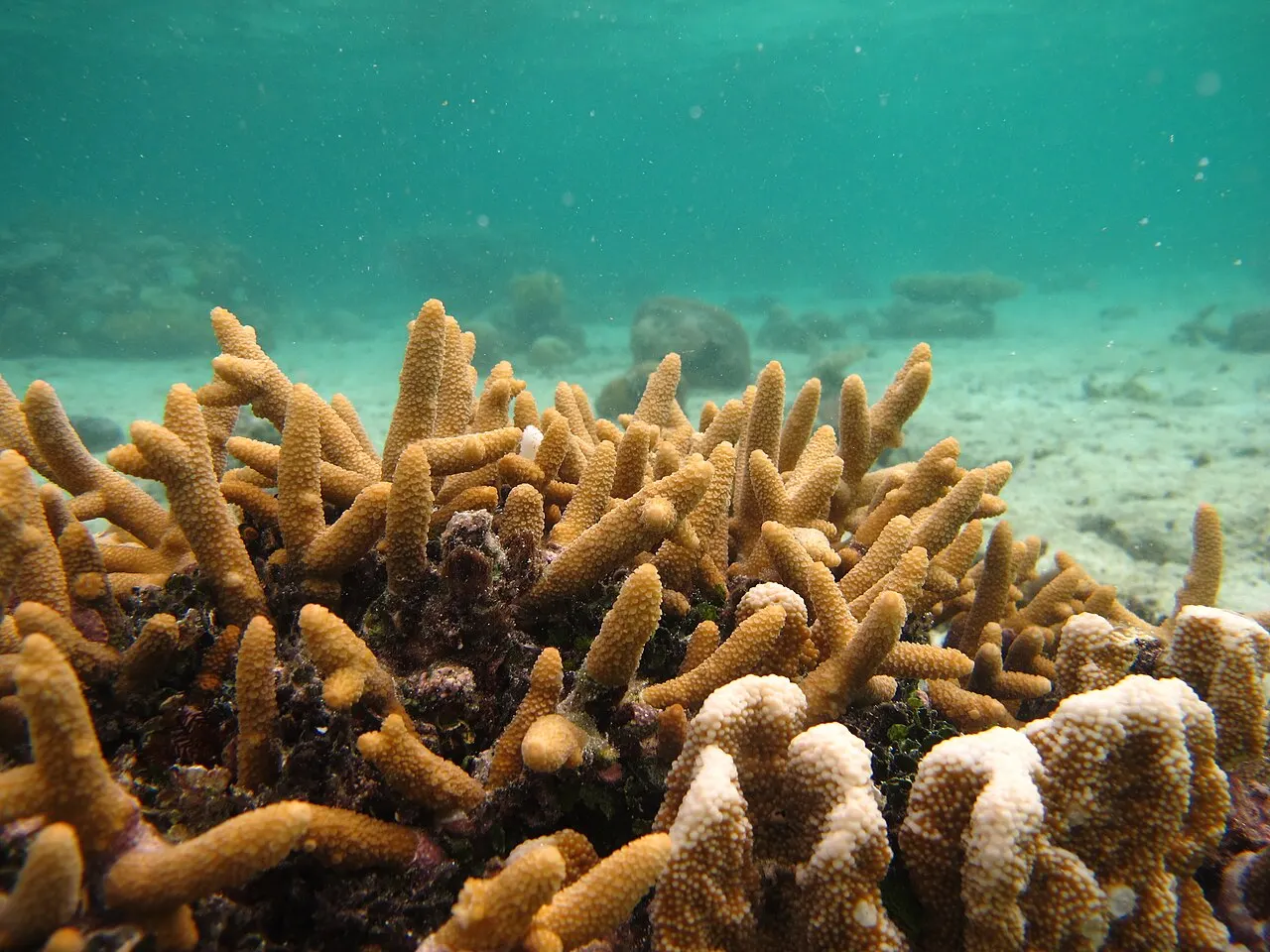
Acropora aspera is a staghorn coral that grows in low clumps or tables on shallow reef flats and lagoons across the Indian Ocean and the western Pacific. It comes in pale green, grey, brown, cream or blue. The IUCN rated it Endangered in 2024, with its population decreasing.
How to recognise it
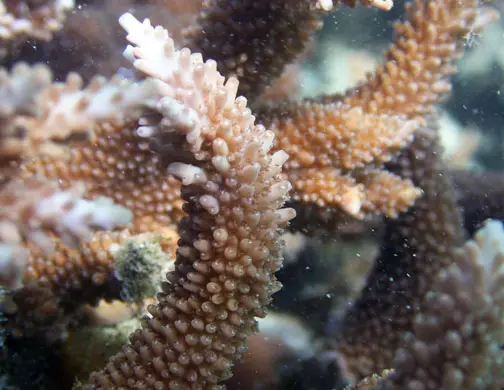
This is a branching coral that forms low clumps or tables with thick branches. Branch length changes with wave exposure. The small cups that house the polyps, called corallites, come in two crowded sizes, and the lower lip of each one sticks out slightly.
Colour varies: pale blue-grey, green, grey, brown or cream, and sometimes bright blue. It is easily mixed up with similar corals. Acropora millepora has radial corallites that are all the same size, and the corymbose form of Acropora pulchra has much finer ones.
Where it lives
It occurs from Sri Lanka, the Maldives and Oman in the Indian Ocean, through Thailand, the Philippines, Indonesia and Australia, to Fiji, Samoa and the Marshall Islands in the Pacific. The Red List counts more than 40 countries and territories.
It prefers reef flats, shallow lagoons and exposed upper reef slopes, and occasionally turns up in deeper water. The Red List gives a depth range of 0 to 15 m. Where corals zone by depth, it reportedly sits between the shallower Acropora pulchra and the deeper Acropora millepora.
Pins are Wikidata “endemic to” fields. Orange dots, when present, are GBIF occurrence tiles — survey bias included.
How it lives
Like other reef-building corals, it hosts algae (zooxanthellae) in its tissue and relies heavily on their photosynthesis. A two-year study at Kavaratti atoll, India, by Suresh and Mathew (1995) found that calcification was lowest in the June to September southwest monsoon, probably because cloud and sediment reduced the light. Branch extension showed no clear seasonal pattern.
Why it is in trouble
It is reportedly particularly prone to bleaching when the water gets too warm. In a 2017 PeerJ experiment, injured colonies held at 32 degrees C, two degrees below the 34 degree bleaching threshold used in that study, showed less fluorescent protein, less calcification and no regrowth of clipped branch tips. Colonies kept at 26 degrees C regrew their tips within 12 days.
The Red List lists ongoing, low-impact pressures including coastal development, sedimentation, shipping lanes, storms, temperature extremes and disease, and records a continuing decline in the area the species occupies. It projects a population reduction of about 62 percent and uses a generation length of 10 years. Crown-of-thorns starfish, which prefer Acropora corals, can add local losses when their numbers surge.
What is being done
The species is on CITES Appendix II. The assessment lists site protection and management, habitat restoration, species recovery, captive propagation and a genome resource bank as conservation actions. Whether the species occurs in a protected area is recorded as unknown.
Sources
Written for this catalog in our own words from the sources below, checked against them on 12 November 2026. Population figures are estimates and carry the year they were made. Status and assessment year: IUCN. 2026. The IUCN Red List of Threatened Species. Version 2026-1. iucnredlist.org.
- IUCN Red List assessment, Acropora aspera (2024)
- Corals of the World, Acropora aspera factsheet
- Wikipedia, Acropora aspera
- Heat stress and injury recovery in Acropora aspera, PeerJ 2017 (abstract via Europe PMC)
- Suresh and Mathew 1995, Indian Journal of Marine Sciences 24(2) (CMFRI record)
- Wikimedia Commons, File:Acropora_aspera.JPG