Critically Endangered
Acridotheres tertius
Acridotheres tertius
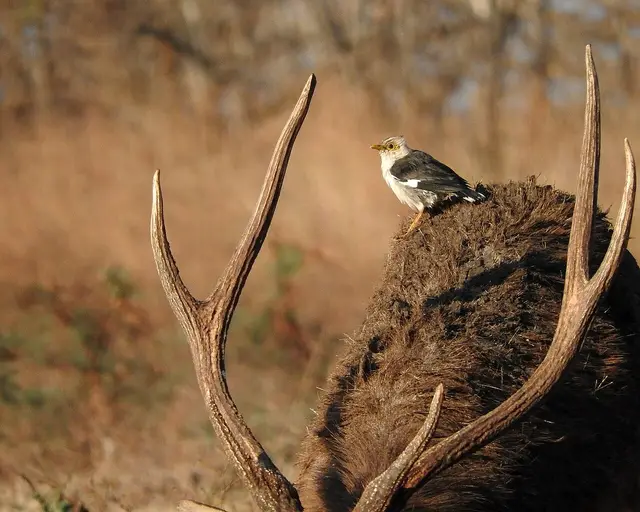
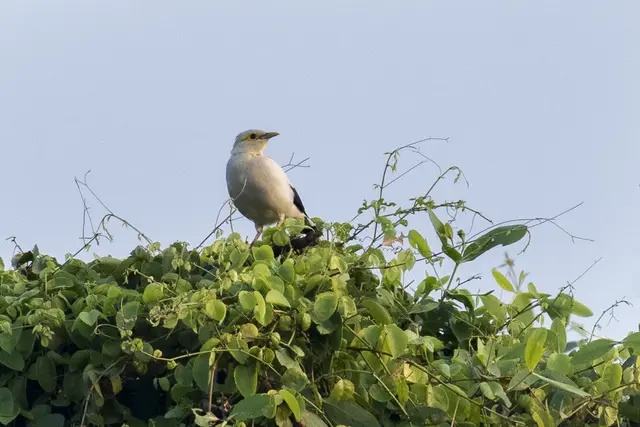
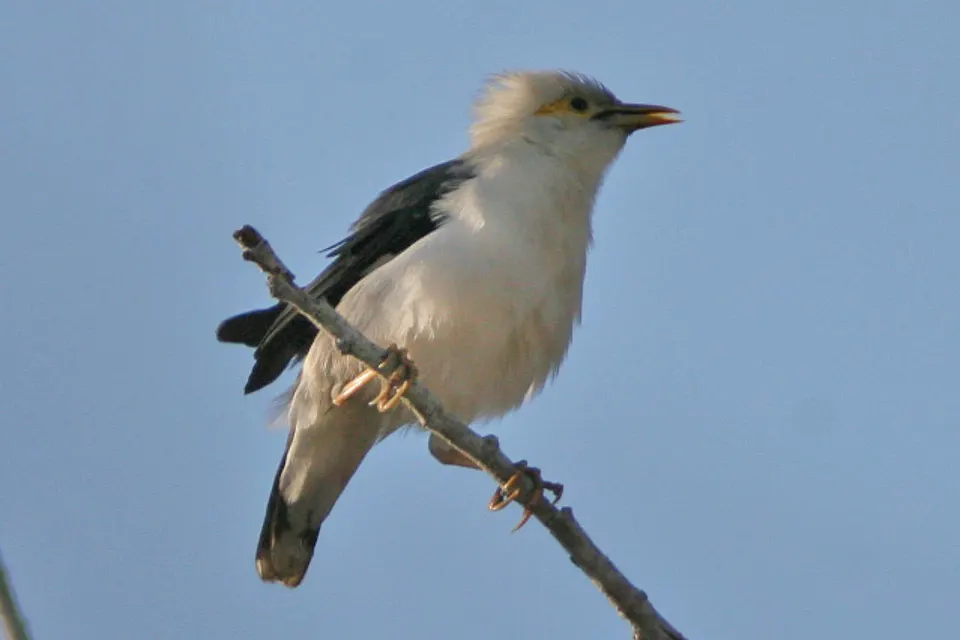
The grey-rumped myna (Acridotheres tertius) is a pale starling from Bali, Indonesia, mostly white with a grey back and rump and black wings. Some authorities treat it as a species of its own, others as a form of the black-winged myna. The IUCN Red List classed it as Critically Endangered in 2018.
How to recognise it
It is a medium-sized, stocky starling about 23 cm long, mostly clean white with black wings and tail. Adults have a short white crest, bare yellowish or pinkish skin around the eye, and a yellow bill and legs. Males and females look alike, and the voice is a run of loud, harsh whistles.
The dark grey back and grey rump separate it from its Javan relatives. The black-winged myna proper has a white back and rump, and the grey-backed myna of far eastern Java has a grey back with a white rump. Young grey-backed and grey-rumped birds look much like the black-winged myna, which makes identification harder.
Where it lives
The grey-rumped myna is found on Bali. The IUCN treats its presence on the Lesser Sunda islands further east as possibly extinct, and some authorities question the old Lombok records, since they may involve escaped birds. The IUCN puts its extent of occurrence at about 1,700 square km. It ranges from sea level up to 2,400 m, in dry forest, dry and moist shrubland, dry savanna, pasture and farmland.
The 2018 assessment counts two subpopulations, the larger holding an estimated 51 to 250 birds. It also records that the species occurs in at least one protected area.
Pins are Wikidata “endemic to” fields. Orange dots, when present, are GBIF occurrence tiles — survey bias included.
How it lives
It is not a migrant. The black-winged myna group as a whole eats fruit, nectar and insects, feeds in pairs and small groups, roosts communally and nests in holes lined with twigs. Detailed studies of the Bali birds themselves are scarce, so this picture rests mostly on the wider group.
The three forms can interbreed. A 2018 study in Global Ecology and Conservation found birds in Indonesian bird markets that appeared to be crossbreeds, and urged the authorities to prevent captive-bred mynas from being released outside their home range.
Why it is in trouble
The main cause is the cage-bird trade. Black-winged mynas were regarded as fairly common in the 1980s and 1990s, especially the grey forms, and about 20 years before the 2018 study none of them was considered globally threatened. High levels of trapping for the domestic pet market brought them to the brink. The IUCN lists deliberate capture and pesticide use as threats to this myna.
The 2018 assessment gives 50 to 249 individuals and a continuing decline. The 2018 study put the wild population of the Bali form at some 200 birds, against roughly 2,000 estimated to be in private hands in Indonesia. Across the group, pet birds now outnumber wild ones. The study also cited a theft from a breeding centre in West Java that took 149 black-winged mynas and two grey-rumped ones.
What is being done
Black-winged mynas have been on Indonesia's protected species list since 1979, and a 2018 revision of the list names all three forms separately. Catching, moving or selling them is illegal, with penalties of up to five years in prison and fines of up to about US$7,250. The 2018 study described enforcement as absent, erratic or inefficient.
The IUCN records that conservation sites have been identified across the whole range and that the species is held in captivity and covered by education programmes, but that there is no recovery plan and no systematic monitoring scheme. It recommends a secure captive breeding programme, stricter enforcement of capture and trade rules in bird markets, and control of agricultural pesticides. Releases of confiscated or captive-bred birds have not been coordinated, and the 2018 study noted that Javan birds had been released on Bali. It called for stronger enforcement and a joint management plan covering all three species.
Sources
Written for this catalog in our own words from the sources below, checked against them on 12 November 2026. Population figures are estimates and carry the year they were made. Status and assessment year: IUCN. 2026. The IUCN Red List of Threatened Species. Version 2026-1. iucnredlist.org.