Endangered
Acanthaeschna victoria
Acanthaeschna victoria
The thylacine darner (Acanthaeschna victoria) is a large dragonfly with dark side stripes from the east coast of Australia, recorded in New South Wales and Queensland. The IUCN Red List classed it as Endangered in 2017. A 2012 paper reported its surprise rediscovery, and its common name nods to the thylacine.
How to recognise it
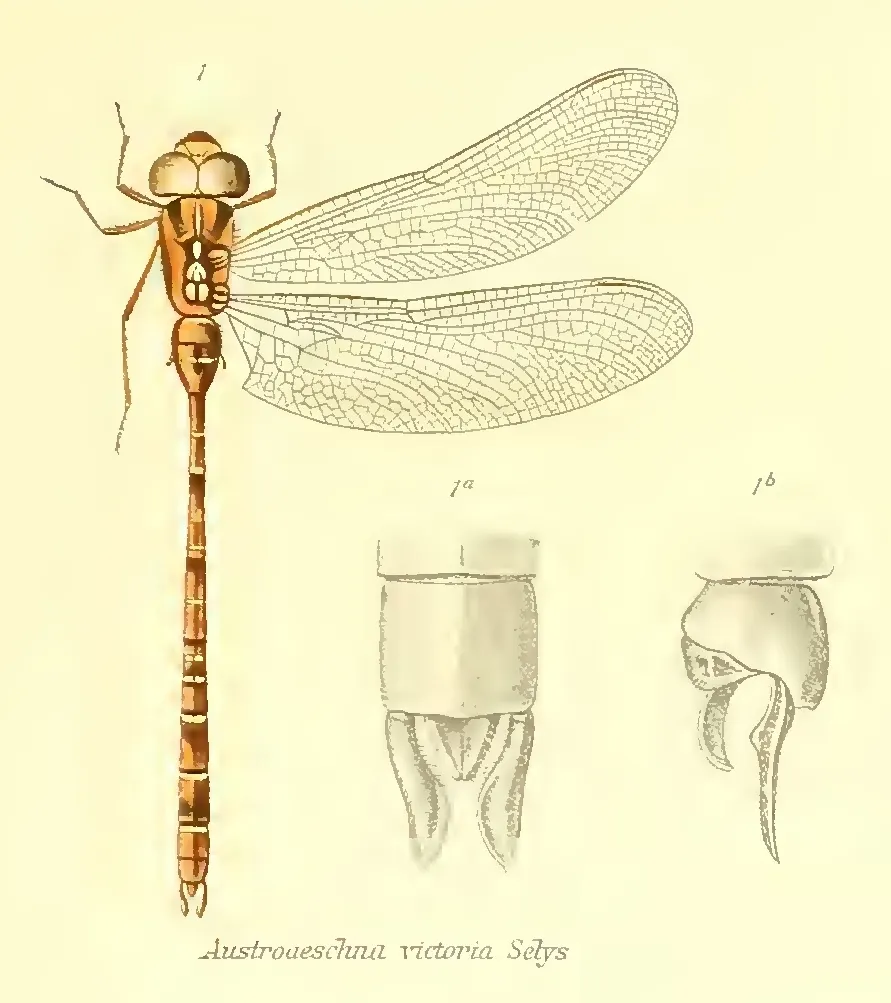
It's a big dragonfly with a dark stripe down each side of the body from head to abdomen. The abdomen is long and slender and banded along its segments. Reportedly the wings are clear, with a small dark mark at the nodus and a yellowish-tinted pterostigma (the cell near the wingtip). Sources differ on overall colour, giving it as brown in one account and cream with black side stripes in another.
The genus name refers to spine-like teeth at the tip of a female's abdomen. René Martin described the species in 1901, and it is the only member of its genus.
Which family it belongs to
Its family placement is not settled across sources. IUCN and GBIF list it in the darner family Aeshnidae. Dragonfly specialists, including the title of the 2012 rediscovery paper and an identification key, place it in Telephlebiidae. You may see it under either.
Where it lives
IUCN lists records from New South Wales and Queensland and counts five locations. Another source gives New South Wales and Victoria, so the exact range is not agreed. The estimated area it actually occupies is only 32 to 500 square kilometres, though its overall range outline (extent of occurrence) is about 121,500 square kilometres.
IUCN lists permanent and seasonal rivers and streams, plus marshes and swamps, as its habitats. One dragonfly photo site says it inhabits slow, possibly temporary streams. It occurs in at least one protected area.
Pins are Wikidata “endemic to” fields. Orange dots, when present, are GBIF occurrence tiles — survey bias included.
How it got its name
In 2000 the dragonfly specialist Gunther Theischinger suggested the common name thylacine dragonfly for a species with black side stripes and a history he likened to that of the Tasmanian tiger. In 2012 Theischinger and Jacobs published a paper in Agrion titled as a surprise rediscovery of the species, calling it a key taxon in dragonfly evolution.
Adults are rarely seen. A specimen photographed in Theischinger's laboratory in New South Wales was reared from a larva.
Why it is in trouble and what is being done
IUCN records a decreasing population, with ongoing decline in the area it occupies and in its subpopulations, and a severely fragmented distribution. The listed threats are housing and urban development, commercial and industrial areas, tourism and recreation areas, small-holder and large-scale farming and grazing, groundwater abstraction, and more frequent or intense fires.
Together these degrade the wetlands and streams it depends on.
The actions IUCN lists are site and area protection and management, protection of resources and habitat, and restoration of habitat and natural processes. The species is known from at least one protected area.
Sources
Written for this catalog in our own words from the sources below, checked against them on 12 November 2026. Population figures are estimates and carry the year they were made. Status and assessment year: IUCN. 2026. The IUCN Red List of Threatened Species. Version 2026-1. iucnredlist.org.




