Diplopoda in crisis
1 records. Red List version 2026-1
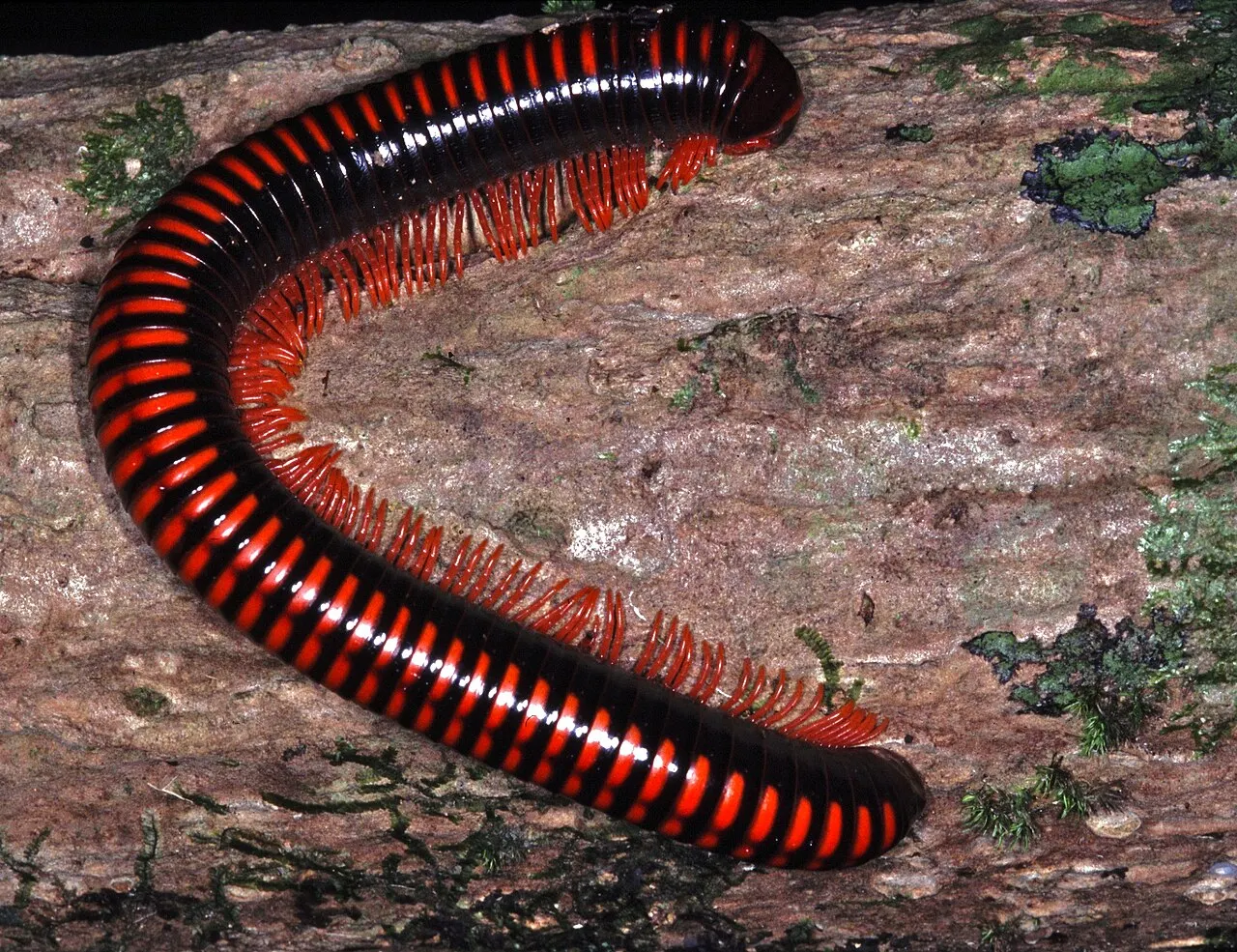
In this catalog, Diplopoda stands for millipedes. We list 1 millipedes that the IUCN Red List records as threatened enough to be Critically Endangered, Endangered or Extinct in the Wild: 1 Critically Endangered.
This is the only member of the group in the catalog, so the whole shelf is one record.
A class is a filing shelf, not a measure of risk: it says nothing about how fast any one species is declining. Status and assessment years come from the IUCN Red List (version 2026-1); how to read an IUCN assessment explains what the categories and criteria mean, and each record links to its own assessment.
Millipedes are many-legged arthropods with two pairs of legs on most body segments. They are among the first animals to have colonised land: the oldest known body fossil is about 427 million years old, from the Silurian.
About 12,000 species have been named, but researchers estimate the real total at somewhere between 15,000 and 80,000. Most species have small ranges because millipedes spread slowly, which is why so many are known from just one forest or one island.
Most are detritivores. They eat fallen leaves, litter and dead wood, and their guts break it into fragments that microbes can finish off. Their defence is to coil up under a hard exoskeleton, and many ooze irritating or toxic secretions, which can include hydrogen cyanide.
Why these animals are threatened
Few millipede species are widespread, because they disperse poorly. A species that can't travel far and lives in one habitat has little room to cope when that habitat is cleared or altered. That is an inference from the small-range fact, not a sourced threat list for the group.
The true species total may be several times the described number, so the described species are only part of the group.
What the catalog lists
The catalog has 1 record in this group: Aphistogoniulus corallipes, listed as Critically Endangered. It belongs to the family Pachybolidae in the order Spirobolida.
Spirobolida is an order of roughly 500 species in 12 families, mostly tropical and often brightly coloured. Pachybolidae is one of its families, with about 49 genera.
One record in a group of thousands of described species says very little about millipedes overall. It says little beyond that this one species has been assessed.
Sources for this section
- Millipede, Wikipedia: 12,000 described species, 15,000 to 80,000 estimated, diet, defence, 427 million year fossil, limited dispersal
- Spirobolida, Wikipedia: about 500 species in 12 families, tropical, often brightly coloured
- Pachybolidae, Wikipedia: family in Spirobolida, 49 genera
Status breakdown
1 records: Critically Endangered 1.
All species
Spirobolida (1)
The A to Z index lists the species with a full account; the catalog search finds any record by name.
Quick answers
- How many millipedes are in this catalog?
- 1, listed by the IUCN Red List as 1 Critically Endangered.
- What is Diplopoda?
- Here, Diplopoda means millipedes. It is a taxonomic class used to group the catalog.
- Where do the statuses come from?
- From the IUCN Red List (version 2026-1), with a link to each species' assessment on iucnredlist.org.