Clitellata in crisis
2 records. Red List version 2026-1
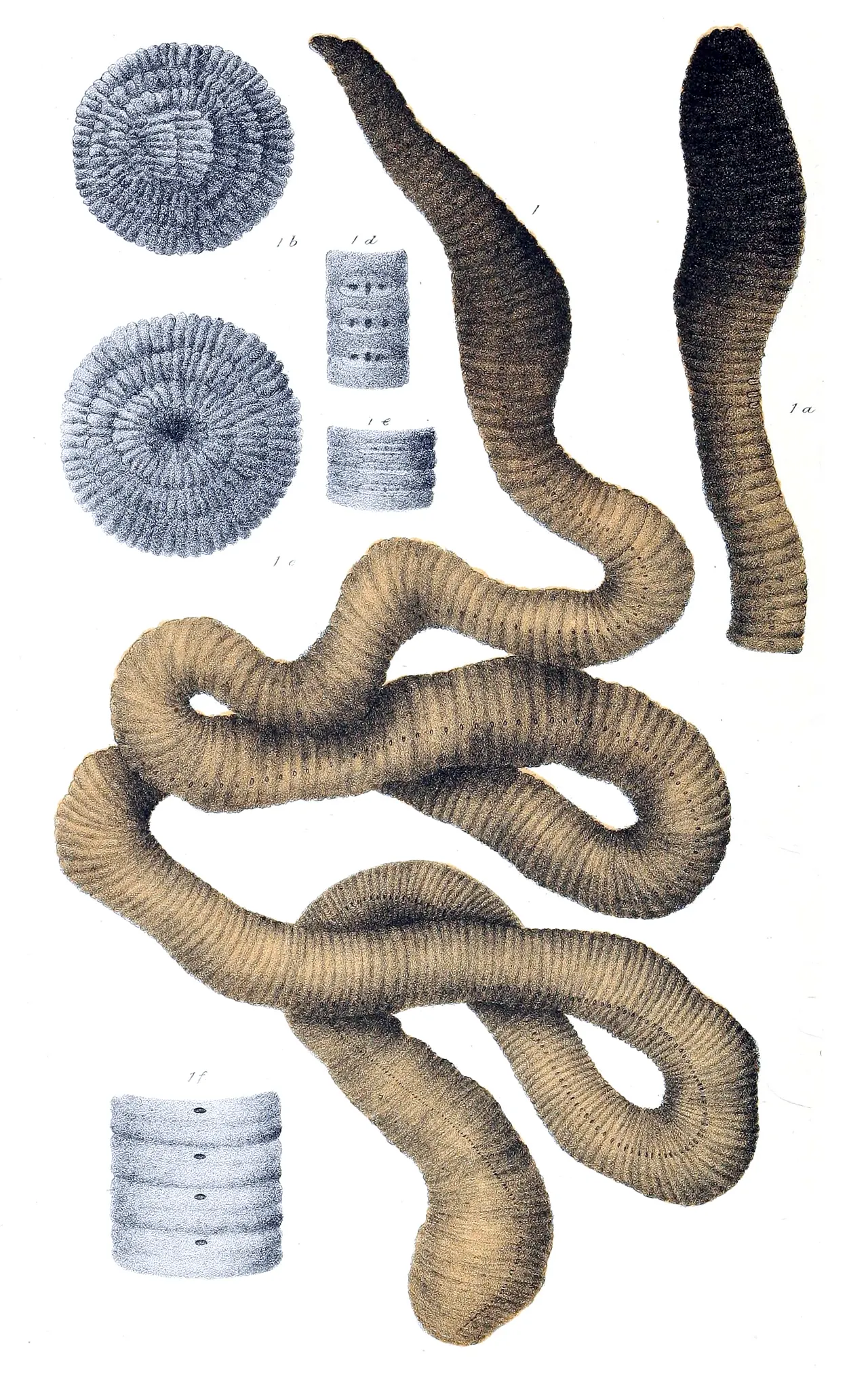
In this catalog, Clitellata stands for earthworms, leeches and their relatives. We list 2 clitellate worms that the IUCN Red List records as threatened enough to be Critically Endangered, Endangered or Extinct in the Wild: 2 Endangered.
A class is a filing shelf, not a measure of risk: it says nothing about how fast any one species is declining. Status and assessment years come from the IUCN Red List (version 2026-1); how to read an IUCN assessment explains what the categories and criteria mean, and each record links to its own assessment.
Clitellata is the class of segmented worms that holds earthworms and leeches. What defines them is the clitellum, a glandular band near the front of mature adults. It makes mucus that holds mating partners together and then forms the cocoon in which the eggs develop, with no larval stage.
The class has about 8,000 species. Most oligochaetes, the group that includes earthworms, burrow in damp soil or mud, and earthworms are its largest members. Clitellates also live in fresh water and the sea, and leeches are found in freshwater, land and marine habitats worldwide.
Why these animals are threatened
The two clitellates in the catalog are both very large earthworms in the family Megascolecidae, and both depend on deep, moist soils. The giant Gippsland earthworm of Victoria, Australia, is typically about 1 m long and can reach 3 m. It lives in deep burrows in clay subsoil, mainly along stream banks and on some hillsides. Its colonies are small and isolated, it takes about 5 years to mature and has a low reproductive rate. Cultivation, heavy cattle grazing and effluent run-off harm it, and dense tree planting dries out its soil. No successful captive breeding has been achieved. A national recovery plan dates from 2010.
The Oregon giant earthworm, Driloleirus macelfreshi, reaches more than 0.9 m long and digs permanent burrows in deep, moist, undisturbed soils of riparian forests. It was described in 1937 from a specimen collected in 1903. It has been documented at 15 sites in Oregon's Willamette Valley and one in the Coast Range, and its last sighting is given as 2008. Less than 1 percent of the valley's original native grassland survives, and competition from introduced earthworms is considered a major threat.
What the catalog lists
Both records are Endangered, and both come from the order Crassiclitellata, the big burrowing earthworms. The Oregon species is listed on a 2014 assessment, so the situation may have changed since.
Almost nothing about leeches or the thousands of small aquatic and soil species is in the catalog. The two records say nothing about how safe those groups are.
Sources for this section
- Wikipedia, Clitellata: clitellum and cocoon, no larval stage, about 8,000 species (undated), oligochaete and leech habitats
- Wikipedia, Giant Gippsland earthworm: size, Victoria range, burrows in clay, slow maturity, threats, 2010 recovery plan, no captive breeding
- Wikipedia, Oregon giant earthworm: size, Willamette Valley sites, 1937 description, last sighting 2008, habitat loss and competition, 2014 assessment
Status breakdown
2 records: Endangered 2.
All species
Crassiclitellata (2)
- Megascolides australis EN
- Oregon giant earthworm Driloleirus macelfreshi EN
The A to Z index lists the species with a full account; the catalog search finds any record by name.
Quick answers
- How many clitellate worms are in this catalog?
- 2, listed by the IUCN Red List as 2 Endangered.
- What is Clitellata?
- Here, Clitellata means earthworms, leeches and their relatives. It is a taxonomic class used to group the catalog.
- Where do the statuses come from?
- From the IUCN Red List (version 2026-1), with a link to each species' assessment on iucnredlist.org.