Cephalopoda in crisis
1 records. Red List version 2026-1
In this catalog, Cephalopoda stands for octopuses, squids, cuttlefish and nautiluses. We list 1 cephalopods that the IUCN Red List records as threatened enough to be Critically Endangered, Endangered or Extinct in the Wild: 1 Critically Endangered.
This is the only member of the group in the catalog, so the whole shelf is one record.
A class is a filing shelf, not a measure of risk: it says nothing about how fast any one species is declining. Status and assessment years come from the IUCN Red List (version 2026-1); how to read an IUCN assessment explains what the categories and criteria mean, and each record links to its own assessment.
Cephalopods are the marine mollusks that include octopuses, squid, cuttlefish and nautiluses. More than 800 living species are known, plus around 11,000 extinct ones. Octopuses, squid and cuttlefish have shells that are internal or missing, while Nautilus keeps an outer shell.
All of them live in the sea, from the surface to the abyssal and hadal depths, and they are most varied near the equator. They catch prey with arms and tentacles, a beak and toxic digestive saliva, and defend themselves with camouflage, colour displays and ink. They are widely described as the most intelligent invertebrates.
The deep-sea octopuses in the catalog
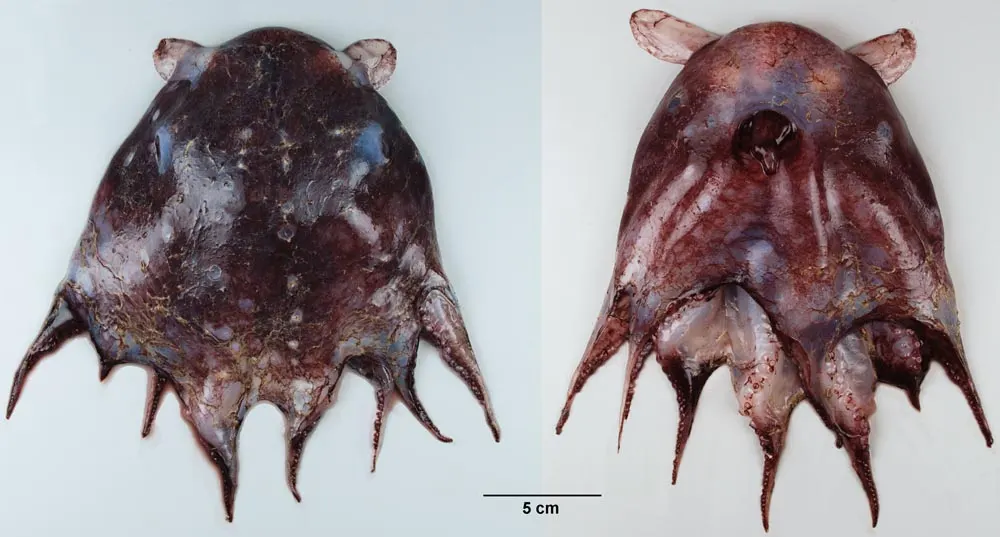
The catalog's only cephalopod is Opisthoteuthis chathamensis, in the family Opisthoteuthidae. Opisthoteuthis is a genus of cirrate octopuses, nicknamed flapjack octopuses, with about two dozen species. Cirrate octopuses have small strands called cirri along their arms and two fins on the head, and they swim with fin movement and a pulsing bell rather than the jet propulsion of most octopuses. Opisthoteuthidae are mainly seafloor dwellers, and stomach data for cirrates point to a diet of crustaceans and worms.
O'Shea described O. chathamensis in 1999. Where it lives and what threatens it are not covered by the sources used here, so this section stays general.
Why this record is hard to read
Deep-sea cirrates are fragile and easily damaged when sampled, so data on them are limited. For an animal this poorly known, a Critically Endangered record is a reason for caution, and it should not be read as a long-term count.
With more than 800 living species in the class, a single record cannot represent cephalopods generally.
Sources for this section
- Wikipedia, Cephalopod: over 800 living species, about 11,000 extinct, subclasses, marine habitat range, hunting, defences, intelligence
- Wikipedia, Opisthoteuthis: cirrate flapjack octopuses, genus described as having 25 species (the page's own list shows 22), O. chathamensis described by O'Shea 1999, listed CR
- Wikipedia, Cirrate octopus: cirri, two head fins, swimming style, Opisthoteuthidae benthic, diet from stomach data, fragility and limited data
Status breakdown
1 records: Critically Endangered 1.
All species
Octopoda (1)
The A to Z index lists the species with a full account; the catalog search finds any record by name.
Quick answers
- How many cephalopods are in this catalog?
- 1, listed by the IUCN Red List as 1 Critically Endangered.
- What is Cephalopoda?
- Here, Cephalopoda means octopuses, squids, cuttlefish and nautiluses. It is a taxonomic class used to group the catalog.
- Where do the statuses come from?
- From the IUCN Red List (version 2026-1), with a link to each species' assessment on iucnredlist.org.