Endangered
Negros striped babbler
Zosterornis nigrorum
The Negros striped babbler is a small, streaked songbird found only in the mountain forests of Negros Island in the Philippines. Despite its name it is closer to the white-eyes than to the true babblers. The Red List assessed it as Endangered in 2024, with a small and shrinking population.
How to recognise it
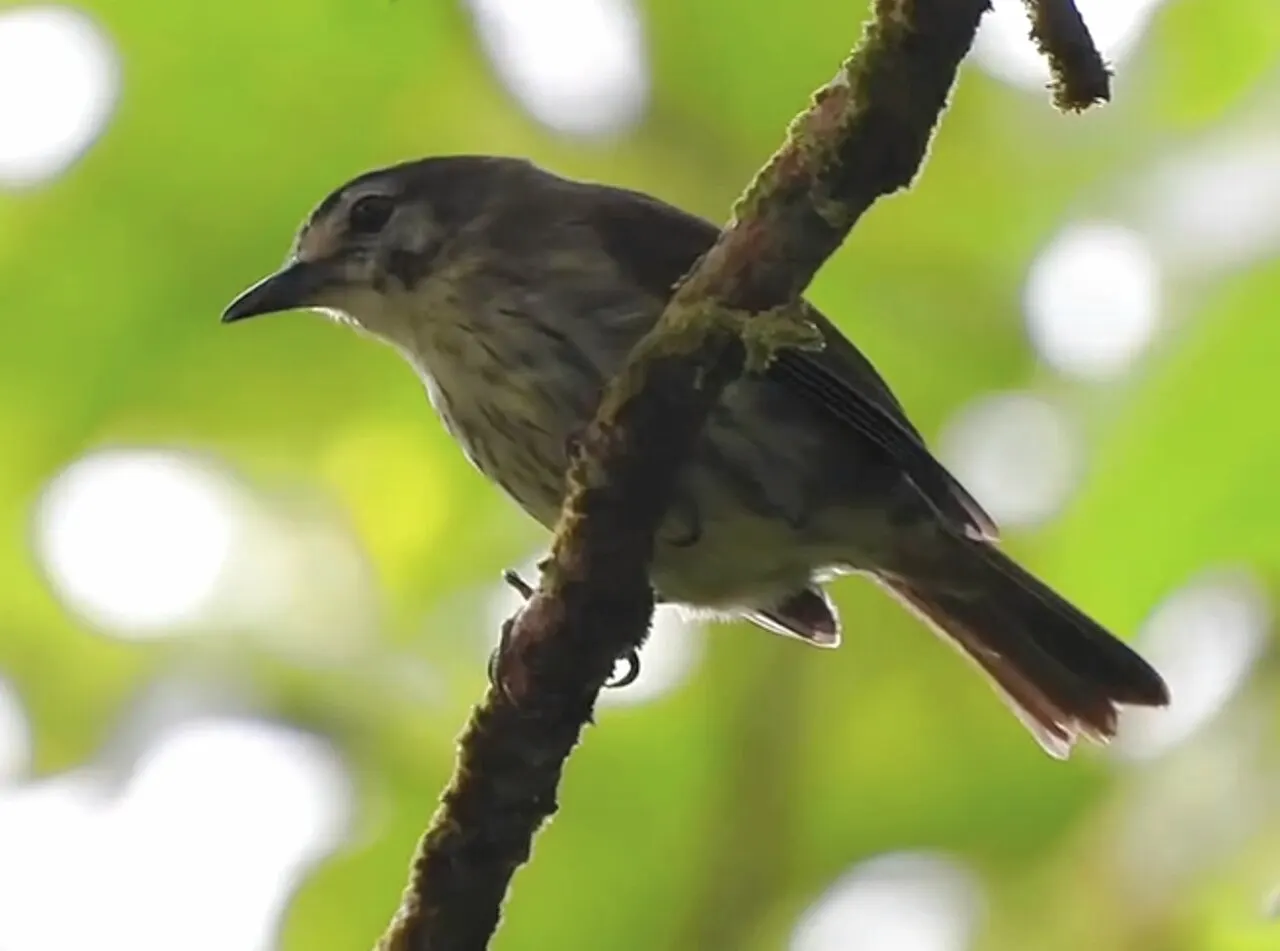
This is a small bird with light brown upperparts and pale underparts marked with fine black streaks. The throat is white, and bold markings on the face frame the ear.
It looks very like its relative the Panay striped babbler, which was treated as the same species until 1990. The Negros bird has paler, more finely streaked underparts. It was described in 1952 as a true babbler in the genus Stachyris, and is now placed in Zosterornis, in the white-eye family. It is also known as the Negros tree-babbler.
Where it lives
It occurs only on Negros. The Red List gives an elevation range of 900 to 1,600 m, in moist montane forest, and it is also recorded in plantations. Mount Talinis is one of its key sites.
It may still live on Mount Kanlaon, where transect counts reported in 2017 found 10 birds at about 850 to 1,450 m and 4 at about 1,450 to 1,800 m, none lower down.
It tolerates some disturbance. Birds have been recorded in secondary growth and at forest edges, though it seems to need some forest cover.
Pins are Wikidata “endemic to” fields. Orange dots, when present, are GBIF occurrence tiles — survey bias included.
How it lives
Striped babblers eat insects and small fruits. They forage in the understorey and bushes, sometimes up to about 20 m high, and search dead foliage, even in banana plants. They are seen alone, in pairs or in groups of up to about 20, and often join mixed flocks with birds such as the Visayan bulbul and Visayan fantail.
Breeding is poorly known. A juvenile was seen in September, and birds with enlarged gonads were found in November and December.
Why it is in trouble
Negros has lost almost all of its original forest, reportedly leaving only about 4% by 1988. The Red List assessment names shifting agriculture, agro-industrial farming and the unintended effects of small-scale harvesting as the main pressures, and records the population as decreasing.
The 2024 assessment estimates 750 to 2,300 birds. An older figure, from 2015, was 600 to 1,700. Between 5 and 40% of the population is thought to live inside protected areas. The Kanlaon counts were reported alongside a list of causes: tree cutting for firewood and charcoal, timber poaching, bird hunting and conversion of forest to farmland.
What is being done
The bird occurs in at least one protected area, and conservation sites have been identified across its range. There is no recovery plan and no systematic monitoring scheme. Site protection is the action listed.
Awareness campaigns have reportedly been run near Mount Talinis, where a neighbouring geothermal reservation gives some indirect protection to high forest.
Sources
Written for this catalog in our own words from the sources below, checked against them on 12 November 2026. Population figures are estimates and carry the year they were made. Status and assessment year: IUCN. 2026. The IUCN Red List of Threatened Species. Version 2026-1. iucnredlist.org.




