Endangered
Adriatic Marmored Bush-cricket
Zeuneriana marmorata
The Adriatic marbled bush-cricket (Zeuneriana marmorata) is a squat, dark, flightless bush-cricket of brackish reed beds and wet meadows around the northern Adriatic. Only about four populations remain, in north-eastern Italy and Slovenia. The IUCN Red List rated it Endangered in 2016. Males are easier to hear than to find.
How to recognise it
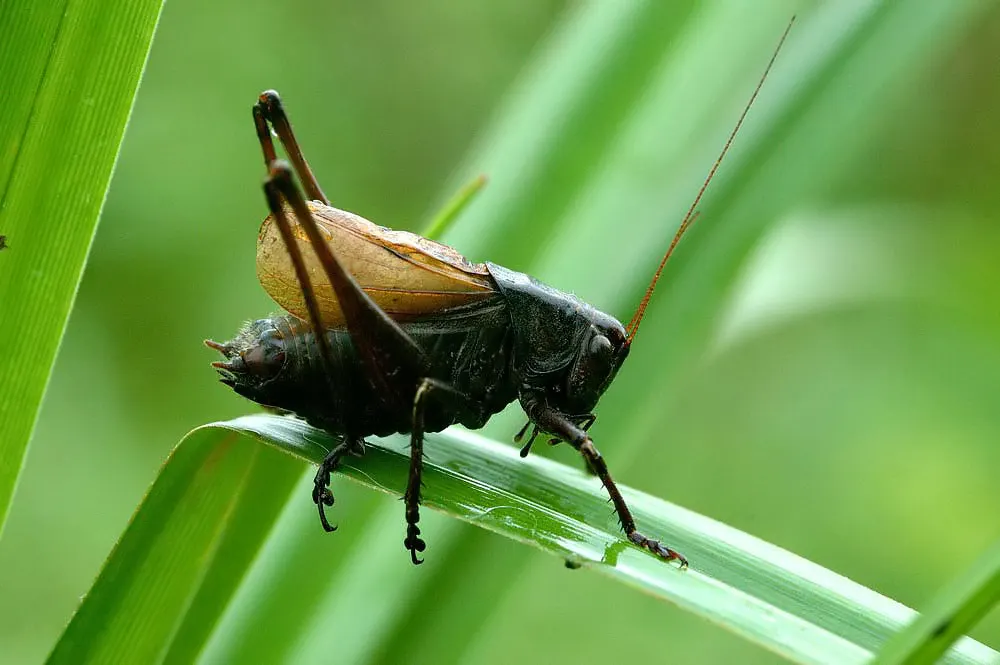
It is a medium-sized bush-cricket, roughly 16 to 21 mm long, with a stocky build. The body is black or blackish brown and the wing covers are dark brown. The female has a short, slightly upturned ovipositor 8 to 9 mm long. Nymphs are blackish brown with a paler patch on the pronotum and back.
Spotting one is hard. It stays in dense vegetation and drops or jumps away at the slightest alarm. Males give themselves away by singing, a powerful call made by rubbing the forewings together, audible from more than 30 m. The song makes survey by sound feasible.
Where it lives
It was once widespread across the low coastal plain of the north Adriatic, with old records from near the Adige mouth, Chioggia and Aquileia. After decades without a sighting it was presumed extinct, until it was rediscovered near Monfalcone, at the Lisert wetland, in 1996. A Slovenian population in the marshes south of Ljubljana was found in 2004.
Italian populations now sit in three areas of Friuli Venezia Giulia: the Lisert springs and Timavo mouth near Monfalcone, the mouth of the Isonzo, and the Marano Lagoon. The Red List gives a range from sea level to 300 m, an area of occupancy of 20 to 36 square kilometres and five subpopulations. A 2017 Italian action plan counted about 57 ha of habitat left in total, only around 16 ha of it in Italy.
Pins are Wikidata “endemic to” fields. Orange dots, when present, are GBIF occurrence tiles — survey bias included.
How it lives
It likes moist ground beside water where sedges, rushes or common reed dominate. Sites are flooded now and then, but it does not live where water stays high through the growing season. It tolerates mild salt, and at the Isonzo mouth and in the Marano Lagoon it lives where brackish water floods the ground.
There is one generation a year, and the eggs, laid in plant stems, pass the winter. In Italy nymphs were seen in early June 2016 and adults from the second half of June, with singing males thinning out after July. It feeds on common reed leaves and is probably omnivorous, like other bush-crickets. It cannot fly and seems to move little, so it is unlikely to recolonise lost ground on its own.
How many are left
The action plan put the total at an estimated 3,000 to 5,000 adults a year across all four populations. In July 2016, transect counts found about 156 singing males per hectare at Lisert and 163 at Punta Sdobba on the Isonzo. The plan's rough estimate was 300 to 500 singing males at Lisert and at least 400 at each of two Isonzo sites.
Why it is in trouble
Drainage and reclamation, mostly between the world wars and up to the 1950s, turned coastal wetlands into cropland. Heavy insecticide use against malaria after the war, including DDT, is thought to have contributed to its decline in northern Italy. At Lisert, industrial expansion since the 1970s, drainage works and a railway have shrunk and dried the habitat, and scrub and trees are taking over.
The Red List population trend is decreasing. It lists small-scale farming, water abstraction for agriculture and other ecosystem modifications as ongoing threats, and industrial development and pesticides as past ones. Sea-level rise could make the Isonzo and Marano sites too salty.
What is being done
Friuli Venezia Giulia law forbids catching the species, and all Italian sites except Lisert lie in protected areas. The Lisert springs, home to one population, had no protection as of the 2017 plan, and a proposed strictly protected biotope there had not been established. The plan, written for 2016 to 2022, sets goals including a survey of sites for possible translocation by 2020 and a translocation strategy by 2022. A conservation strategy was also prepared for Slovenia.
The Red List assessment also lists taxonomy among its research needs: the relationship between this species and Zeuneriana amplipennis, which occurs from Serbia to Romania, has not been studied genetically.
Sources
Written for this catalog in our own words from the sources below, checked against them on 12 November 2026. Population figures are estimates and carry the year they were made. Status and assessment year: IUCN. 2026. The IUCN Red List of Threatened Species. Version 2026-1. iucnredlist.org.




