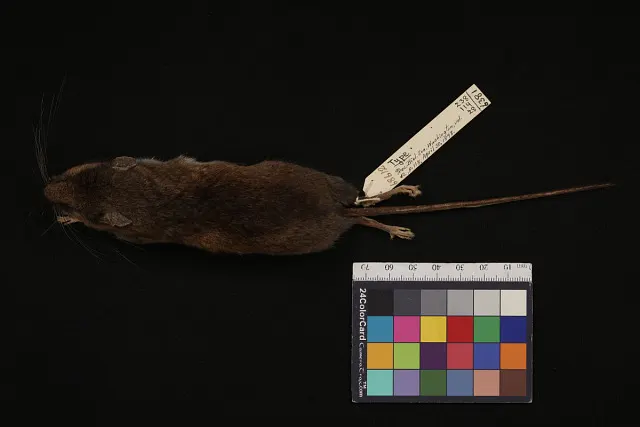
Critically Endangered
Zempoaltepec deermouse
Habromys lepturus
The Zempoaltepec deermouse (Habromys lepturus), also called the slender-tailed deer mouse, is a small cloud forest rodent known from a single mountain, Cerro Zempoaltepec in Oaxaca, southern Mexico. The IUCN Red List classed it as Critically Endangered in 2018 and records its population as decreasing.
How to recognise it
Detailed published measurements and colour descriptions are scarce, and no size is given in the sources available. The IUCN notes that it looks much like the Ixtlan deer mouse (Habromys ixtlani), another Oaxacan cloud forest species.
American zoologist C. Hart Merriam described it in 1898 from a specimen collected on Mount Zempoaltepec at about 2,500 metres (8,200 feet), and he first called it Peromyscus lepturus. The preserved type specimen is catalogued in the US National Museum as USNM 68612. The species was later moved to the genus Habromys, whose members are known as crested-tailed deer mice.
Where it lives
The IUCN assessment says it is known only from Cerro Zempoaltepec, above 2,500 metres in Oaxaca. It treats this as a single location, with an extent of occurrence of only 86 square kilometres. The habitat is subtropical or tropical moist montane forest, with cool, wet conditions and ferns and lichens.
A genetic study of the genus in the journal Therya sampled animals on Cerro Zempoaltepetl, an alternative spelling, about 4.5 kilometres north of Santa Maria Yacochi in the municipality of Tlahuitoltepec. It found that the lineage reached the mountain from the Sierra de Juarez, though the study gives conflicting dates for that move.
Pins are Wikidata “endemic to” fields. Orange dots, when present, are GBIF occurrence tiles — survey bias included.
How it lives
Very little has been published on this particular animal, and the IUCN calls it rare. Its genus gives some clues. The Therya study describes the seven Habromys species as having arboreal habits and a high degree of habitat specialisation, and says some may live at low densities with small home ranges. How far that applies to the Zempoaltepec deermouse itself is not documented.
Why it is in trouble
The assessment names deforestation within its small range as the threat and records a continuing decline in the extent and quality of its habitat. It does not say what is driving the forest loss. The species qualifies as Critically Endangered under criterion B1ab(iii), the rule for animals with a very small range, a single location and a habitat in decline. The population is not considered severely fragmented, and no population size is given.
Its relatives face similar pressure. The Ixtlan deer mouse is also Critically Endangered, and every member of the genus depends on cloud forest.
What is being done
The assessment reports no conservation measures currently in place and records that the species does not occur in a protected area. No species-specific programme is known, and no captive population is mentioned.
Sources
Written for this catalog in our own words from the sources below, checked against them on 12 November 2026. Population figures are estimates and carry the year they were made. Status and assessment year: IUCN. 2026. The IUCN Red List of Threatened Species. Version 2026-1. iucnredlist.org.




