Endangered
Zebra oto
Otocinclus cocama
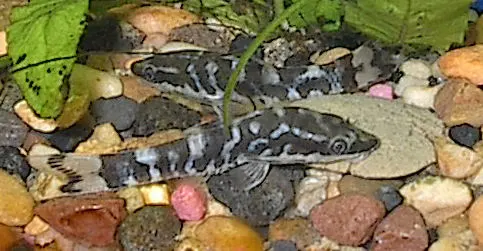
The zebra oto (Otocinclus cocama) is a tiny armoured catfish from the Peruvian Amazon, about 4 cm long and marked with dark vertical blotches. It is known with certainty from one stream and is sold in the aquarium trade. The IUCN Red List rated it Endangered in 2016, citing its tiny range and collection for that trade.
How to recognise it
It is a small suckermouth catfish in the family Loricariidae. The back and head are pale, bluish white to creamy yellow, crossed by four dark saddle-shaped blotches, and the tail fin carries a W-shaped band. The vertical blotches set it apart from other otos. It also has a complete lateral line, which its relatives lack, and a high tooth count.
Adults reach about 4.5 cm in standard length. Males are usually 5 to 10 mm smaller than females and have a small cone-shaped papilla behind the anus.
Where it lives
Roberto Reis described the fish in 2004 from Yanayacu creek near Jenaro Herrera, in the Loreto region of Peru, and that remains the only place it is known with certainty. Aquarium references suggest it may range through the lower Ucayali and Marañón basins, but the Red List assessment counts a single location and an extent of occurrence of about 1,340 square km.
Aquarium references describe its habitat as small tributaries or slow marginal zones of larger rivers, with clear water and dense marginal plants. The assessment lists permanent rivers and small pools.
Pins are Wikidata “endemic to” fields. Orange dots, when present, are GBIF occurrence tiles — survey bias included.
How it lives
Like other otos it is a grazer, scraping algae and biofilm from plants and other surfaces. Aquarium keepers describe it as peaceful but timid, happiest in a group of six or more in a mature, well-planted tank, and sometimes delicate after import.
Breeding in aquariums has been reported, but details are scarce.
Why it is in trouble
Collection for the ornamental fish trade is the one threat the IUCN assessment lists. The fish was first offered to the trade around 2000, sold as Otocinclus "zebra" before it had a scientific name. The Red List gives its population trend as unknown, though it records a continuing decline, and the assessment says it should be revised if the species turns out to be more widespread.
No part of its range is protected, and the species is not covered by CITES. Large-scale breeding in Asia has been reported, which could in principle ease pressure on wild stocks, but its effect has not been measured.
Sources
Written for this catalog in our own words from the sources below, checked against them on 12 November 2026. Population figures are estimates and carry the year they were made. Status and assessment year: IUCN. 2026. The IUCN Red List of Threatened Species. Version 2026-1. iucnredlist.org.




