Endangered
Zambezi flapshell turtle
Cycloderma frenatum
The Zambezi flapshell turtle (Cycloderma frenatum) is a large, fast, fully aquatic softshell turtle of southeastern Africa, centred on Lake Malawi and the rivers of Mozambique and Tanzania. The IUCN Red List moved it to Endangered in 2016, projecting a population decline of about 50 percent driven by harvest.
How to recognise it
It is a big softshell with an oval, leathery olive-grey carapace that reaches about 56 cm. The adult shell is smooth, while young turtles have a ridge down the back and rows of small bumps. The head and neck are very dark olive in adults, and the head tapers into a projecting snout with a long neck that can shoot forward almost the length of the shell.
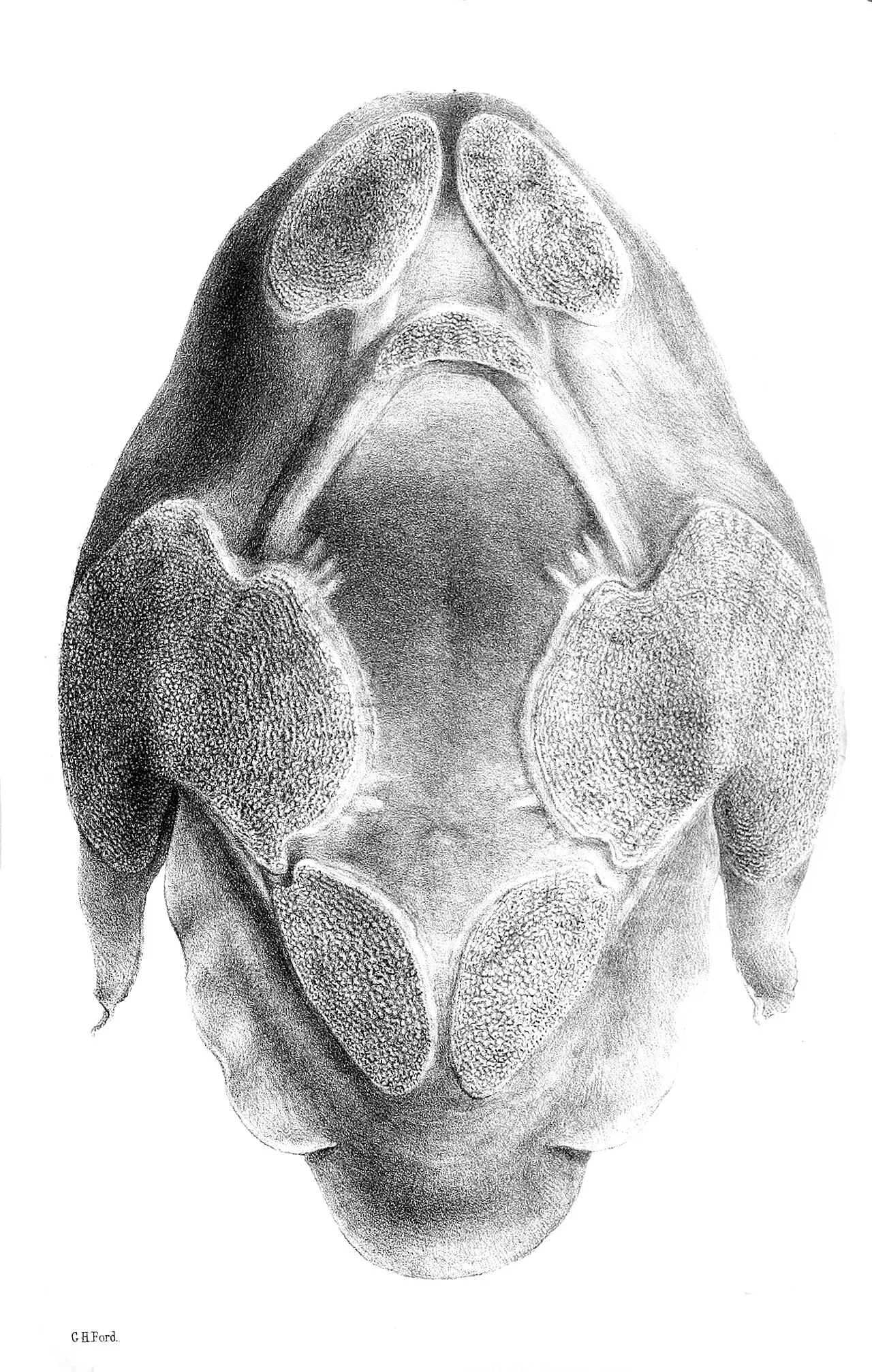
Flaps on the underside of the shell let the turtle tuck in its hind legs and tail. Males have longer, thicker tails than females. Its only living relative in the genus, Aubry's flapshell turtle, is dark reddish brown. Hatchlings from Lake Malawi measure 40 to 48 mm.
Where it lives
The centre of its range is Lake Malawi. It extends south down the Shire River into the Zambezi and across the Mozambique plain to the Save River, reaching Gonarezhou National Park in Zimbabwe. It also occurs north to the Rufiji basin in Tanzania, in Lakes Chiuta and Chilwa, and in the Rovuma River. In Lake Malawi it's common in the shallow southern end and rare in the deep north.
The IUCN lists Malawi, Mozambique, Tanzania, Zambia and Zimbabwe. A 2011 account by Broadley and Sachsse treats Zambian records as doubtful. The turtle lives in rivers and lakes from sea level to about 500 m, and seems to prefer sandy bottoms.
Pins are Wikidata “endemic to” fields. Orange dots, when present, are GBIF occurrence tiles — survey bias included.
How it lives
Young turtles lie hidden in sand with only the eyes showing and shoot out at passing fish. Adults approach prey slowly and snap once the neck can reach. In southern Lake Malawi adults also eat mussels and large aquatic snails, digging mussels out with the claws of the forefeet. Adults may travel several kilometres from shore, and up to half a dozen can be seen basking at the surface on calm days.
Females come ashore at night between late January and April and lay 17 to 25 hard-shelled eggs, 33 to 35 mm across, in a shallow hole in shade, usually within 200 m of water. Incubation takes 8 to 11 months. Crocodiles eat adults, and young turtles probably fall to Nile monitors and birds.
Why it is in trouble
People have long eaten the turtles and their eggs. In 1949 a herpetologist saw scores of eggshells on village middens in southern Lake Malawi, and nesting females were easy to catch. The turtles also drown or are taken in large fishing nets. The 2016 assessment names harvest, run-off and sewage as threats, and lists the population as decreasing.
That 2011 account found no commercial exploitation or international trade and no reported declines, so the 2016 listing rests on projected decline. Whether village consumption continues at the same rate is unknown.
What is being done
Some populations live in protected areas, including Lake Malawi, Gorongosa and Zinave National Parks, Niassa Game Reserve and Gonarezhou National Park. The IUCN lists site management, national and international legislation and awareness work among the actions, and records no recovery plan or monitoring scheme in place. The 2011 account called for population monitoring and a fresh Red List assessment, which followed in 2016.
Sources
Written for this catalog in our own words from the sources below, checked against them on 12 November 2026. Population figures are estimates and carry the year they were made. Status and assessment year: IUCN. 2026. The IUCN Red List of Threatened Species. Version 2026-1. iucnredlist.org.




