Endangered
Chapala chub
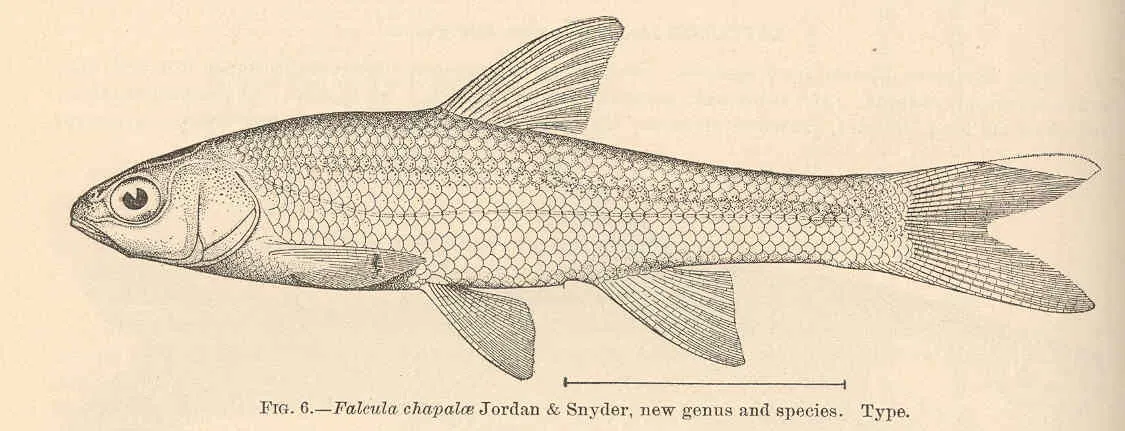
Yuriria chapalae
The Chapala chub is a freshwater fish found only in Lake Chapala and the Rio Grande de Santiago that drains it, in the Mexican states of Jalisco and Michoacan. The IUCN Red List assessed it as Endangered in 2019, with a decreasing population. Very little has been published about its biology.
What it is
Yuriria chapalae is a ray-finned fish in the minnow and shiner family, Leuciscidae. Jordan and Snyder described it in 1899. Its genus, Yuriria, holds three species, all found in Mexico's Lerma, Chapala, Grande de Santiago and Ameca river basins.
Published detail on its length, diet and breeding is scarce, so the fish is better known by where it lives than by how it looks.
Where it lives
It is endemic to Lake Chapala and its outflow, the Rio Grande de Santiago, in Jalisco and Michoacan. The Red List records it from two locations at about 1,500 to 1,525 m elevation and gives its extent of occurrence as 2,770 square km.
Its habitat is listed as seasonal freshwater lake and permanent river or stream. Its movement pattern is unknown, and the area it occupies is still shrinking. Lake Chapala is Mexico's largest freshwater lake and a main drinking water source for about 5 million people.
Pins are Wikidata “endemic to” fields. Orange dots, when present, are GBIF occurrence tiles — survey bias included.
Why it is in trouble
The assessment lists an unusually long run of threats: runoff, sewage, nutrient loads, soil erosion and silt, herbicides and pesticides, oil spills, mining seepage, drought, dams, and water taken for homes, farms and businesses. Harvest for food, both small and large scale, and recreational use also appear.
Water quality in the lake is a concern. A 2021 study rated it poor on a water quality index, blaming industrial and agricultural effluents, and found dissolved cadmium and lead above the continuous-exposure limits for aquatic life. A 2024 to 2025 study that sampled water, sediment and fish at eight stations measured 17 pesticides and 8 heavy metals. It detected DDT residues at every site, and cadmium and lead exceeded Mexican limits in pore water where the Santiago meets the lake at Zula.
Introduced fish share the lake too. The 2024 to 2025 study compared a native catfish with invasive blue tilapia, common carp and largemouth bass, and an earlier study of pollutants in lake fish sampled carp and tilapia as well. These findings concern the lake as a whole, not this chub in particular.
What is being done
The Red List records no recovery plan and no systematic monitoring scheme for the species, so its actual numbers are poorly known. It notes a harvest management plan and conservation sites identified over its whole range, but the species does not occur in a protected area.
The Endangered rating under criterion B1ab(iii) rests on a small range, few locations and continuing loss of habitat quality.
Sources
Written for this catalog in our own words from the sources below, checked against them on 12 November 2026. Population figures are estimates and carry the year they were made. Status and assessment year: IUCN. 2026. The IUCN Red List of Threatened Species. Version 2026-1. iucnredlist.org.




