Endangered
Yellow Cardinal
Gubernatrix cristata
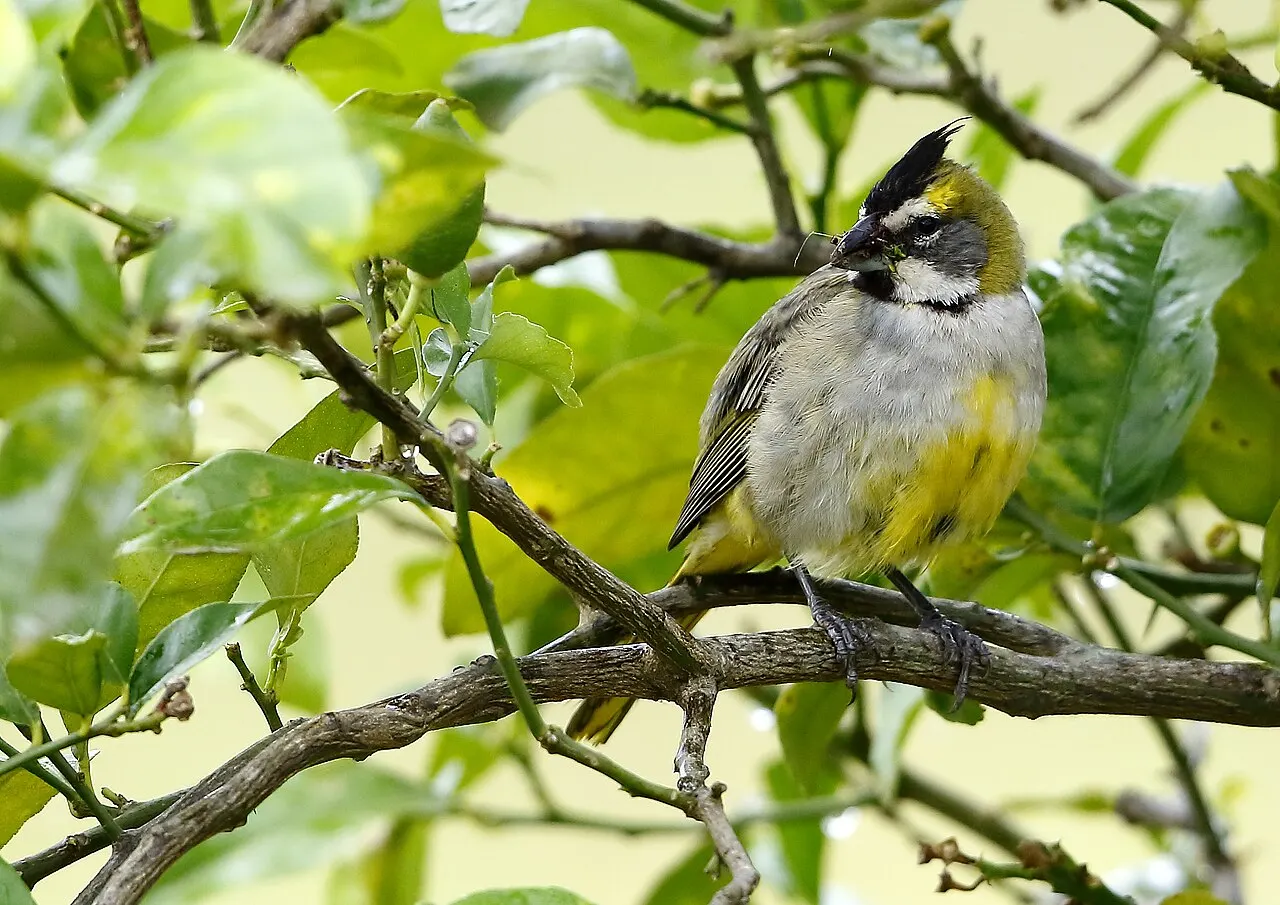
The yellow cardinal (Gubernatrix cristata) is a crested songbird of the open thorn scrub and grasslands of Argentina, Uruguay and southern Brazil. The IUCN Red List classed it as Endangered in 2018, with a decreasing population. Its bright plumage and song made it a favourite cage bird, and trapping is a major reason it is scarce.
How to recognise it
The male is easy to pick out. It has a black crest and black throat patch, a yellow eyebrow and moustache stripe, yellow underparts and streaky yellowish-olive upperparts. The female is similar but plainer, with white facial stripes, a grey breast and flanks, and yellow mostly confined to the belly.
Despite its name it is not a true cardinal. It is the only member of its genus and sits in the tanager family, and genetic work has placed the diuca finch as its closest relative. The two species are known to hybridise.
Where it lives
The species ranges over Argentina, Uruguay and Brazil, with some sources also listing Paraguay. It favours open woodland and thorny scrub with patches of trees among grassland, including plants such as espinillo, molle, coronilla and tala. The IUCN lists dry savanna, temperate and subtropical shrubland and temperate grassland as its habitats, from sea level to about 700 m.
Releases and field studies have taken place in San Luis, Buenos Aires and La Pampa provinces in Argentina. Uruguayan authorities say the bird has already disappeared from many of its original habitats.
Pins are Wikidata “endemic to” fields. Orange dots, when present, are GBIF occurrence tiles — survey bias included.
How it lives
Breeding in Uruguay runs from about October to December. Nests are vulnerable to the Shiny Cowbird, a brood parasite that lays its eggs in other birds' nests. In a 2020 study in Bird Conservation International, Atencio, Reboreda and Mahler found nearly every monitored nest in La Pampa had been parasitised, with an average of 4.5 cowbird eggs per parasitised nest.
Why it is in trouble
The IUCN estimates 1,000 to 2,000 mature birds (2018 assessment) and records a decreasing trend, with a population fall of 50 to 79 percent estimated over three generations. A news report gives a higher figure, 1,500 to 3,000 birds. Uruguay is thought to hold roughly 300 and Brazil about 50.
Capture for the illegal cage bird trade is the best-known cause, and males are reportedly taken more often than females. The IUCN also lists farming, ranching and grazing among the pressures. In Entre Ríos, officials intercepted a van carrying 95 yellow cardinals and 20 Bolivian siskins bound for Uruguay, packed in crowded conditions.
What is being done
The species is on CITES Appendix II. Seized birds are now rehabilitated, tested genetically to find their population of origin, and released there. Genetic studies show the populations differ. Uruguayan specialists add that males from one genetic group may not attract females from another, so mixing them is avoided.
Releases include 27 birds in southern Buenos Aires province in 2020, 14 birds in Uruguay after five months in quarantine, and 23 in a private reserve in northern San Luis. The work involves a group called the Yellow Cardinal Alliance, which includes Aves Argentinas and Fundación Temaikén.
Results are mixed. At a La Pampa release site in 2019, nearly every monitored nest was parasitised by Shiny Cowbirds and no chicks survived to recruitment. The 2020 study concluded that future plans need to look at habitat suitability and cowbird numbers.
Sources
Written for this catalog in our own words from the sources below, checked against them on 12 November 2026. Population figures are estimates and carry the year they were made. Status and assessment year: IUCN. 2026. The IUCN Red List of Threatened Species. Version 2026-1. iucnredlist.org.
- IUCN Red List assessment, Gubernatrix cristata (2018)
- Wikipedia, Yellow cardinal
- Birds of the World, Yellow Cardinal introduction
- Uruguay Ministry of Environment, El cardenal amarillo, una especie en extincion
- Noticias Ambientales, 23 yellow cardinals released
- Bichos de Campo, 27 cardenales liberados (October 2020)
- Cambridge Core, Atencio, Reboreda and Mahler (2020), Bird Conservation International




