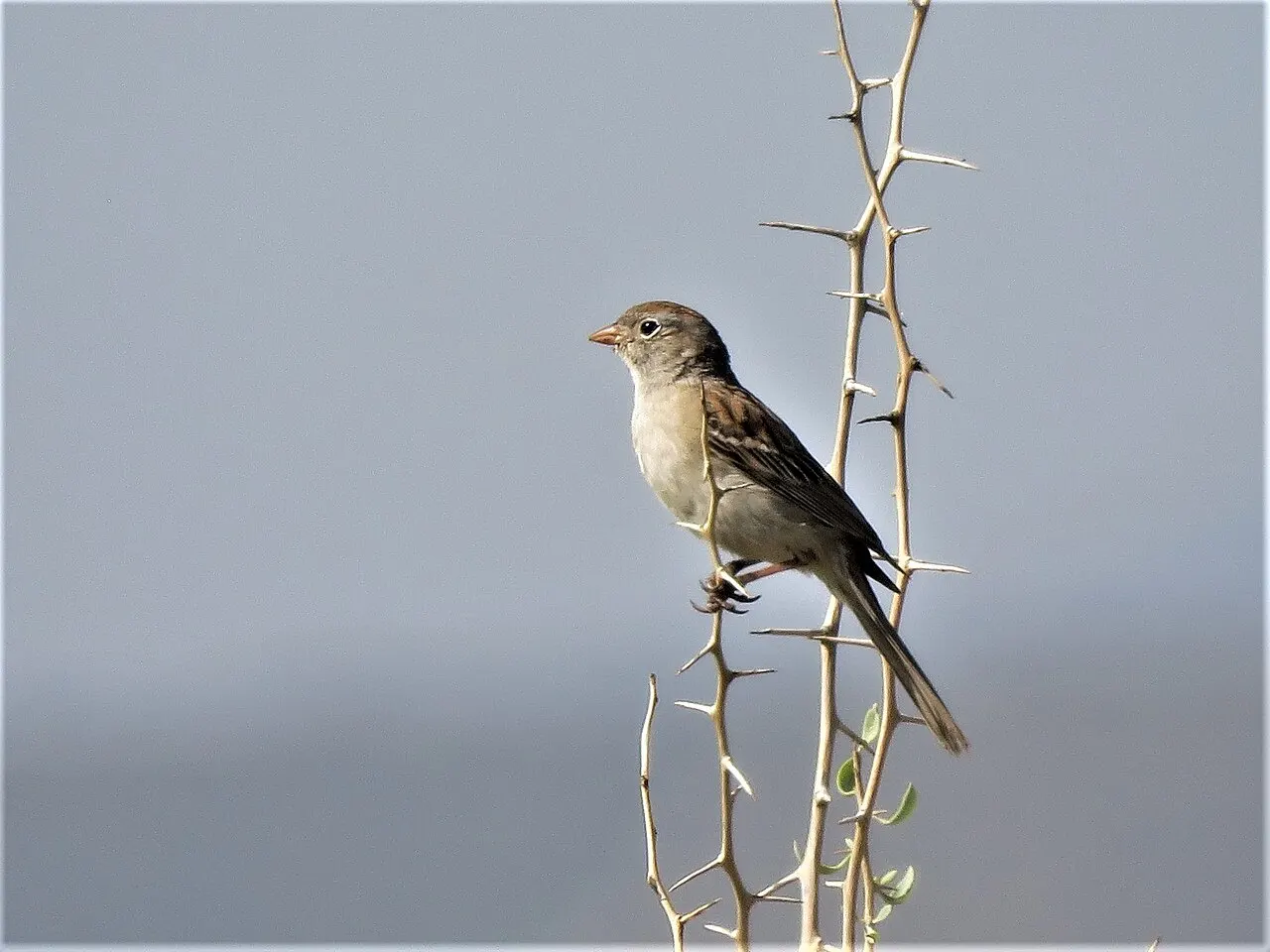
Endangered
Worthen's Sparrow
Spizella wortheni
Worthen's sparrow (Spizella wortheni) is a small, rufous-capped sparrow of the dry grasslands and desert scrub of northeastern and central Mexico. The IUCN Red List rated it Endangered in 2017. Its only known US record is a single bird shot in New Mexico in 1884, and how many survive is disputed.
How to recognise it
It's a slim sparrow about 12.5 to 14 cm long, with a grey head, a rufous crown, a brown stripe behind the eye and a pink bill. The back is grey-brown with dark streaks, the underparts are plain grey, and the wings carry pale edges and whitish to buff wing-bars.
It looks a lot like the field sparrow, but has a plain grey face without a rusty stripe behind the eye, and darker legs. Its song is a dry, chipping trill lasting two to three seconds.
Where it lives
The species belongs to the Chihuahuan Desert region of Mexico. Records come from Coahuila and Nuevo Leon south to Zacatecas and San Luis Potosi, at roughly 1,200 to 2,450 m. The IUCN codes the United States as a place where it is extinct: the type specimen was shot near Silver City, New Mexico, on 16 June 1884, and the bird has not been recorded north of the border since.
It breeds in open dry grassland and shrubby desert, including mesquite and yucca-juniper grassland, short-grass prairie and prairie dog towns. The IUCN rates high-altitude grassland and dry shrubland as its important habitats. It also uses weedy, fallow potato fields, but not fields that are being actively farmed.
Pins are Wikidata “endemic to” fields. Orange dots, when present, are GBIF occurrence tiles — survey bias included.
How it lives
Worthen's sparrow doesn't migrate, though after nesting it wanders in search of water and other resources. Pairs form around March and nesting runs from about May to July, timed to the seasonal rains. A 2017 study in Bird Conservation International found that breeding appears to track rainfall. The nest is a cup of woven dry grass low in a shrub or on the ground, holding two to five pale blue, brown-mottled eggs. Snakes and coyotes often prey on nests, and livestock sometimes disturb them.
In winter it eats mostly weed seeds. During nesting it takes insects, spiders and moths. After breeding, birds gather in flocks of 10 to 50, sometimes alongside other sparrows and horned larks.
Why it is in trouble
Its grassland and scrub have been ploughed for crops, potatoes in particular, and degraded by grazing and fragmentation. The IUCN lists small-holder farming, agro-industry grazing and ranching, and problem native species or diseases among the threats, and records a continuing decline. American Bird Conservancy also points to drought, shifting rainfall and pesticides, which can poison birds or remove their insect prey.
Population figures conflict. The IUCN gives 250 to 999 mature birds (2017), with all of them treated as one subpopulation. An older figure of 100 to 120 individuals dates from 2004. In summer 2013, Scott-Morales and colleagues counted 316 singing males on 76 transects, which they scaled to about 632 birds in the area searched, assuming equal numbers of males and females. They found ten new small breeding populations, with about 65 percent of counted birds in San Luis Potosi, and put the range at about 17,000 km2, against the 25 km2 often quoted. They suggested the Red List status be reconsidered and possibly lowered to Vulnerable.
What is being done
The IUCN reports a recovery plan, a monitoring scheme, and conservation sites identified across the species' range, at least one of them a protected area. Since 2007 American Bird Conservancy, Southern Wings, the Rio Grande Joint Venture and Pronatura Noreste have worked in the El Tokio Grassland Priority Conservation Area, where more than 140,000 acres have been protected through purchase or conservation agreements.
The IUCN lists site and area management and awareness work as conservation actions, and its research priorities are life history, population size and trends, and threats. The Rio Grande Joint Venture works with landowners on sustainable grazing.
Sources
Written for this catalog in our own words from the sources below, checked against them on 12 November 2026. Population figures are estimates and carry the year they were made. Status and assessment year: IUCN. 2026. The IUCN Red List of Threatened Species. Version 2026-1. iucnredlist.org.




